
15 April 2025
Conditions come good for establishing clover
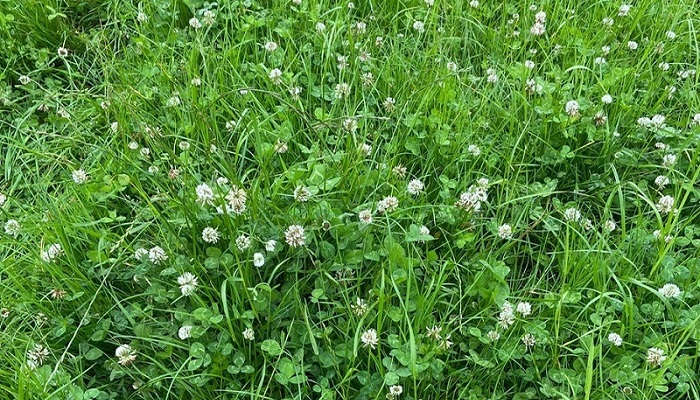
Warm soils and weekend rain have provided the ideal conditions for establishing clover – either through reseeding or over-sowing, Signpost Climate Advisor, Eoin Woulfe shares some key tips.
White clover is a valuable addition to grassland swards, stemming from its ability to take nitrogen from the atmosphere and make it available to the accompanying grass plants, thus allowing farmers to make savings on chemical nitrogen fertiliser.
A recent review of Teagasc’s clover research concluded that a perennial ryegrass/white clover sward receiving 100 kg per hectare less chemical nitrogen produced similar pasture production to that of a perennial ryegrass only sward. This was based on the perennial ryegrass/white clover sward having on average 20 to 25% white clover over the grazing season.
Additionally, when managed appropriately, perennial ryegrass/white clover swards have the potential to increase animal performance, reduce greenhouse gas emissions and increase farm profitability.
Lots of positives of course, but there is one caveat – actually establishing white clover within your grassland swards; something which can prove rather challenging if soil fertility, paddock selection or post establishment management is lacking.
The two primary methods of establishing white clover are either through a full reseed or by over-sowing. Each option has its positives, but when going down the clover road, it’s best to follow Teagasc’s blueprint on white clover establishment.
Paddock selection
When deciding which paddocks to establish clover in, the following should be considered:
- Optimal soil fertility is crucial. Soil pH levels should ideally be between 6.3 and 6.7 and soil phosphorus (P) and potassium (K) at Index 3.
- When opting for over-sowing, fields with open swards are preferable, as soil to seed contact is a must and the growing clover seedling requires sunlight.
- Fields with low weed content are ideal, as weeds can compete with clover for nutrients and sward space.
- For dense swards or those heavily infested with weeds, full reseeding would be a better option.
When?
Weather conditions are critical for clover germination. Moist soil conditions during and after sowing are essential. On heavy, wet soils, the ideal time for sowing is early to mid-May. On lighter, drier soils, earlier sowing in late April or early May is desired.
Over-sowing is recommended after a very tight grazing or silage harvest. Soil temperature should be conducive to germination, typically above 10°C. A tight grazing about 10-15 days after over-sowing is important to ensure the young clover plant gets adequate sunlight and a reduction in chemical nitrogen for the rest of the summer will also be a help in this regard.
More information on establishing clover
For more information on establishing grass/white clover swards, watch the below video where Dr. Michael Egan, a Researcher in Teagasc Moorepark, outlines four key things to consider:
The Teagasc Signpost Advisory Programme
Eoin Woulfe is a Climate Advisor on the Teagasc Signpost Advisory Programme. The Teagasc Signpost Advisory Programme provides enhanced advisory and training support to farmers to help them to select and implement climate and sustainability actions that are appropriate and impactful on their farms.
Clover incorporation is one of the main actions selected by participants in the Teagasc Signpost Advisory Programme. Increasing sward clover content allows farmers to reduce the quantity of fertiliser nitrogen that they apply. This benefits the environment and reduces greenhouse (GHG) emissions. Talk to your local Teagasc advisor for further information on the topic.
Find out more and sign up to the Signpost Advisory Programme here.