
27 March 2025
Controlling disease in winter barley
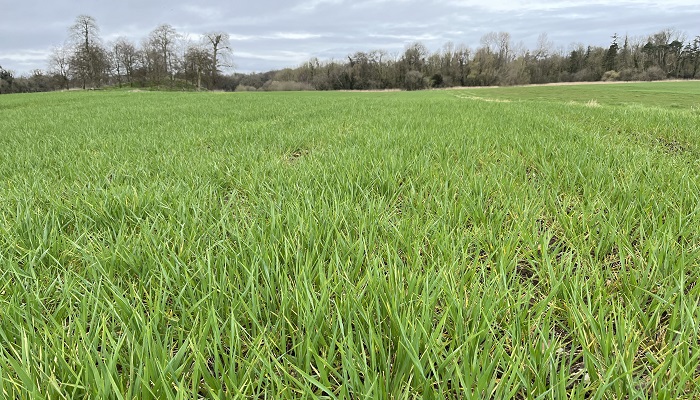
The area of winter barley planted for the 2025 season is significantly higher than in 2024, thanks to favourable sowing conditions last autumn. Ciaran Collins and Stephen Kildea tell us why effective disease management will be crucial in achieving target yields.
Crop establishment has been excellent, with few bare patches in fields. Winter barley crops are in a good position to perform well. Effective disease management will be crucial in achieving target yields.
High yield in barley
Achieving a high yield of barley depends on producing a crop with a large number of grains per m2. Research shows that high-yielding barley crops produce 18,000-20,000 grains/m² and that ear number has the greatest influence on grain number; grain weight is not a large factor. A ‘thin’ crop or a crop with a low ear number is unlikely to achieve a high yield because of the inability of a barley crop to compensate via higher individual grain weight. Wheat, on the other hand, can compensate for thinner crops with more and heavier grains.
Role of fungicides
Fungicides play an important role in achieving high ear numbers. This is especially relevant in the early part of the season where disease can reduce the number of tillers produced. The typical yield response from disease control in winter barley is much less than that in winter wheat but it is still significant at 1.0-1.5t/ha. Teagasc trials show that a three spray programme (mid/late tillering < gs 30, early stem extension gs 31-32 & awn emergence gs 49) gives the best response from fungicides with the early stem extension and awn emergence timings being most important. The earlier timing of mid- to late-tillering may be required in crops with a high level of disease or in varieties with poor disease resistance. However, many growers get excellent disease control from a two-spray programme at stem extension and awn emergence.
Table 1: Winter barley disease control strategy
| Late tillering (GS 25-30) | Stem extension (GS 31-32) | Awns emerging (GS 45-49) | |
|---|---|---|---|
| Diseases |
Rhynchosporium Net blotch Mildew |
Rhynchosporium Net blotch Mildew |
Ramulaira Rhynchosporium Net blotch Mildew
|
| Low disease pressure | Azole / SDHI or QoI | Azole / SDHI or QoI & Multisite (folpet) |
|
| High disease pressure | Azole / SDHI or QoI |
Azole / SDHI or QoI & Multisite (folpet) |
Azole / SDHI or QoI & Multisite (folpet) |
Accessing the risk
Early sowing and successive barley crops will increase disease risk, so walking crops from mid-tillering on is essential to access the level of disease present in the crop. Net blotch and rhynchosporium will be most damaging at this time and will reduce tiller numbers if left uncontrolled. It is also very important to refer to the Department of Agriculture, Food and the Marine’s recommended list resistance to disease ratings to access the level of risk.
Table 2: Winter barley recommended list 2025 – resistance to disease
| Belfry | KWS Cassia | KWS Joyau | KWS Tardis | Molly | SY ARMadillo | Integral | Orcade | SY Canyon | |
|---|---|---|---|---|---|---|---|---|---|
| Mildew | 6 | 5 | 5 | 6 | 8 | 6 | (5) | (7) | (8) |
| Rhyncosporium | 8 | 4 | 6 | 7 | 7 | 8 | (6) | (7) | (7) |
| Brown rust | 6 | 7 | 7 | 6 | 7 | 5 | (7) | (8) | (7) |
| Net blotch | 7 | 7 | 7 | 7 | (7) | 7 | (7) | (7) | (6) |
Control
For mildew control, Prothioconazole-based products (e.g., Proline) are effective. While mildew specific fungicides may not be necessary in all cases, if mildew pressure increases, adding a specific mildewicide should be considered in susceptible varieties – e.g. Cassia, Joyau and Integral.
Our current winter barley varieties have relatively good resistance to net blotch (all rated 7 except for Canyon (6)) and rhynchosporium (Cassia (4) is an exception). Resistance is present in Irish Net Blotch populations, particularly to SDHI and Qol so the best control will come from Qol based (eg. Comet) in combination with and Azole (e.g. Proline).
Ramularia poses the greatest threat late in the season. In high pressure situations, full control is unlikely, so the goal is to delay its impact long enough to minimise yield loss. Recent Teagasc research indicates that Revystar XL, Macfare Xpro, and a Prothioconazole/Folpet combination can provide effective control.
Table 3: Chemical group and example product
| Chemical group | Example product |
|---|---|
| Azole | Proline |
| SDHI | Imtrex |
| QoI | Comet |
Knowing what and when to spray…
Each year, Teagasc conducts research in both winter and spring barley to provide growers with advice as to what fungicides to apply and when to apply them. To ensure the information from these trials is representative of what is actually happening in farmers’ fields these are typically conducted on a number of sites, with varying levels of disease pressures.
As Ramularia is a late-season disease, often only appearing in mid-June in winter crops or mid-July in spring crops, designing trials to focus solely on it can be difficult. To overcome this, we try to select varieties on which to conduct the trials that have good resistance to the other diseases. Without this, diseases such as Rhynchosporium or net blotch will have killed the crop before we can investigate Ramularia.
Test products
However, as such varieties are not always available, the trials are designed in such a way to minimise the impacts of the other diseases. Often this simply involves over-spraying the trial area with fungicides that we know will control those other diseases, whilst allowing Ramularia to develop. We can then apply our test products at the ideal growth stage for Ramularia control, awns emerging, knowing that the only major disease present is Ramularia. Whilst awns emerging is the most effective fungicide timing to control Ramularia, Teagasc is conducting a series of trials with fungicides applied at all the different typical timings, alone and in combination.
In doing so, this will provide the much needed data to help us understand how the wider fungicide programme impacts Ramularia development and therefore guide future fungicide programmes.
The above article first appeared in the March/April edition of Today’s Farm. For more information, view the Today’s Farm publication here.