
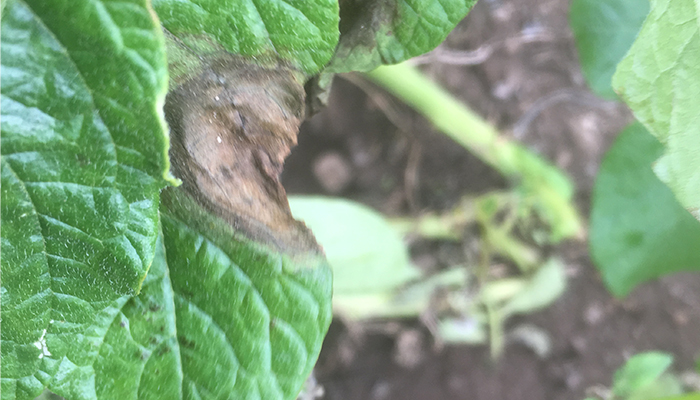
A resistant strain of potato late blight detected in 2023 prompted a national response to protect the potato industry. Steven Kildea, Amanpreet Kaur, Deirdre Doyle, Ewen Mullins and Shay Phelan tell us more.
In late autumn 2023, a single sample of Phytophthora infestans with resistance to the carboxylic acid amide group of fungicides was detected in Ireland. Currently the control of potato late blight caused by P. infestans is almost exclusively reliant on the application of fungicides. This highlights the immediate and significant threat the detection of this strain posed to the Irish potato industry.
To prevent such devastating impacts, it is essential to be able to rapidly detect this strain, devise control strategies to prevent its spread, and effectively communicate this to the industry.
A coordinated approach was taken between crops researchers and specialists to develop detection tools, and devise and disseminate field control strategies. To detect resistance, the team developed a digital droplet PCR capable of detecting P. infestans and associated fungicide resistance in a variety of matrices including potato leaves, FTA® preservation cards and spore samples. This allowed for the rapid and extremely sensitive detection of resistance.
In parallel, control strategies were devised which ensured both the mixing and alternation of fungicides at each application, guaranteeing field control whilst limiting potential selection for the resistant strain. These strategies were communicated to the industry throughout the season via dedicated workshops, crop walks, press articles and a trials tour. Whilst the strain was again detected in 2024, its impact on late blight control has been contained.
Read more from Teagasc Research Impact Highlights 2024
Contact: stephen.kildea@teagasc.ie
Funding: Teagasc core funding
Impact Pathway: Technology Development & Adoption