
17 May 2024
Controlling Net blotch in RGT Planet Spring Barley
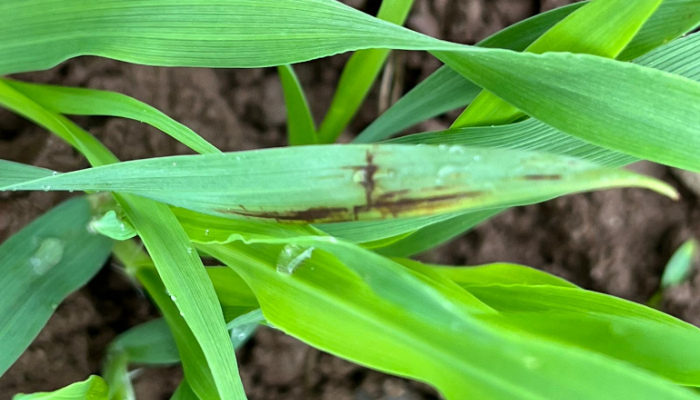
Net blotch in RGT Planet is hardly a new phenomenon but growers are concerned by how early in the crops development it has appeared this year. Ciaran Collins tells us more.
There are reports of net blotch in some crops at the 2-3 leaf stage but these reports are mostly from fields where RGT Planet was grown last year.
RGT Planet has the lowest rating for net blotch (4) on the DAFM spring barley recommended list for 2024. The situation is exacerbated where the preceding crop was RGT Planet and a green bridge between existed between crops. Recent rain and current mild temperatures have created the perfect environment for the disease.
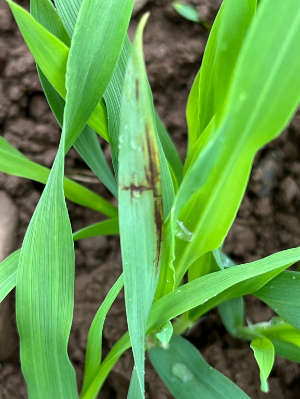
Net blotch on RGT Planet. Waterford May 14 2024.
Barley yield is driven by tiller number, so it is vital to protect the crop during the primary development phase. Losing tillers to disease will significantly reduce yield potential. With late sowing this year, the whole growing season is condensed into a much shorter period so the focus should be on maximising tiller production.
Even with late sowing a two-spray programme is advised for spring barley, with the first at the end of tillering/start of stem extension and a second fungicide as awns emerge. However where there is a high level of disease, net blotch in this case, the first fungicide should be brought forward to early/mid-tillering. Some of the first sown crops, April 18/19, are already at this stage.
A level of resistance to all the main fungicides has been found in net blotch, so chemistry and rates must be chosen carefully to control the threat from net blotch.
Prothioconazole (Proline etc.) is the most effective azole against net blotch, but good rates are needed to achieve good control. Although resistance to strobilurin fungicides caused by the F129L mutation is an issue, they will give better control than SDHI’s. Within the strobilurin group Pyraclostrobin (Comet, LS Pyrac) is the most effective as it least affected by the F129L mutation. Macfare (Prothioconazole + Bixafen + Flupyram) 0.8-1.0L/ha will also give excellent control.
In scenarios where net blotch is present in a crop, apply the first fungicide at early/mid tillering.
Options
Prothioconazole + Pyraclostrobin @ (50-60% rate)
Eg. Prothioconazole 0.4 – 0.5L/ha Proline/ Aurellia / Pride / Prostar / Protendo 250 EC/ Pecari 250 / Province / Trinity 250
+
Pyraclostrobin 0.5 – 0.6L/ha Comet 200, Modem 200/ LS Pyrac /Tomec
Or
Macfare 0.8 – 1.0L/ha