
27 October 2024
Crossfostering and Nurse Sow Management
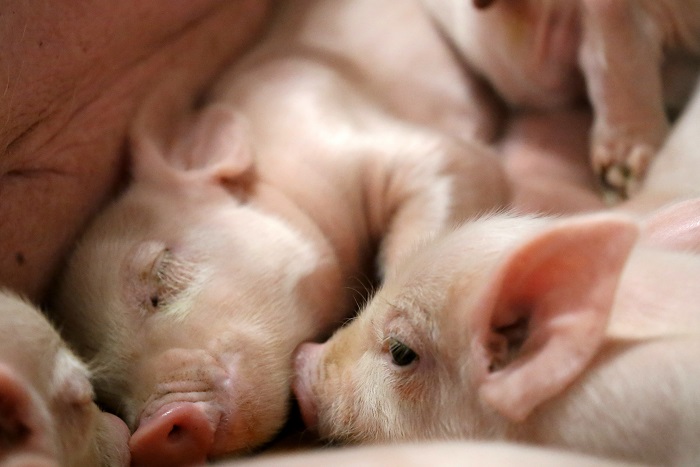
Hans Bundgaard, a Consultant Pig Veterinarian and co-founder of Porcus ApS in Denmark, addressed the critical topic of cross-fostering and nurse sow management at the recent Teagasc Pig Farmers Conference.
Crossfostering and nurse-sow management are implemented on farms to reduce pre-weaning mortality. This article outlines best practices.
Procedure for Crossfostering
- Count the new-born piglets by the sows
- Move the smallest piglets (below 700 g) to a nurse sow
- Only crossfoster when piglets have had sufficient colostrum intake
- Count the sows’ functioning teats – do this before farrowing to know how many piglets the sow can nurse *
- Move the largest excess piglets to nurse sows
- Move as few piglets between litters as possible
*If you use a milk cup system, crossfoster two piglets more than the number of functioning teats
Up to 48 hours post farrowing you can add piglets to available teats without risking the teat drying up.
Managing Nurse Sows
Nurse sows are chosen to handle excess piglets and ensure that larger litters can be successfully reared.
If the nurse sow lies sternally 3-5 hours after receiving a new litter of piglets, and milk let-down is not observed:
- Administer pain relief according to vet’s instructions before placing the piglets by the sow.
- Supply straw, hay or similar material.
If, after 8 hours, the sow has not accepted the piglets, move the piglets to another nurse. Give the nurse sow piglets of the same size and age as the ones moved to the intermediate nurse sow.
If you experience problems with nurse sows failing to accept piglets, try leaving the newborn piglets and the sow’s own piglets in the farrowing pen for 1 hour before separating the litters.
Do not:
- Leave the nurse sow without piglets for 1-2 hours, this will not make the nurse sow accept the new piglets any faster.
- Leave two of the nurse sow’s own piglets with the new piglets for 12 hours, as that will cause unrest in the litter because there are too many piglets by the udder for too long.
Nurse Sow and Intermediate Nurse Sow Procedure
In sectioned systems i.e. All-in , All-out (AIAO), move the nurse sow and the intermediate nurse sow to a pen in the room where the piglets are born, as nurse sows transmit fewer pathogen bacteria than piglets, you should move the nurse sows in, rather than moving the piglets out. Once the piglets are ready for weaning, they should be weaned at the same time as the rest of the piglets in the section. Therefore, you should allow for a number of empty pens in the farrowing room if you intend to use nurse sows.
To use two-step nurse sows, it is useful to identify potential nurse sows and intermediate nurse sows the day before you expect to use them.
The nurse sow
- Receives excess new-born piglets
- Is a young sow in medium body condition that nursed its own piglets well
- Finished farrowing 4-8 days ago
- Does not receive more piglets than it has given up
- Is moved to the piglets’ section if sectioned (AIAO) management is practiced
- The 4-8 day old piglets are moved to an intermediate nurse sow that has nursed for a minimum of 21 days
The intermediate nurse sow
- The intermediate nurse sow weans piglets that are 21 days old and receives 4-8-day old piglets from the nurse sow.
- Is in medium body condition with teats accessible to the piglets
- Nursed its own piglets well
- Does not receive more piglets than it has given up
- Is moved to the piglets’ section if sectioned (AIAO) management is practiced
Conclusion
Effective management of nurse sows and crossfostering ensures higher piglet survival rates and better growth outcomes. It’s important to ensure minimal piglet movement and appropriate fostering timing to reduce disease pressure on the farm.
Read the full Teagasc Pig Farmers’ Conference 2024 Proceedings