
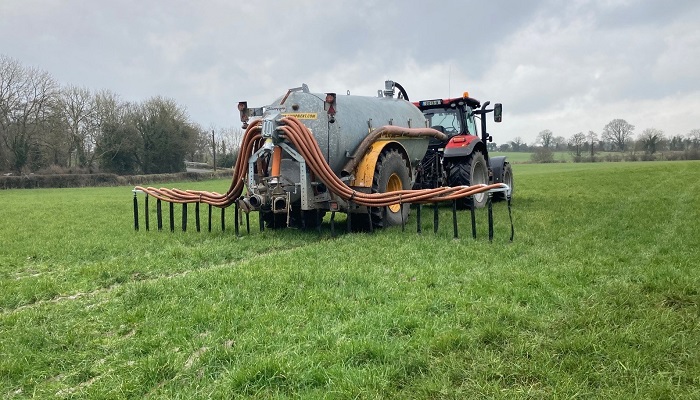
Farmers and contractors are reminded that the final day to apply slurry is today, September 30th, after which the prohibited period for applications will come into effect.
Where final day slurry applications are occurring, farmers must pay head to ground conditions and the weather forecast. Failing to do so may have a detrimental impact on water quality. Remember, weather and ground conditions can have a significant impact on nutrient being lost to water.
Spreading slurry on fields that are waterlogged, flooded or likely to flood is prohibited by the regulations. Adding slurry to fields under these conditions greatly increases the likelihood that the nutrients from slurry will be lost to water either by over land flow in the case of saturated soils or by leaching to ground water. When ground conditions are suitable, it is important to check the weather forecast as slurry should not be spread when heavy rainfall is forecast as this can also lead to soil saturation and nutrient losses.
Table 1: Buffer margin for spreading organic fertilisers from waters
| Water body / feature | Slurry / FYM/ Soiled Water |
| Water supply >100m3 or >500 people | 200m |
| Water supply >10m3 or >50 people | 100m |
| Water supply <10m3 or <50 people | 25m |
| Lake shoreline | 20m |
| Exposed cavernous or karstified limestone features | 15m |
| Any surface watercourse where the slope towards watercourse is >10% | 10m |
| All other surface waters* | 5m* |
*Distance is 10m for two weeks before and two weeks after the closed period for spreading organic manures
It is important to match the rates of application of organic fertilisers to the growth rates of the grass/crop. Applying slurry at rates greater than crop demand means that nutrient is available to be washed away into the drainage network or leached to groundwater.
- Farmers should assess their storage facilities to ensure that they meet the minimum storage requirements for their county
- The last day for slurry spreading is September 30th
- For two weeks leading up to the closed period for spreading, slurry must be kept at least 10 meters away from rivers, streams, watercourses and drains
- Slurry cannot be spread on fields that are:
- frozen or snow covered
- waterlogged
- flooded or likely to flood
- heavy rain is forecast within 48 hours
For more tips and advice on protecting water quality, visit the Teagasc ASSAP webpage here.