
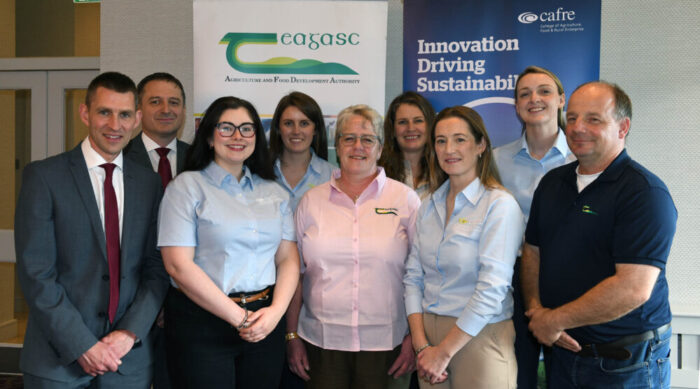
Representing a significant proportion of land across the island, almost 200 delegates joined CAFRE and Teagasc for the Uplands Symposium 2025 to deepen their understanding of upland farming systems and to explore future policy opportunities.
Held over two days, September 2-3, in Co. Antrim, Head of the Knowledge Advisory Service at the College of Agriculture, Food and Rural Enterprise (CAFRE), Albert Johnston opened the gathering of farmers, researchers and industry experts, commenting:
“Hills and uplands represent a significant proportion of land across the island. We are keen to transfer knowledge on how uplands can contribute to the delivery of ecosystem services for wider society.”
The important role of upland agricultural systems in the delivery of multiple outcomes including carbon sequestration and biodiversity in addition to the production of food was highlighted by DAERA Deputy Secretary, Martin McKendry, who pointed to the value of the connected thinking between CAFRE and Teagasc and the important role the former’s Glenwherry Hill Farm Centre plays in demonstrating innovation.
The Uplands Symposium, now in its third year, Director of Teagasc, Professor Frank O’Mara noted, was a platform to showcase the diverse initiatives underway.
“This event aims to deepen understanding of upland farming systems and explore future policy opportunities to advance education, advisory services and research,” Professor O’Mara noted.
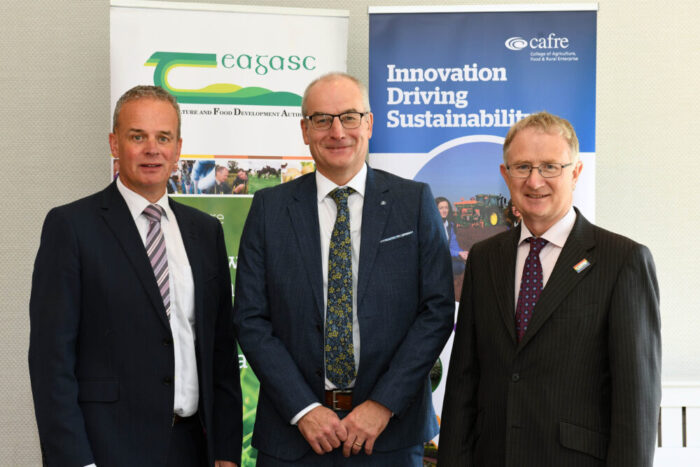
Pictured at the Uplands Symposium are: Paul McHenry, CAFRE Director; Martin McKendry, DAERA Deputy Secretary; and Professor Frank O’Mara, Teagasc Director.
The CAFRE Hill Farm Centre
Day two of the Uplands Symposium revolved around the CAFRE Hill Farm Centre, which plays a central role as a demonstration platform for the delivery of education and knowledge transfer programmes.
“In Northern Ireland, almost a quarter of the land type is classified as peat, and over 10,000 farms comprise mainly of severely disadvantaged land. The Hill Farm enables CAFRE to showcases innovative systems and technologies to help deliver profitable, sustainable enterprises,” explained Mark Scott, Head of Sustainable Land Management at CAFRE.
He explained that CAFRE’s Farm Centres are working towards objectives within the College Estate Strategy to deliver on outcomes for carbon reduction, water quality, soil health and habitats to name a few.
“Ultimately, we want to keep carbon in the hill and add to the storage of it whilst creating a habitat for a diverse range of plant, insect and animal species. Efficient, productive livestock are key to helping deliver this,” Mark Scott concluded.
Ulster University’s Dr Sanjeev Dasari provided a detailed look at the research being carried out on the CAFRE Hill Farm, examining peatland carbon emissions. Dr Dasari explained how results from the last two years show that part of the Creeve Moor in Glenwherry is sequestering carbon rather than emitting, clearly highlighting the need for further research in this area across the island of Ireland. While this research is very positive news, it is important to remember that many studies and more data will be required to influence widely accepted emission factors.
Additionally, Dr Declan O’Mahony, AFBI and member of the Glenwherry Hill Regeneration Partnership Project Board, presented habitat mapping and condition data based on the CAFRE Hill Farm.
“The 960 hectares of the Glenwherry Farm site comprise of five main habitat types with a further ten subtypes. The peatlands offer a diverse habitat to over 70 plant species,” he explained.
More on the Uplands
Dr Catherine Keena, Countryside Management Specialist with Teagasc, delivered a comprehensive overview of a range of Irish Upland programmes led by Teagasc. A notable highlight was the Sheep 2025 event, which deepened the understanding of hill sheep grazing patterns. The introduction of the BETTER Farm Sheep Programme aims to move the industry forward through business, environment and technology applications through training, education and research.
Professor Davy McCracken from Scotland’s Rural University College (SRUC) shared experiences from our neighbouring uplands in Scotland. Professor McCracken discussed how changing weather conditions are impacting land and reducing bird populations across the region. SRUC are keen to test and use the remote collection of data whether that be in the form of GPS monitoring of sheep grazing behaviour on various habits or gathering metrics from peatland characteristics. This data all helps to inform decision making to better manage habitats for multiple positive outcomes including carbon sequestration and flood alleviation. Biodiversity management, peatland restoration, woodlands and scrub all play their part alongside upland livestock.
Following the five informative presentations Dr Saorla Kavanagh, Biodiversity Research Officer with Teagasc chaired a thought-provoking panel discussion. Thanking everyone for their contribution and attendance at the Uplands Symposium 2025, Dr Stan Lalor, Director of Knowledge Transfer, Teagasc drew the event to a close.
For more on the CAFRE/Teagasc Uplands Symposium, visit here.