
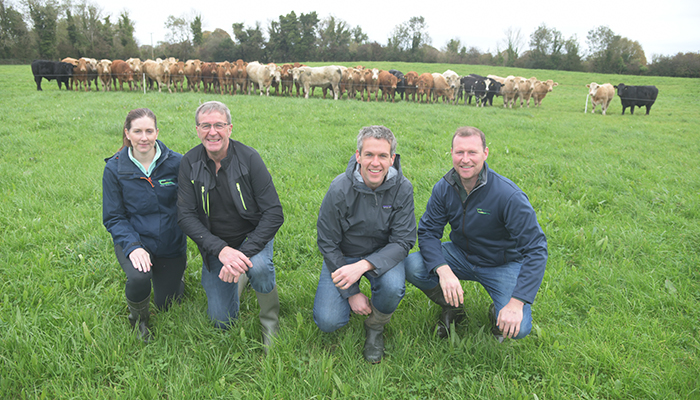
Good facilities, good animal health and good pasture management are a powerful combination on the Murphy family's beef farm in Trim, Co. Meath. David Argue, Teagasc Beef Specialist provides more information.
Trim is a special place. It’s home to many ancient buildings and some very impressive accommodation in the form of Ireland’s largest Norman castle. Built for practicality and effectiveness, the castle was constructed to last centuries and keep its inhabitants performing at their best. You could say the same about state-of-the-art livestock facilities being completed by the Murphy family, who have been farming near Trim since the mid-1950s.
Though the farm has been home to sheep, dairy and tillage enterprises, father and son partners Pat and Michael Murphy today focus on a cattle growing and finishing enterprise. “In 2020, Conor, who has an off-farm job, confirmed his interest in the business by building a new home on the farm and enrolling on a Green Cert Course with Teagasc,” says Pat who works full-time on the farm. “Soon after we established a registered farm partnership and set about re-developing the infrastructure on the farm.”
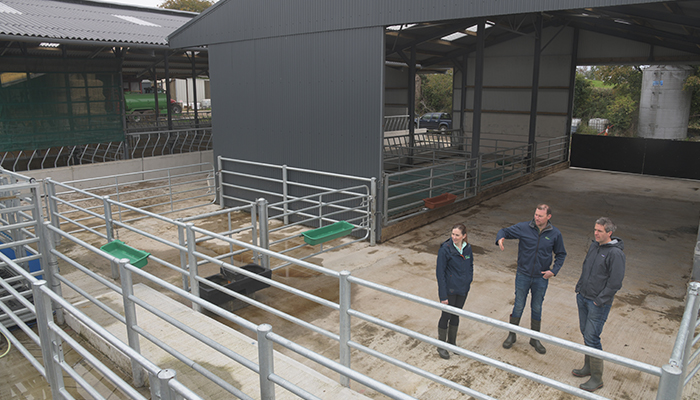
Pat and Conor thought deeply about their cattle’s needs and the facilities were carefully designed to meet them. “We want to create an environment where beef cattle can really thrive,” says Conor. With the support of the TAMS Young Farmer Capital Investment Scheme, the Murphy’s built a slatted shed complex designed for optimum animal performance and ease of management.
Built for comfort
The shed is open on both sides with a high roof, maximising the fresh air that comes through the space. Feed troughs act as a barrier low down on the outside, to prevent draughts at the level where animals are lying.
The slats are covered with comfort mats and the pen sizes are designed for eight to 10 finishing cattle to fit comfortably. Feed is provided to the troughs on the outside of the shed. Each pen opens into a central passageway, allowing easy and efficient handling of cattle, pen by pen.
“We included another new, smaller shed, which was built over an existing slatted tank and includes a straw-bedded area,” says Pat. This is used as an entry point for cattle arriving on the farm. A new handling facility was added near the two cattle sheds, to allow safe and efficient cattle handling. It is clear that Pat and Conor put a lot of time and effort into the design of the handling facility and it is working very well, allowing safe, stress-free management of cattle.
An aeration system works on slurry beneath both sheds. “When the system is on slurry is constantly mixed and there is no need for agitation,” says Pat. A permanent pipe with a connection point is in place in the tank, allowing easy connection to a slurry tanker. Apart from the safety benefit of removing the need for agitation, the system allows for very efficient use of slurry. At any point during the open season a small amount of slurry can be taken out to spread on a specific paddock without the need to agitate the whole tank. “This spring we were able to spread slurry on silage ground while cattle were still in the shed for finishing,” says Conor.
Animal health
The Murphy’s system involves purchasing approximately 60 spring-born bull weanlings at six to eight months old, and bringing them through to beef as steers at 22-24 months. For many years the cattle have been suckler-bred continental weanlings bought in from the west of Ireland. “As the price of these animals has increased significantly this year, we decided to purchase different stock to see how other types of animals would work in the system,” says Pat.
A group of Dairy X Simmental runners was purchased in July, and a group of Angus suckler-bred weanlings arrived at the start of October. A final group of continental weanlings were purchased in the middle of October and these were quarantined in advance of their vaccination programme before joining the rest of the animals.
“One of the main challenges we have experienced on the farm in recent years has been outbreaks of pneumonia among weanlings who have just arrived on the farm,” says Pat. “We have focused on a protocol for managing new arrivals and we work closely with our farm vet.” New arrivals receive hay and water outside and also have access to a well ventilated, straw-bedded shed. The cattle are fed meal twice a day. Their willingness to eat meal is a key health status indicator. After a short adjustment period the newcomers get a mineral injection, a worm dose (levamisole injection) and start their vaccinations for pneumonia and clostridial diseases. These treatments will start two to seven days after arrival, depending on how quickly they settle in and if there is any illness in the group.
Once the stock are settled in on the farm they are turned out to grass, with the aim of completing their full course of vaccinations before they are housed for the winter. “One of our key goals is to start purchasing weanlings directly from farmers to try and cut down on animal health risks,” says Conor. “It will be very helpful to speak to the farmers we are buying from to understand the animals’ vaccination and dosing history.”
Pasture management
The farm system is heavily grass based and Pat and Conor are members of the Meath Grass10 Drystock Group. They say that participating in regular meetings with other farmers and Teagasc advisors has been very beneficial in improving grassland management on the farm. “Grazing typically starts in the first week of February with yearlings out to grass by day and back into the shed at night,” says Conor. “Once they are settled at grass they are put out fulltime and they will be grazing until the middle or end of October. We found 2025 was a good year for grazing. Apart from a pinch point at the beginning of the second rotation in April, grass has been in good supply. Cattle are strip-grazed and are allocated new grass every day.”
More water troughs have been added to allow for back fencing every two to three days, which stops the cattle grazing re-growth. “The electric fences on the farm are controlled by a phone operated switch, so they can be turned on and off by text message, allowing quick and easy repairs to fences when required,” adds Conor.
“The bullocks have performed well at grass this year and by the time they are housed we expect the total liveweight gain from the grazing season will be 245kg,” says Pat. “They will average approximately 550kg when housed at the end of October. Subsequently, they will be fed silage and a high energy finishing concentrate for 100-150 days with a target liveweight of 720kg to give a 400kg carcase at 22-24 months old.”
A key focus for a grass-based system is making good-quality silage. First cut silage on the Murphy farm in 2025 was 73% DMD. “We had an opportunity to make hay at the end of June which we did,” says Pat. “Hay is fed to new arrivals on the farm as part of the arrival protocol.”
Maintaining a healthy herd is seen as a key requirement for achieving performance targets on the farm. A recent dung sample from the calves purchased in July came back with a low worm burden and clear of fluke. They were last dosed with a levamisole injection around the 1st of August. This group will be treated again at housing to prevent the development of Type II Ostertagia, and to clear up any lingering lungworm infections. All animals received an IBR vaccine at the end of September in order to have immunity in place by the time of housing. “Animals are weighed on the same day as they get their vaccine,” says Pat. At housing, all animals have their tails and backs clipped and treated for lice and mites as required.
Pasture
Looking to the future, Pat and Conor will continue a programme of over-sowing multi-species into existing grass fields. The establishment approach has been to take a cut of silage or hay, run a tine harrow through the field once, and then broadcast the seeds using an air seeder on top of the tine harrow on the second pass. The field will then be grazed roughly every two weeks to knock back the existing grass until the new seeds are well established.
Slurry is spread on the field after sowing if available, but little or no chemical N will be spread on that field as it may inhibit the establishment of the clover and herbs. The seed mix broadcast meets the requirement for the Department of Agriculture multi-species sward measure, and contains a mix of grasses, red and white clover, chicory and plantain.
“Healthy and productive soil is key to a productive farm,” says Conor who has joined the BASE group of farmers to learn more about improving soil health. Actions have already been taken on the farm to improve soil health by diversifying the swards through the establishment of clover and herbs.
Soil samples are due to be taken as it’s almost two years since testing was last done. The most recent round of soil sampling revealed that almost half of the farm was Index 1 or 2 for K. Slurry and sulphate of potash was targeted in these fields based on soil sample results.
Lime has been applied on certain fields to increase the pH. Care has been taken as there are high levels of molybdenum on the farm and increasing pH can increase the levels of molybdenum in the forage, which can lead to a copper deficiency in cattle. “We noticed signs of copper deficiency in 2024,” says Pat. “We used mineral boluses containing ionic copper this year and we haven’t seen any further signs of copper deficiency.”
Stock numbers will be increased gradually over time. Stock numbers could be increased by about 15% without the farm going into derogation. “On the infrastructure side, the final major project is to build a new silage pit,” says Pat. TAMS grant approval is in place and that project will hopefully commence shortly. “This will be the final major building project for the time being and should leave us well set up for the future,” says Conor. As the Normans showed 800 years, quality construction lasts.
This article first appeared in the November/ December 2025 edition of Today’s Farm. View the full publication here
Featured image: Aine Gaffney, Teagasc; Pat and Conor Murphy, beef farmers; and David Argue, Teagasc Beef Specialist in front of a herd of beef cattle.