
Driving farm profitability through effective nutrient management
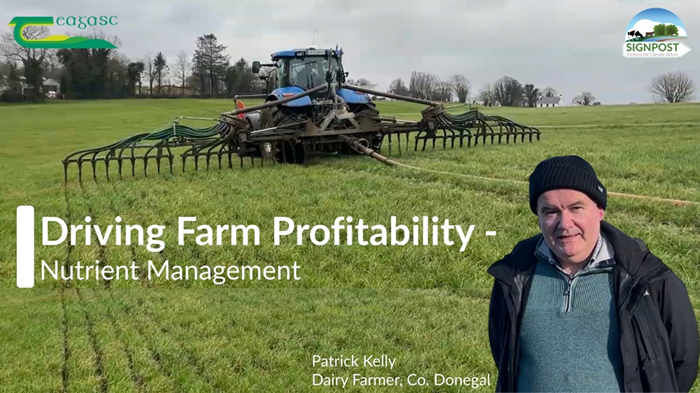
Slurry is a very important asset on Patrick Kelly's farm in Co. Donegal. Making best use of the nutrients within is important for reducing chemical nitrogen use, reducing costs and, additionally, it has environmental benefits
Waterwheel Farm is situated alongside the River Finn in Co. Donegal, an area known as the Finn Valley, and is farmed by Patrick Kelly and his two full time employees – brother-in-law Mark Sammon, and Thomas Doherty.
Currently milking 300 cows with an average Economic Breeding Index (EBI) of €163, calving started on February 14 and is due to finish by the end of April. Calving interval in 2025 was 362 days, with 85% of the herd calved in six weeks. Cows produced 534kg of milk of solids at 3.81% protein and 4.56% butterfat last year.
The farm is currently in derogation with organic nitrogen (N) per hectare (ha) of 228kg and a stocking rate of 2.47 LU /ha.
Soil sampling is carried out every second year, placing a keen focus on lime, phosphorus and potassium as to make best use of chemical nitrogen applied on the farm as protected urea.
Last year, the farm grew 13 t DM/ha of grass, with two cuts of high-quality silage made; first cut harvested on May 14 reached 80 DMD, while second cut on July 8 was 70 DMD.
Slurry is a very important asset on Patrick’s farm. Making best use of the nutrients within is important for reducing chemical N use, reducing costs and, additionally, it has environmental benefits in terms of reducing greenhouse gas emissions, reducing ammonia emissions and reducing the risk to water quality.
Patrick has prioritised investments in slurry and soil water storage over the last five years, providing greater flexibility to apply slurry when he is going to get the best value from the nutrients but also to reduce the risk of runoff into local waterways.
In the below video, Gary Fisher, Teagasc, Climate Action Sustainability Advisor, talks to Patrick Kelly a dairy farmer in Co. Donegal on how he maximises the nutrient content of slurry to grow grass and reduce chemical nitrogen inputs:
Patrick doesn’t have to go out and apply slurry as soon as the spreading season opens. He can wait until he gets good weather and ground conditions and when he will get the best value from it. All slurry is applied using dribble bar, priortising applications in spring when he’ll get most use of the nutrients.
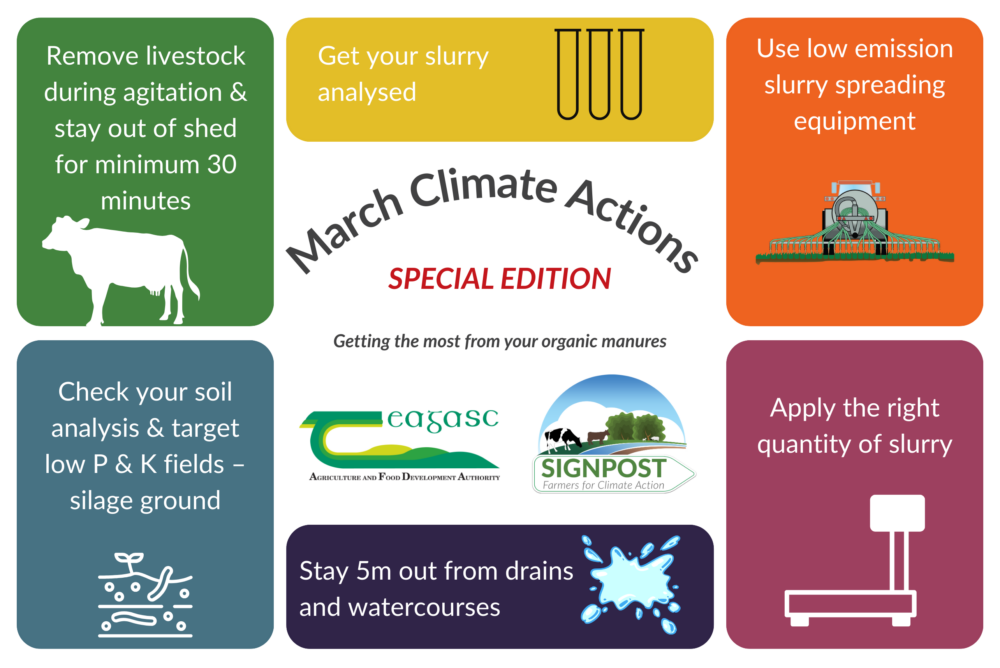
This farm is in derogation so compliance with the regulations is important. Patrick will allow a buffer zone of 10 metres from drains and water ways on the farm when applying slurry for the first two weeks of the spreading season, reducing this to 5m thereafter. It’s important to Patrick that slurry goes out in conditions that are appropriate, otherwise he will have runoff.
Slurry is too valuable a source of nutrients for him to have it lost and obviously if the slurry runs off in bad weather, it’ll have a negative impact on the environment.
Patrick soil samples a part of the farm every year to build up a good profile of the farm. Potassium and phosphorus are an important part of the slurry and Patrick will target the slurry at the fields that need it, like the silage fields.
While Patrick hasn’t tested slurry in recent years, Teagasc Signpost Climate Advisor, Gary Fisher has done some slurry analysis. From this, slurry dry matters have varied from 1.7% to 11.4% dry matter (DM), which shows the variation that exists in slurry dry matter and consequently nutrient content. It is worth getting slurry analysed every 3-4 years to check its nutrient content. If there are different tanks for different classes of animals with varying concentrate feeding rates, get them analysed separately.
For more on the Teagasc Signpost Advisory Programme, visit here.