
EELAP Project Gathers Momentum in Europe, with Progress in Ireland
European agriculture is facing major challenges involving the protection of natural resources (air, soil, water), preserving biodiversity, mitigating and adapting to climate change, while providing healthy and nutritious food for a growing population. Dr Zohreh Rafiee and Dr. Ian Short fill us in on the role of the Enriching European Landscapes with Agroecological Practices (EELAP) project.
The Enriching European Landscapes with Agroecological Practices (EELAP) project, a multi-country partnership promoting agroecology and agroforestry, is now well underway, bringing research, policy engagement and on-farm experimentation together to help create more resilient, sustainable landscapes across Europe.
Funded through the Agroecology Partnership’s first co-funded call, EELAP involves Living Labs in Germany, Hungary, Slovenia, Slovakia and Ireland, with additional modelling and policy input from partners in France and Switzerland. The initiative aims to strengthen knowledge exchange, analyse existing policy frameworks, explore innovative business models, and map out ways to integrate agroecological practices into farm and landscape planning.
Across Europe, EELAP partners have already held field visits, workshops and stakeholder events. Living Lab activities have included on-farm tours in Germany, high-energy multi-day agroforestry festivals in Slovakia, and the recent launch of Slovenia’s Living Lab at an historic silvopasture site. Participants at these events have focused on identifying regional needs, exploring legislative supports and sharing practical experiences of agroforestry in action.
Progress in Ireland
Ireland is responsible for holding two Living Labs consisting of four rounds, with different groups of voluntary stakeholders, including: Farmers and Foresters, Advisory Services and Agronomists, Municipalities and Local Governments, Regional and National CAP Authorities, NGOs and Civil Society Organisations, Market Partners and Value Chain Actors, Researchers and Educational Institutions.
Each round will focus on a specific thematic area:
- Round 1: Awareness and Knowledge of Agroecology: Awareness-raising and exchange of knowledge on agroecological practices adapted to national and regional contexts.
- Round 2: Business Models and Value Chains: Exploration of business models and value chains for agroecological practices, with a focus on socio-economic benefits at the regional level.
- Round 3: Landscape-Feature Planning Tools: Stakeholder feedback on existing spatial and landscape planning tools, and proposals for improvements to better meet practical needs.
- Round 4: Regulatory and Institutional Frameworks: Assessment of regulatory drivers and barriers, and co-development of policy recommendations to support the integration of agroecology.
The Living Labs are grounded in the FAO’s 10 Elements of Agroecology. In addition, discussions and activities are structured around the 13 Agroecology Principles, ensuring that interventions are not only technically robust but also socially inclusive, economically viable, and ecologically regenerative. These principles include recycling, input reduction, soil and animal health, biodiversity, synergies, economic diversification, co-creation of knowledge, social values and diets, fairness, connectivity, land and natural resource governance, and participation.
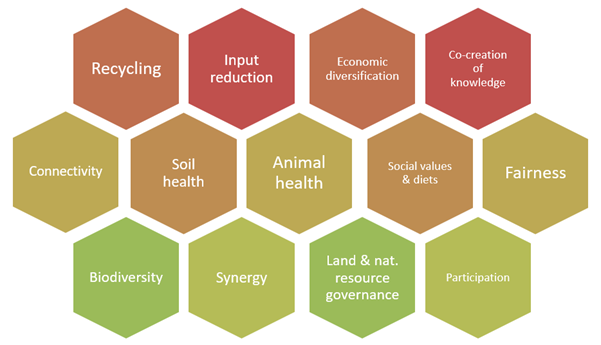
Within this framework, agroforestry – as the main agroecology practice being studied by the EELAP project – contributes both directly and indirectly to the implementation of these principles by enhancing soil health and regeneration, improving biodiversity, supporting climate change adaptation and mitigation, strengthening water management, promoting circular nutrient flows, increasing diversification and resilience, and reinforcing socio-economic viability.
These principles are operationalised through participatory dialogue, capacity development, and structured policy feedback. All four rounds integrate interactive workshops, guided excursions, and collaborative reflection sessions, creating a continuous cycle of learning, feedback, and improvement. This approach ensures coherence and alignment across countries while allowing sufficient flexibility for national and regional adaptation.
To this end, EELAP partners have begun engaging Irish local farm and community networks to lay the groundwork for deeper collaboration. A mapping process has been completed to identify micro to macro level key actors, from farmers to regional policymakers, who will be involved in Living Lab activities. Building on this, a survey designed to understand where farmers need more information or support around agroforestry. Feedback from this session is now being used to refine the survey before broader rollout to the wider Living Lab community.
The activity in Ireland reflects Teagasc’s broader commitment to supporting sustainable land use approaches and to linking research with practice on the ground. By working with farmers and stakeholders early in the process, EELAP aims to ensure that agroecological innovations are rooted in real-world experience and address practical needs.
Participation in the Living Labs offers several benefits, including:
- Contributing to shaping local or national policy and aligning with upcoming requirements (e.g., Carbon Removals and Carbon Farming (CRCF), CAP reform)
- Gaining insights into agroecological practices, planning tools, and business models
- Being recognised as a pioneer and strengthening collaboration with public bodies and other land users
Looking ahead
As Living Labs ramp up their work this year, EELAP will continue to share key insights ranging from policy recommendations to business model development and spatial planning tools. These efforts are designed to create clearer pathways for agroecology and agroforestry across European farms and landscapes.
For more information, please visit the EELAP project website.
If you are interested in attending the Living Labs please email Dr Ian Short at ian.short@teagasc.ie and Dr Zohreh Rafiee at zohreh.rafiee@teagasc.ie
Irish participation in the EELAP project is funded by the Department of Agriculture, Food and the Marine’s Competitive Research Funding Programme, project no. 2024Agroecology982.
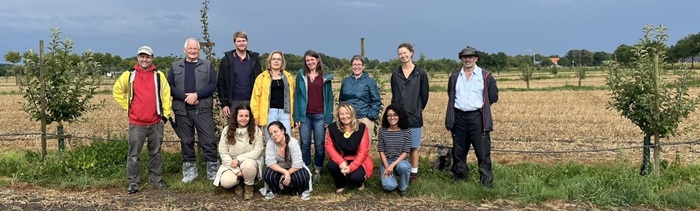
Featured image caption: EELAP project partners at a silvoarable orchard at the kick-off meeting, Munster, Germany.