
16 August 2024
Empty days – a hidden but very real cost
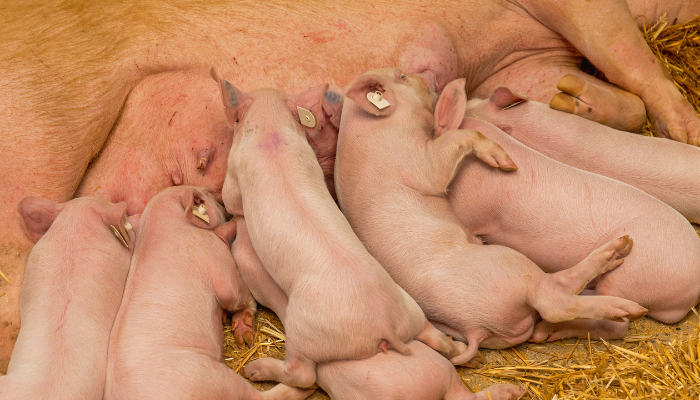
Louise Clarke and Ciarán Carroll discuss how “non-productive days” (NPDs) in breeding sows impact herd efficiency and profitability, emphasizing the importance of managing factors like “not in pig” sows (NIPs), repeat breeding, and environmental conditions to minimize NPDs and improve productivity.
Empty days or non-productive days (NPDs) can be defined as “any day a sow or gilt of breeding age is present in the herd and is not either gestating or lactating”. Non-productive days have one of the most important influences on breeding herd efficiency as they can directly affect unit profitability due to their influence on the number of pigs sold. If overall output is reduced, the number of sales will decrease and therefore the overhead cost per pig will increase. Therefore it is imperative to pay particular attention to NPDs. One factor that affects NPDs is “NIPs”, meaning sows and gilts that are assumed pregnant but actually are “not in pig”.
Common cause of NIPs
Some of the common causes of a high level of NIPs are repeats and abortions. Repeats should account for less than 10-12 % of sows/gilts served. There are two types of repeats; regular and irregular.
- Regular repeats: occur on the cycle; 19-23, 40- 44 days after service and should account for 2/3 of total repeats. Some of the factors associated with regular repeats are boar infertility, damaged or dead semen used for AI, single served timed incorrectly and unsupervised services.
- Irregular repeats: occur outside of 19-23, 40-44 days after service and are usually associated with sow failure i.e. embryonic mortality. Irregular repeats should not exceed one third of total repeats.
Regarding abortions, there are numerous reasons why a sow may abort but some of the most common are cause by disease, injury and environmental stress. Lameness and pain, particularly from abscesses in the feet or leg weakness can also cause abortions due to stress. Sow mortality in late pregnancy has a major impact on empty days as the entirety of her pregnancy will be classed as empty days because no litter was produced.
Cost associated with increase in empty days?
There are significant costs associated with empty days, and this can sometimes be ignored or neglected, especially when pig prices are high and farm performance is generally good. Many believe that a good farrowing rate alone indicates good productivity and sow performance. However a sow herd can have a good farrowing rate but still be inefficient especially if ‘repeats’ (NIPS) are occurring late in pregnancy. Table 1 is an example to show the opportunity cost of not identifying NIPs early while still having a good farrowing rate. If we analyse a single week of services through to farrowing on two 600 sow units; unit A has a poor/high number of empty days and unit B has a good/low number of empty days. On both units 30 sows were served and if we assume that they will have a gestation length of 115 days, a lactation period of 28 days and a weaning to service interval of 6 days, this gives a total of 149 days in a sow’s cycle. On both units 27 of the 30 served sows farrowed giving a 90% farrowing rate.
Table 1. Opportunity cost of not identifying NIPs early despite having a good farrowing rate.
|
|
Number of Sows |
Gestation days/ sow |
Lactation days/ sow |
Return to service days/ sow |
Other empty days/ sow |
Total days/ sow/ litter |
Farrowed |
|
Unit A “Poor herd” |
27 |
115 |
28 |
6 |
– |
149 |
Yes |
|
3 NIPS at 80 days |
115 |
28 |
6 |
80 |
229 |
No |
|
|
Ave/sow |
115 |
28 |
6 |
8 |
157 |
– |
|
|
Ave Litters /sow/year |
2.32 (365/157) |
||||||
|
Unit B “Good herd” |
27 |
115 |
28 |
6 |
– |
149 |
Yes |
|
3 regular repeats at 21 days |
115 |
28 |
6 |
21 |
170 |
No |
|
|
Ave/sow |
115 |
28 |
6 |
2.1 |
151.1 |
– |
|
|
Ave Litters /sow/year |
2.42 (365/151) |
||||||
This results in litter per sow per year of 2.32 and 2.42 respectively even though both herds have an excellent farrowing rate of 90%. So what will be the cost of this difference?
If we assume the average weaned/litter is 13.2 and each unit had a combined post weaning mortality of 6% then:
- Net alive per litter: 13.2 weaned – 6% mortality = 12.4 pigs sold per litter
- Pigs sold/year @ 2.42 litter/sow/yr: 42*12.4*600 sows = 18,005 pigs / year sold
- Pigs sold / year @ 2.32 litter/sow/yr: 32*12.4*600 sows = 17,261 pigs / year sold
- Difference in pigs sold per year = 744 pigs
If these missing pigs had been brought to slaughter (89kg dwt. @ €2.36/kg), then this equates to €156,270 in lost sales revenue on an annualised basis.
What can you do?
There are many causes of NIPs as highlighted above however good management plays a vital role in reducing the number of NIPs in your herd. Some aspects to consider include:
Accurate record keeping
Accurate individual identification of sows & sow groups allows you to concentrate on these pens at 21 & 42 days post service. Some of the information you need to record on your service record card includes; Sow no., date weaned, date served, expected farrow Any other observations (e.g. bleeding, previous abortions etc.)
Observation throughout gestation
Attention to detail at service must ensure that mating is successful and occurs at the correct time, that semen quality is adequate and that no post- mating discharges occur. Carefully observe sows from day 14-15 after service for signs of slight discharge or sticky mucus and monitor these sows as they are likely to return. Walk a teaser boar through the dry sow house daily to check for served females on-heat/repeating concentrating in particular on served gilt pens and groups three & six weeks post service.
Pregnancy testing
One opportunity to reduce NIPs is by pregnancy testing. Early and accurate identification of pregnant and non-pregnant sows and gilts in combination with accurate individual sow recording can allow earlier identification of repeats or abortions which will help to improve reproductive efficiency in your herd.
Lighting
Low lighting will trigger higher level of repeats and abortions at any time but especially in the autumn as the pineal gland (light sensor) within the sow’s brain has an effect on the progesterone hormone. Lighting in sow/gilt housing should be at 300 lux. To maintain a viable pregnancy requires constant daylight length. Ideally this should be 12-16 hours per day, beginning at 6am. It is important that the covers of the lights are regularly cleaned (every 6 months) as dirty covers can reduce the effective light intensity by 50%. Review your lighting now as we approach the Autumn.
Temperature
Wet, damp environments or high air movement (draughts) cause chilling and increase demands for energy. Ensure that the service house is dry and warm (21-22oC). Use a max/min thermometer to assess the room temperature at night. Remember that if the tank is deep and empty which may cause under slat air drafts this will not be picked up by min/max thermometer. On a windy day do a smoke test over some of the slats to see if there is upward draft from tank.
Aggression
Aggression between unfamiliar pigs is natural and may result in stress and injuries (lameness). High levels of aggression may occur when mixing your sows in the dry sow house and can negatively affect your Only move sows and gilts within 2 days or after 28 days post-service. Ensuring that the sows have feed in the trough on entry into the dry sow house may reduce the level of aggression. To help identify if aggression after mixing is having a negative impact pregnancy scan to assess the effect of fighting/mixing – ideally at feeding time to make the job easier.
In conclusion, a high level of NIPs will significantly increase your number of empty days even when you have a high farrowing rate. While the days involved in gestation and lactation are effectively fixed, the key to increasing your efficiency is to improve your NPDs and management plays a vital role in doing this. Minimising NPDs is therefore one of the most important aspect of sow management after breeding.