
16 February 2024
Encouraging the use of pig slurry
Farmers interested in importing slurry, in order to minimise fertiliser costs, are advised to complete a nutrient management plan first to assess their nutrient needs against slurry import rules. Louise Clarke tells us more
It is important that farmers are aware of the maximum amounts they can import, in order to avoid potential cross-compliance breaches as well as environmental concerns. This applies to the purchases of concentrates, fertiliser, as well as organic manure imported to the holding in each calendar year. The responsibility rests with the “occupier of a holding” for the management of fertiliser and soils on their own farm. They should be encouraged to soil test and use the information to ensure the best use of slurries and fertilisers on their farm.
The principle of soil analysis is to determine the average nutrient status of an area and to give a measure of the available nutrients in the soil. Soil nutrient levels change slowly over time. Therefore, soil test results will provide the basis for nutrient advice for a number of years until soils are resampled. Late December and early January are ideally suited to taking soil samples. At this point in time most grassland will be rested and therefore samples taken will not be influenced by false reading from livestock manure. Soil sampling represents a very small overall cost when considered against the potential improvement on the return on investment in fertilisers.
All farmers should take soil tests and have nutrient management plans drawn up for their farms if they want to optimise crop growth (grass or tillage crops) on their farms. Farmers may not be getting the best value from their fertilisers whether they are using organic or chemical fertilisers if they are not aware of their soils requirements. If a farmer is using pig slurry, doing a nutrient management plan early in the year may help ensure they do not use unnecessary chemical phosphorus which will reduce the amount of pig slurry they may obtain. Farmers need to plan ahead to get the best out of using organic fertilisers such as pig slurry to save them money.
Last year saw a number of new rules and changes to existing rules which affect livestock and tillage farmers in relation to nutrient management when importing slurry, spreading slurry and buying compound fertiliser. Importing farmers should make sure they are aware of all these changes early in the start of the New Year to avoid any mistakes later on in the year.
Some of the new changes
New soil testing requirements
- From 1st January 2023, all farms with a grassland stocking rate above 130 kg N/ha and all arable land, must complete soil tests for Phosphorus (P). Without a completed soil test, a soil P index 4 is assumed. Parcels with Soil P index 4 cannot accept any organic manure applications (except if potatoes, beet or maize are being grown).
- If the stocking rate is less than 130 kg N/ha and no soil test is done you must use a soil P index of 3.
- Soils with more than 20% organic matter (often referred to as “peaty soils”) shall not exceed the P allowance for Index 3 soils.
- Only parcels that are shown to be Index 1-3 are eligible to import organic manure.
- Soil tests must be completed at least once every 4 years with max area per soil test of 4 hectares (9.9 acres).
- This change is very important for any farmer wishing to use pig manure.
Low Emission Slurry Spreading
- Low emission slurry spreading (LESS) must be used for the application of slurry produced solely by pigs on any holding.
- It is the importing farmer’s responsibility to accept the importation of organic manure onto their holding on their ie portal once it has been uploaded by the exporting farmer.
Limit of 170 kg Organic N per hectare
- The limit of 170 kg of organic N per hectare still applies to all farms that import organic fertilisers such as pig manure. The amount considered to be applied to commonage shall not exceed 50 kg of N per hectare. Now the calculation is based on not exceeding 170 kg of organic N per hectare in the current year.
Value of pig slurry
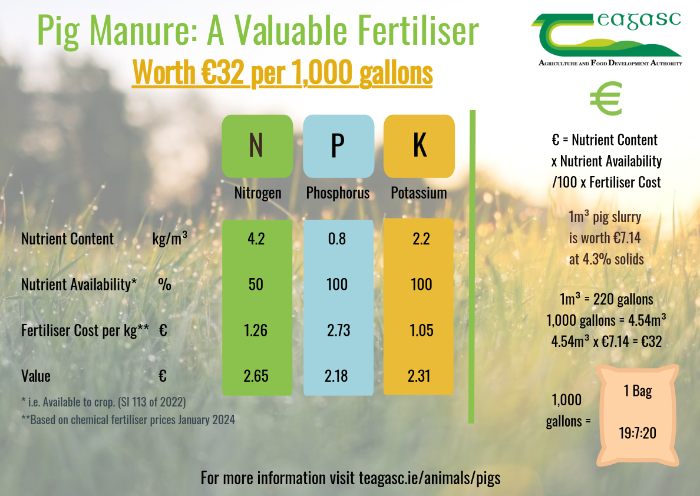
The fertiliser value of pig manure at 4.3% solids is currently valued at €7.14/m3, this translates into €32 per 1000 gallons. As the solids content increases there will be a corresponding increase in the nutrient content and in the fertiliser value.
1m3 pig slurry is worth €7.14 at 4.3% solids
1m3 = 220 gallons
1000 gallons = 4.54m3
4.54m3 x €7.14 = €32
1000 gallons = 1 bag 19:7:20
| N | P | K | ||
|---|---|---|---|---|
| Nitrogen | Phosphorus | Potassium | ||
| Nutrient content | kg.m3 | 4.2 | 0.8 | 2.2 |
| Nutrient availability * | % | 50 | 100 | 100 |
| Fertiliser cost per kg ** | € | 1.26 | 2.73 | 1.05 |
| Value | € | 2.65 | 2.18 | 2.31 |
Health and Safety
As the slurry spreading season starts again, there is a reminder to all farmers to please take the time to assess farm safety before the start of the busy period and make appropriate changes to help keep yourself and others safe. Check machinery and ensure all PTO shafts have guards in place. In particular, check guards on PTO shafts of slurry mixing and spreading equipment. Do not leave opened tanks unattended. Farms are a busy place where several tasks are being completed each day and health and safety should not be an afterthought to any of these tasks.