EuroTier 2026: Thoughts from the Teagasc Pig farmer advisors
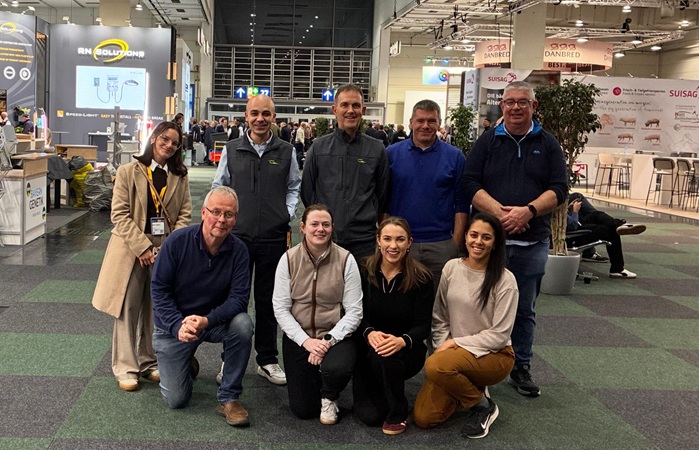
Knowledge Transfer personnel of the Teagasc Pig and Poultry Development Department, Ciarán Carroll, Louise Clarke, Michael McKeon and Ger McCutcheon attended this year’s EuroTier in Hannover, Germany. Here, they share their thoughts, impressions and overall take-home messages from the event.
What were your overall impressions of EuroTier 2026?
After having a good experience overall, Ciaran Carroll explained that it was “great to meet with the exhibitors and our network of contacts to find out what’s new and available for pig farmers.
“It was also great to see so many Irish pig farmers there, and it’s a good opportunity to catch up with them too. I’d say the crowds were smaller this year, I’m not sure why, but it made it easier to get around and gave more time to talk with the exhibitors,” Ciarán Carroll added.
Louise Clarke concurred with Ciarán’s thoughts, adding: “It was 2022 when I was there last and I definitely noticed a smaller crowd this year, maybe the current market situation in other parts of the EU had an effect on the attendance.” To this, Michael McKeon added: “The subdued mood at the show reflected the current poor market outlook.”
Ger McCutcheon added: “I enjoyed the show. There appeared to be less people in attendance and the people at the various stands seemed to have more time to engage and answer questions.”
What were the most interesting or significant innovations you came across in pig production?
Ciarán Carroll commented on the array of loose farrowing / temporary crating systems on display, which has been the case for a number of shows now.
“Some had tweaked their older systems based on learnings to date with systems already installed on farms. From discussions with suppliers, they all expect the floor area required (once the EU Directive is issued) to be 6-6.5m2.”
Three systems caught Ciaran’s eye. The first featured a creep area that can be closed off from the sows quite easily. It can also be expanded to allow more piglet space as they grow.
Another system’s floor, he added, had “a good design with a drained creep area / heat pad which could be useful when there are outbreaks of scour in the pen (would keep the creep area cleaner).” Thirdly, Ciaran identified a new and interesting weighing scales that can be used for all categories of pigs, from piglets to sows.
“The pig walks along the scales and gets weighed, with the data automatically uploaded to the cloud. It is compatible with most computerised pig management systems,” Ciaran Carroll added. He also gave a special mention to the WELFARMERS seminar at the show too.
Louise Clarke also spotted a new technology for counting pigs using a camera-based system, adding: “However, farmers would need the correct area to place it as dust may affect it. I also saw the new dry sow feeding system. There are one or two farmers in Ireland who have them already, but I thought they were very impressive and easy to operate.”
Of note to Michael McKeon was the continued evolution of loose lactation pen designs and the number of companies selling electronic dry sow feeder controllers which work on a plug-plug out basis, adding: “If a controller isn’t working you can plug it out and plug in a replacement”. The camera-based technology for county pigs also caught Michael’s attention.
Focusing on what stood out for him, Ger McCutcheon said: “I felt that there was more thought put in to help farmers adapt to the loose lactation requirements that are on the way in the next 10 years.
“They had more ideas to allow conversion of the existing accommodation. I also liked the scraper system that separated the liquid and solid in the channel. The moving rubber floor under the pigs is a mad innovation from Sweden – but I see [other companies] have used it in their houses also. It probably requires further research in terms of its durability over time,” Ger McCutcheon added.
What developments in automation, artificial intelligence and/or precision livestock farming do you think will become increasingly important in the future?
“I thought there would be more AI evident in the pig halls this year but found it lacking,” Ciarán Carroll commented.
“From talking to other farmers, there was much more AI in the cattle halls. There were some AI weighing systems (using photos/video to estimate weight). For the future, anything that can improve feeding, weighing, or the provision of enrichment materials will be useful.
“Sorting machines (feeders) may also be useful, but from discussions some of these systems can have poorer ADG, FCE etc. Systems that monitor sick pigs (off water/feed, high temperatures, etc) will prove very useful.”
Again, agreeing with Ciarán, Louise Clarke added: “I walked the dairy halls and thought they we much better for advancements on the AI side. My only stand out in the pigs was the camera to weigh the live pig, calculating its deadweight and working out the size of ham, belly etc.”
Michael McKeon pointed to a camera technology over the service area which can be used for analysing body condition post weaning, but this technology doesn’t appear to be widely available yet.
Innovations in terms of robotic power washing to increase automation and the additional monitoring available through AI to report on feed usage and pig performance were standouts for Ger McCutcheon.
Were there any developments that you feel could help Irish pig farmers address some of their biggest current challenges?
On this, Ciarán Carroll added: “Some of the new loose lactation / temporary farrowing pens will address the challenge in this area. Pig management systems (of which there were many) will also improve farm efficiency (if you don’t measure you can’t improve). More automation will reduce the workload, which will ease pressure on labour availability, but we will still need people to work with and look after our pigs.”
For Louise Clarke, the automated washer for the pig pens was probably the highlight here.
“There were plenty of different types available and I don’t think there are any in Ireland at the moment. Along with labour saving, it will hopefully improve biosecurity,” she explained.
Ger McCutcheon added: “The robotised power washer is something that has not taken off here. It does 85% of the washing, but you still need the human to do the last 15%.”
On technological development that could make a real difference on Irish pig farms, Michael McKeon added: “Loose lactation crate design is continually improving but the big issue is the cost and lack of return on investment. This has probably been the biggest advancement of the last 10 years at the show.”
Key takeaway: What were some of the key ideas or lessons you took away from EuroTier 2026 that you would like Irish pig farmers to know about and why?
On the key lessons, Ciarán Carroll added: “Pig farmers across Europe and beyond are facing the same challenges, notably a lack of profitability at the moment.
“They are a resilient group and will weather this storm too. Getting the opportunity to visit EuroTier would have shown them that they are not on their own, they all face similar issues and there are plenty of people out there working in the sector and associated industries that are available and willing to help (even if sometimes it’s only to share the problems via a chat). There are lots of old and new technologies to be seen at EuroTier, many of which can help to improve pig production.”
Michael McKeon added: “The show is very worthwhile for producers to attend to see new versions of technology,” while Ger McCutcheon added: “Good ideas and innovations are always welcome. I felt that the show was more practical in terms of its solutions to some of the future challenges.”
For further information on EuroTier, or any of the machinery and technical advancements showcased at the event, please contact your local Teagasc advisor.