
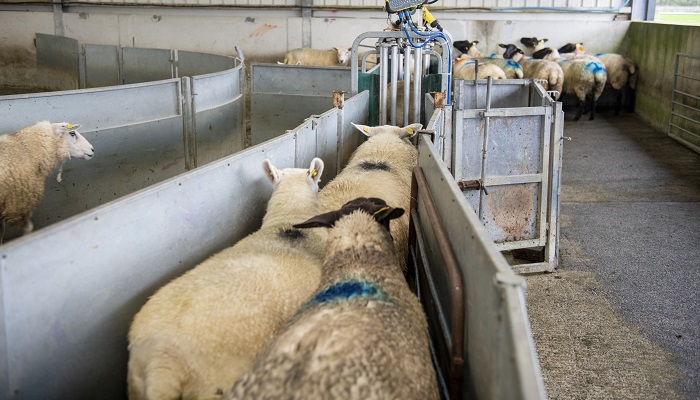
Body condition score (BCS) is an important way of assessing the nutritional status of a flock without the need for anything more than a pair of hands and a race, Research Officer at Teagasc Athenry, Dr. Frank Campion tells us more.
Breeding ewes use their body reserves essentially as a sink and store for energy during the year, building up body condition when energy demand is low – such as between weaning and mating – and mobilising body condition when energy demands are high during lactation. Indeed, body condition score (BCS) is an important way of assessing the nutritional status of a flock without the need for anything more than a pair of hands and a race.
Body condition in sheep is assessed through using your hand to feel along the sheep’s lumbar region between the last rib bone and the hip bone. The level of fat and muscle cover on four areas is assessed: the spinous process, the transverse process, over the ends of the transverse process and the fullness of tissue between spinous and transverse processes. Once ewes are dried off post-weaning and up to mating is the best time to build ewe BCS. It can take 8-10 weeks to put on 1 full BCS unit on a ewe so for flocks mating in early March they already are already inside this window.
Benefits of improved BCS
Building ewe BCS takes time and management, but the rewards are evident in flock performance through improved pregnancy rates, litter sizes and improved lamb performance by increasing the ewe’s ability to reach her peak milk yield. Research carried out on the Teagasc BETTER sheep farms has also shown that ewes in correct BCS are less likely to lose lambs and less likely to be culled from the flock. This work has also demonstrated that ewes in correct BCS are more resilient in times of poor weather, particularly in springtime and are better able to maintain performance compared to ewes that are below target BCS.
Fit for breeding
Mating time for mid-season lambing flocks is coming fast and at this stage preparations should be well under way with cull ewes already identified. It is important to keep a regular check on the ewes being kept for this year to ensure other problem ewes are identified and issues dealt with promptly to ensure all ewes selected for mating are fit and sound. A key component of this is getting ewes in the correct BCS. This can be made very simple by identifying ewes that ‘thin’ or ‘fit’ with any ewes <BCS 3.0 considered as ‘thin’.
Thin ewes should be clearly marked and given preferential treatment in the run up to mating by grazing with the ewe lambs or fattening lambs not on concentrates e.g. grazing covers of 8-10cm down to 6cm and not being forced to clean out paddocks. Marking these ewes is important as ewes that fail to regain BCS by mating should then be culled as it can indicate an underlying health problem or be an indication that she is unable for the system. These ewes unfit for the system will be a ‘’passenger’’ for the rest of the year requiring additional feeding and management.
BCS on the BETTER farm programme
In August, all the ewes in the Teagasc BETTER farm programme lowland flocks had their BCS assessed and on average ewe BCS was 3.2. However, the key figure from this was that on average just over 13% of ewes in each flock were less than BCS 3.0. It is important to remember that currently just because these ewes are thin does not necessarily mean they are the worst ewes in the flock. In fact, some of the best ewes in the flock will be thin after weaning as they will have mobilised body reserves into milk production for the lamb. These figures are better than the same time last year which reflects the comparatively better weather and grass growing conditions for most in 2025 compared 2024.
All ewes regardless of BCS should be regularly checked and allowed to regain BCS in the run up to mating, restricting ewes or trying to remove BCS at this stage is not a good idea. Having ewes in the correct BCS at mating will not only improve flock performance but also make flock management for the year ahead easier.
More from Teagasc Daily: BETTER hill sheep farming – the Kerrigans’ journey
More from Teagasc Daily: Research update: Early results from hill lamb finishing study
More from Teagasc Daily: What’s your plan for flock replacements?