
Exploring a new BASELINE for Irish agriculture
Claudia Barry, Biodiversity Research Technician, Meritxell Grau Butinyac, FarmBioNet Project Manager, Dr. Saorla Kavanagh, FarmBioNet Project Coordinator & Research Officer, bring us insights from the Project BASELINE EIP launch, a farmer-led initiative focused on soil health, science and innovation.
Research Officer, Dr. Saorla Kavanagh joined the launch of the Project BASELINE EIP on February 6th, 2026, in Co. Kildare. Project BASELINE is a farmer-led initiative focused on soil health, science, and innovation, and is something to get excited about. Hosted on the Colton family farm near Athy, the event was launched by Minister for Agriculture, Food and the Marine, Martin Heydon TD.
The project is widely supported as evidence by the high number of representatives from CAP Network Ireland, the Department of Agriculture, Food and the Marine, the Department of Housing, Local Government and Heritage (DHLGH), farmers, the National Parks and Wildlife Service (NPWS), SETU, Teagasc and others.
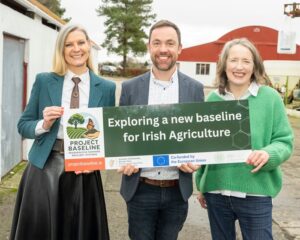
Photo caption: Pictured above at the launch of Project BASELINE EIP are Pippa Hackett, Rob Coleman and Grace Hamilton.
The project coordinator Rob Coleman, Chairman of BASE Ireland and a farmer from North Cork, introduced BASE Ireland and Project BASELINE. Farmers involved in BASE Ireland are simply sharing information on how they can improve their land, their environmental impact and their income.
The group’s philosophy centres on looking ‘inside the farm gate’ – focusing on what farmers can control, testing ideas on their own farms and learning from one another.
“Change is disruptive by its nature, and facing this challenge is so much easier when you surround yourself with positive people willing to have a go.”
This project aims to help create a stronger future for Irish agriculture and a brighter future for people and the planet.
“We are farming, not mining,” he said, highlighting the importance of sustaining and regenerating soils to secure both productive and environmental gains. He stressed that improving soil health and protecting the environment does not have to come at the expense of farm income – the two can go hand in hand.
Over the past decade, BASE has grown from small beginnings into an organisation with policy influence and now, a formal research arm through Project BASELINE.
An innovative EIP approach
The Project BASELINE is funded under Ireland’s European Innovation Partnership (EIP) programme. Coleman paid tribute to the Department for its commitment to supporting innovative, farmer-led initiatives through the EIP model, which aims to bring fresh thinking and practical solutions to agricultural challenges.
Project BASELINE will build on the years of practical experience already gathered by BASE farmers. The aim is to apply robust scientific measurement and data analysis to farmers’ lived experience – putting numbers on observed improvements in soil health, environmental performance and financial outcomes.
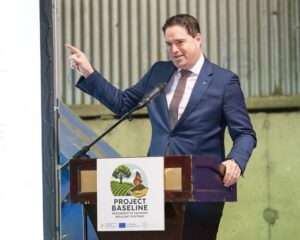
Minister Martin Heydon at the launch of Project BASELINE.
Minister Heydon highlighted how farmers throughout the country are taking different actions towards protecting the environment and that it is not about how good you are but the journey you travelled.
Highlighting that the journey of the farmers participating in the Protecting Farmland Pollinators EIP is one that continues despite the projects end date in December 2023. The locally-led approach used by EIP projects has been shown to have positive outcomes for the environment and for farmers.
We need to take the learnings from these EIP projects, and the multi-actor approach used to ensure that we can push their scalability. The farmer led Farmer Moth Monitoring EIP is EIP that has successful been scaled up and is now under the National Moth Monitoring Programme.
Project BASELINE manager, Pippa Hackett outlined how the initiative will assess relevant ecological and financial variables to determine whether practices that feel better on the ground truly deliver measurable benefits. The project will also examine the social and cultural dimensions of change – exploring why adopting new practices can be challenging and how peer influence and community norms shape decision-making on farms.
Collaboration and knowledge-sharing
The event was attended by representatives from a wide range of current and former EIP projects, reflecting a strong spirit of collaboration within the sector. Representatives from FarmBioNet’s Thematic Network on Farming and Biodiversity were also in attendance.
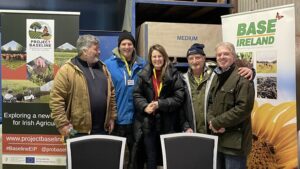
Protecting Farmland Pollinators EIP farmer alumni with Dr Saorla Kavanagh. Pictured left to right are: Tom Tierney, Nigel Gillis, Dr Saorla Kavanagh, Colm Flynn, and James Kelly. Tom, Nigel and Colm are all members of FarmBioNet’s Irish National Network.
Opening the door to change
In closing, Coleman emphasised that the aim of Project BASELINE is simple: to “open the door” so that any farmer interested in change has access to the knowledge, data and experience gathered by the group.
By sharing practical insights backed by solid science, the project hopes to inspire a stronger, more resilient future for Irish agriculture – one that safeguards soils, protects water quality and supports biodiversity, while maintaining viable farm businesses.
The launch concluded with a Foliar Feeding Workshop which covered a number of topics including dissolving urea for foliar application, foliar application for grassland and growth rates and covers in a 21-day rotation.
Related reading:
Biodiversity-friendly farming practices