
06 September 2022
Extended grazing – an alternative approach to winter ewes
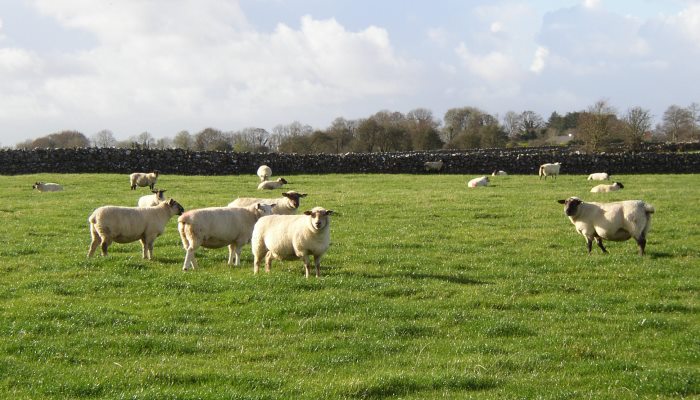
Extended grazing involves allowing herbage to accumulate for grazing during the winter period. This involves removing stock from paddocks in September and early October, thus enabling herbage accumulation for grazing from mid-December onwards. Dr. Tim Keady, Teagasc Researcher, Athenry explains
Introduction
The extent of area of the farm from which stock need to be removed to enable herbage accumulation depends on:
- the stocking rate,
- the period of time it is proposed to extend-graze the flock and
- the amount of herbage that will be offered daily during extended grazing.
During extended grazing, herbage is frequently allocated to the flock and electric fences are placed in front of, and behind, the ewes thus preventing them from going back onto areas already grazed.
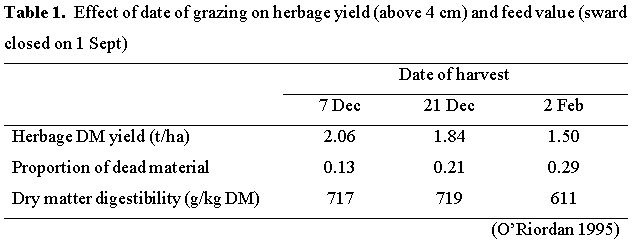
The feed value of the herbage depends on the growth interval, i.e., the time between closing the paddock, to accumulate herbage, and grazing. The effects of date of grazing on herbage feed value are presented in Table 1.
As the date of extended grazing is delayed the proportion of dead herbage increases and herbage feed value, as determined by DMD (dry matter digestibility), declines. Also herbage dry matter (DM) yield declines after a period due to leaf senescence and decay.
Ewe performance
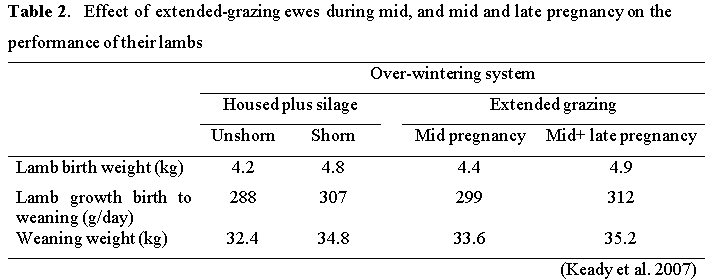
In studies undertaken at Athenry ewes were extended-grazed either during mid-pregnancy or during both mid- and late-pregnancy while other ewes were kept indoors and offered medium feed value grass silage.
The results of one of these studies are presented in Table 2. Relative to ewes that were housed and unshorn, extended grazing increased lamb birth weight and growth rate from birth to weaning and, thus, increased weaning weight. Extended grazing throughout mid- and late-pregnancy resulted in a greater response than extended grazing during mid-pregnancy only. However, when compared to ewes that were shorn at housing, extended grazing had no beneficial effect on ewe or lamb performance.
Herbage allowance
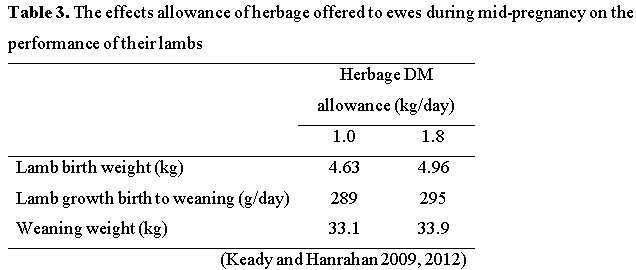
The effects of herbage allowance offered to ewes during mid-pregnancy (early December to 4 weeks prior to lambing) on the performance of their lambs were evaluated in two studies at Athenry; the results are presented in Table 3. Increasing herbage DM allowance by 0.8 kg/day increased daily forage DM intake by 0.19 kg per ewe. Thus, only 24% of the additional allocated herbage was consumed by the ewes. Lambs from ewes on the higher grass allowance were heavier at birth (+0.33 kg) and at weaning (+0.8 kg) and grew faster from birth to weaning (+6 g/day).
During mid-pregnancy, and where there is a good utilization rate of herbage, an allowance of 1.3 kg herbage DM should suffice. Higher herbage allowances result in reduced utilization rate and a requirement for a greater area of the farm to be closed in autumn to accumulate herbage for extended grazing during mid and late pregnancy.
Frequency of herbage allocation
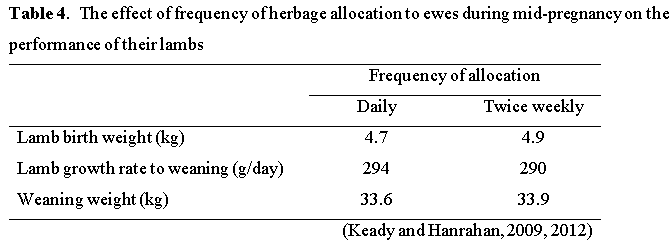
The effect of frequency of herbage allocation to ewes in mid pregnancy on the performance of their lambs was evaluated at Athenry (Table 4). In these studies the ewes were extended-grazed from mid-December to 4 weeks prior to lambing, at which stage they were housed and offered grass silage ad-lib and a total of 19 kg concentrate prior to lambing. During extended grazing the ewes were allocated herbage either daily or twice weekly. Frequency of herbage allocation had no effect on lamb birth or weaning weight, or on lamb growth rate from birth to weaning.
Impact on spring grazing
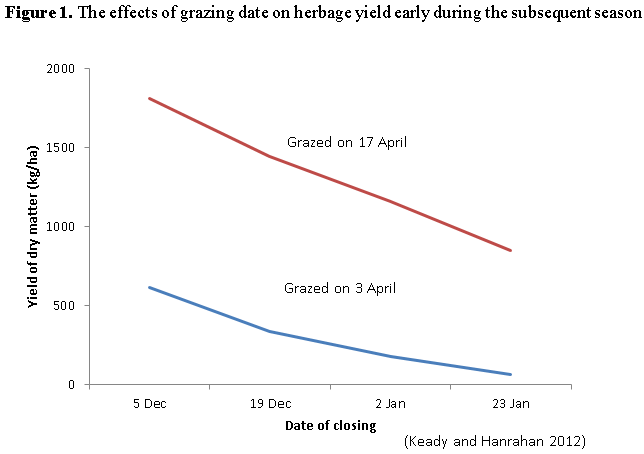
The effect of the date of extended-grazing on herbage yield during the early part of subsequent spring grazing was evaluated at Athenry. In that study swards were closed either on 5 December, 19 December, 2 January or 23 January. Each 1 day delay in grazing date reduced herbage DM yield by 21 and 35 kg/ha (Figure 1) when grazed on 3 April and 17 April which is equivalent to 7 and 12 ewe-grazing days, respectively. The data from this study clearly illustrated that delayed grazing had a major effect on herbage yield in the subsequent spring.
Impact on sward composition
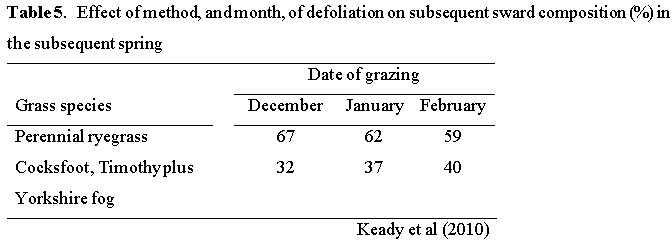
Ewes are allocated relatively small areas of pasture in extended-grazing systems as typically the area involved has a heavy cover of herbage. A study was undertaken to evaluate the effects of extended grazing management on sward botanical composition; the results are presented in Table 5. Delaying grazing date resulted in a reduction in the perennial ryegrass content of the sward and the combined content of Cocksfoot, Timothy and Yorkshire Fog increased. Therefore extended grazing will lead to a reduced reseeding interval.
Conclusions
- Extended grazing provides an alternative system of managing ewes during mid or mid- to late-pregnancy.
- On farms employing extended grazing, autumn is the most critical time for grass supply as paddocks need to be closed to accumulate herbage for extended grazing at a time when lambs need to be finished and the ewes need to be prepared for joining.
- Increasing the interval between autumn closing and subsequent grazing:
- increases the proportion of decayed herbage.
- reduces herbage feed value.
- reduces the proportion of perennial ryegrass in the sward.
- delays subsequent herbage accumulation for spring grazing.
- Allocating herbage to ewes either daily or twice weekly makes no difference to the performance of their lambs.
- Each 1 day increase in the length of the interval between closing and extended grazing reduces herbage DM yield during the subsequent spring (depending on day of grazing) by up to 35 kg/ha; equivalent to 12 ewe-grazing days.
The Teagasc Sheep Specialists, Researchers and Teagasc Advisors issue an article on a topic of interest to sheep farmers on Tuesdays here on Teagasc Daily. Find more on Teagasc Sheep here Teagasc provides a Local Advisory and Education service to farmers. Find your local Teagasc office here