
Extending the grazing season and managing drying off on Teagasc/Lakeland Demo Farms
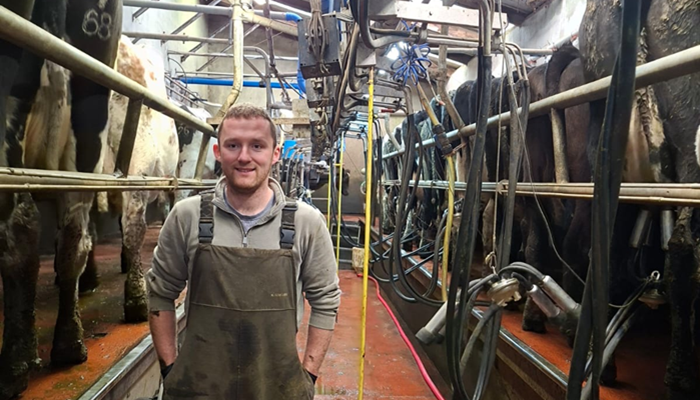
Teagasc/Lakeland Dairies Joint Programme advisor, Sean Callan visits Cian Jobe in Co. Longford, focusing on the final round of grass and drying off plans. He also provides an update on milk and grassland performance from the monitor farms.
Farmer Update – Cian Jobe
Cian’s herd is currently producing 1.60 kg MS/cow, a reduction of 0.21 kg since the beginning of October.
While milk volume has eased, protein percentage has improved by 0.21%, largely due to the high proportion of grazed grass in the diet.
Cian is currently grazing covers of 1,600 kg DM/ha, with cows receiving 4 kg of silage at the barrier. Meal feeding has also been reduced by 0.5 kg/cow to 3kg per head.
With farm cover and ground conditions remaining favourable, Cian hopes to continue grazing day and night for another two weeks, followed by a further week of daytime grazing. To facilitate this, he will increase the amount of high-quality silage being fed, while closely monitoring his average farm cover (AFC), to make sure he will have adequate grass available in spring (Target 1st December AFC 750 kg DM/ha).
Dry period
Cian places a major emphasis on the dry cow period, recognising its importance for next year’s calving season and milk production.
Through regular body condition score (BCS) monitoring, he has moved thinner cows to once-a-day milking to manage condition.
He plans to dry off his first batch in two weeks, including cows currently under-conditioned (BCS < 2.75) and first-calvers. An extended dry period of 90 days or more should help these cows calve down in 2027 in optimal condition (Target BCS of 3.25).
Cian uses Selective Dry Cow Therapy (SDCT) to reduce antibiotic use on farm. His fourth and final milk recording will take place within 30 days of drying off.
He estimates that 30% of cows will require antibiotic dry cow treatment, with the remainder receiving teat sealant only.
Treatment decisions are formed by using individual cow somatic cell count (SCC) data from current years milk recordings (four recordings) and previous years’ SCC history (cows consistently below a SCC of 100,000), alongside clinical mastitis records. The herd’s average SCC was 103,000 cells/ml between January and September 2026.
If you have any questions regarding SDCT, make sure to reach out to your milk quality advisor, vet or your Teagasc advisor for guidance.
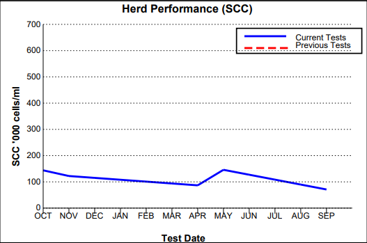
Figure 1: SCC chart for the last 12 months on Cian Jobe’s farm
Group performance update
Milk performance has remained strong over the last four weeks. Despite milk volume dropping from 18.8 to 16.2 litres/cow (a 13.8% reduction), average fat percentage increased from 5.39% to 5.62%, with protein also rising from 4.21% to 4.38%. As a result, average milk solids production dropped from 1.85 to 1.66 kg MS/cow, a 10% decrease over the last month. Impressively, the group’s average somatic cell count dropped from 145,000 to just 127,000.
Table 1: Milk production on the Teagasc/Lakeland demo farms (week starting November 2, 2026)
| Farmer | Location | Litres/cow | Fat % | Protein % | Kg MS/cow | SCC ‘000 | Meal kg |
| Julie Mullarkey | Monaghan | 18.0 | 5.31 | 4.48 | 1.82 | 100 | 3 |
| Cian Jobe | Longford | 15.5 | 5.66 | 4.35 | 1.60 | 131 | 3 |
| Killian Brennan | Cavan | 14.0 | 5.95 | 4.41 | 1.49 | 99 | 4 |
| Sean Murtagh | Westmeath | 16.0 | 5.61 | 4.37 | 1.64 | 151 | 3 |
| Eoin Corrigan | Meath | 16.5 | 5.93 | 4.38 | 1.75 | 147 | 4 |
| Andrew Cluskey | Louth | 17.0 | 5.25 | 4.3 | 1.67 | 135 | 4 |
| Average | 16.2 | 5.62 | 4.38 | 1.66 | 127 | 3.5 | |
Farm covers have declined in line with reduced grass growth rates. Since last month’s update, average farm cover (AFC) has dropped from 992 to 752 kg DM/ha, while cover/LU has fallen from 323 to 272 kg DM/LU.
Growth rates have also dropped by over 50%, falling from 60 to 26 kg DM/ha/day. Pre-grazing yields vary considerably across the group, ranging from 1,000 to 2,200 kg DM/ha. The demonstration farmers have reduced grass demand to an average of 38 kg DM/ha/day by lowering the milking platform stocking rate to 2.88 cows/ha and introducing high-quality silage into the diet, ranging from 3 to 8 kg/cow.
Table 2: Grassland performance on the Teagasc/Lakeland demo farms (week starting November 2, 2026)
| Farmer | Location | Average farm cover | Cover/LU | Pre-grazing yield | Demand/ha | Growth rate/ha | MP Stocking rate LU/ha | Silage (kg) being fed |
| Julie Mullarkey | Monaghan | 896 | 242 | 2,200 | 67 | 23 | 3.70 | 3 |
| Cian Jobe | Longford | 721 | 249 | 1,600 | 29 | 26 | 2.89 | 4 |
| Killian Brennan | Cavan | 572 | 178 | 1,500 | 31 | 25 | 3.22 | 8 |
| Sean Murtagh | Westmeath | 861 | 406 | 2,150 | 36 | 30 | 2.12 | 8 |
| Eoin Corrigan | Meath | 780 | 248 | 1,800 | 25 | 30 | 3.14 | 8 |
| Andrew Cluskey | Louth | 680 | 309 | 1,000 | 40 | 22 | 2.20 | 4 |
| Average | 752 | 272 | 1,708 | 38 | 26 | 2.88 | 6 |
All six farmers continue to walk their farms regularly, closely monitoring AFC. With plans to graze well into November, they are carefully managing grass utilisation to ensure adequate grass supplies are available to match their 2027 calving dates. The farmers will use the grass budget tool to decide when to finish up grazing to ensure the closing farm cover is at 750kg DM/Ha on the 1st of December.
Teagasc National Dairy Conference
This year’s Teagasc National Dairy Conference will take place in Cork on Wednesday, 25th November. The theme of this year’s conference is “Developing Resilient Dairy Farming Systems”, and is taking place in the Radisson Blu Hotel, Little Island, County Cork. The conference is focused on the latest developments and research in the Irish dairy sector.

For more information, including the sessions and workshops planned, visit here.