
FarmBioNet becomes a partner in the All-Ireland Pollinator Plan 2026-2030
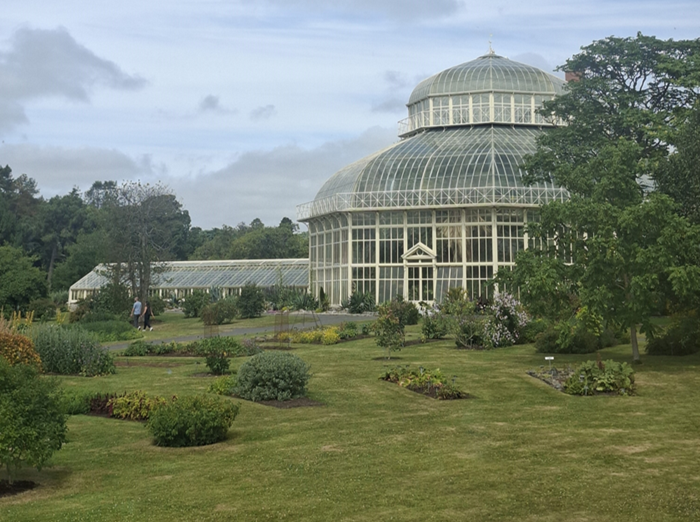
Meritxell Grau Butinyac, FarmBioNet Project Manager, and Claudia Barry, Biodiversity Research Technician, explain how FarmBioNet, working with the All-Ireland Pollinator Plan, will help people understand what biodiversity needs while also giving them practical ways to provide it.
On July 9th, 2026, the National Botanic Gardens in Dublin hosted the launch of the All-Ireland Pollinator Plan (AIPP) 2026 – 2030, a five-year roadmap to support the pollinator community across the island of Ireland.
The plan was launched jointly by Ireland’s Minister for Nature, Heritage and Biodiversity, Christopher O’Sullivan TD, and Andrew Muir, Northern Ireland’s Minister of Agriculture, Environment and Rural Affairs. The plan, for the first time, sets out a shared vision for the whole island.
That vision is a simple but ambitious one: pockets of nature every 200 meters. A solitary bee will rarely fly further than that to find food, so the AIPP’s ten work packages are all built around closing those gaps in farmland, towns, along roads and gardens; so that pollinators always have somewhere nearby to feed, shelter and nest.
For everyone working on FarmBioNet, the launch felt close to home. Dr Úna FitzPatrick of the National Biodiversity Data Centre (NBDC), who has coordinated the AIPP since its first phase in 2015, spoke about how far things have come: 130 partner organisations are now signed up island-wide, an increase of 32 since the second AIPP, and the new plan sets out 50 strategic aims and 75 success metrics across its ten work packages, a more flexible structure designed to allow knowledge-exchange and peer-learning to grow within each sector over the next five years.
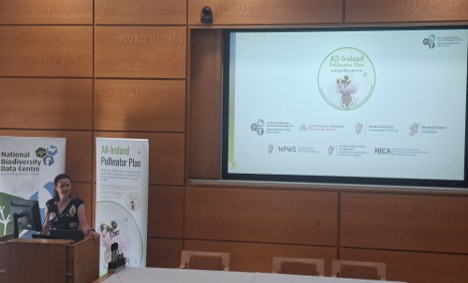
Dr Úna FitzPatrick, Chief Scientific Officer at the National Biodiversity Data Centre, presenting at the All Ireland Pollinator Plan launch.
Farming front and centre
Work Package 1, Protecting Farmland Pollinators, is where the AIPP and FarmBioNet overlap most directly. Among the speakers reflecting on the previous phase’s progress was Andrew Bergin, a member of FarmBioNet Irish National Network, described his experience of implementing biodiversity-friendly farming (BFF) practices on his farm.
He described a “positive jigsaw” effect: individual, low-cost, easy-to-implement changes (hedges cut less often to let flowers and fruit develop, awkward corners left for succession planting, a pond reinstated, insecticide use cut right back) that add up to something much bigger when farmers compare notes and build on each other’s results.
That is exactly the kind of knowledge-exchange FarmBioNet exists to support. Our Farming and Biodiversity National Network in Ireland brings farmers, advisors, researchers and policymakers together to identify and share BFF practices that are practical, while maintaining productivity.
Hearing Andrew describe how taking part in the Protecting Farland Pollinators EIP, which included a Farmland Pollinator scoring tool turned “what should I do?” into a practical, farm-specific action list is a useful reminder of what good Agricultural Knowledge and Innovation Systems (AKIS) collaboration can achieve, and it’s the same spirit behind our own workshops and farm walks over the past year.
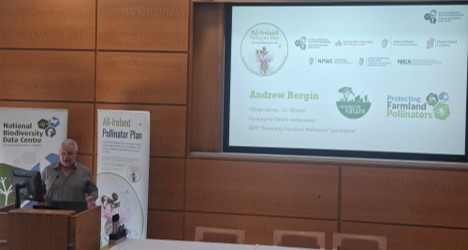
Andrew Bergin, FarmBioNet National Network member, presenting at the All Ireland Pollinator Plan launch.
The AIPP’s next phase for Work Package 1 will build a new tool aimed specifically at protecting farmland for pollinators, developed with input from farmers, and launching in the coming months with support from the NBDC. This scorecard tool will allow farmers to score their own farm for pollinator friendliness. As a partner organisation in the AIPP, FarmBioNet will promote this work package and encourage engagement across the agricultural sector.
A shared island, a shared challenge
Several speakers returned to the same theme: this AIPP is genuinely all-island, with new funding support from the Government of Ireland’s Shared Island Fund alongside the Department of Agriculture, Food and the Marine, the National Parks and Wildlife Service and the Northern Ireland Environment Agency. Practical commitments announced on the day included €1.8 million for the Shared Island cooperation strand of the AIPP and £49 million for restoration work on Lough Neagh, both signalling that pollinator-friendly land management is being treated as infrastructure, not an afterthought.
Dr Dara Stanley, representing the Irish Pollinator Research Network (IPRN), highlighted how far the underpinning research has come too: 76 papers published during the last phase alone, feeding directly into policy briefs on nature restoration. That research base is what allows projects like FarmBioNet to point farmers towards practices with real evidence behind them.
Why this matters for our network
FarmBioNet and the All-Ireland Pollinator Plan are not the same project, but they are pulling in the same direction: helping people who manage land understand what biodiversity needs and giving them practical ways to provide it. As the 2026 – 2030 AIPP rolls out its farmland work package over the coming months, we’ll be watching closely for tools, guidance and opportunities that our National Network members can put to use directly on their own farms.
If you farm, advise farmers, or simply want to see more pockets of nature dotted across the landscape, both networks are worth keeping an eye on. You can read the full All-Ireland Pollinator Plan 2026-2030 at pollinators.ie, and find out more about FarmBioNet Ireland’s National Network by emailing Farmbionet@teagasc.ie.
FarmBioNet is funded by the European Union’s Horizon Europe Framework Programme and is led in Ireland by Teagasc.