
Farming for Soil Health: Assess your Soil Health
Soil is one of the farm’s most important resources. It takes many years to develop, but it can be damaged or lost very quickly. Once soil is badly degraded, it can be difficult and costly to restore.
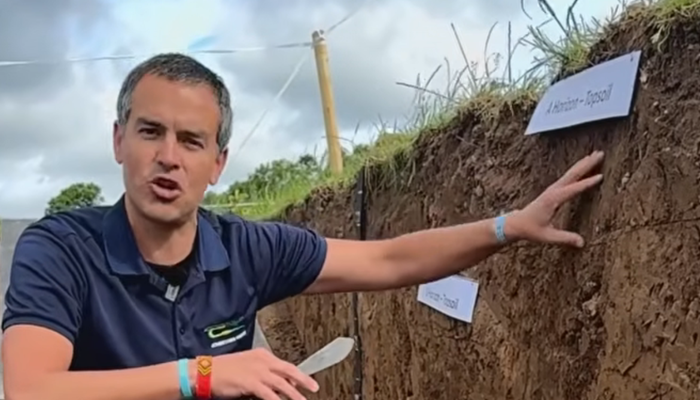
As part of the Farming for a Better Future Open Day, taking place in Teagasc, Johnstown Castle, today, June 10, Luis Lopez-Sangil delved beneath the surface to tell us more about the importance of assessing your soil health.
Soils are multifunctional living systems. As such, the critical functions they provide to societies rely on their health status. Soils are also limited resources, irreplaceable at human time scale. In the EU, 60-70% of soils are currently degraded, and continue to deteriorate, costing over €50 billion per year. Protecting healthy soils from degradation is critical for human wellbeing, food production and economic development.
Luis Lopez-Sangil tells us more in the below video:
Completing a soil health assessment
Soil health assessments can easily be done in the field (in situ). A quick look at the topsoil combined with digging a small pit (exposing the top 40-50cm of soil profile) can give us valuable information about the type of soil and its health status.
It’s important to note that soils are very diverse, with their different physical, chemical and biological properties dictating their functions and vulnerabilities.
Soils also vary by depth, with soil organic matter (SOM) and biological processes normally accumulating at the top. All these natural differences need to be accounted for when assessing soil health.
What to do:
- Compare areas of good and poor performance on the farm. Look for evidence of poor crop establishment or growth, reduced water infiltration, physical damage and/or erosion. These are areas you may want to investigate further.
- Use visual assessment techniques. Features of biological activity are the main indicators of good soil health status: check for deep and extensive root growth, presence of rounded aggregates, crumbly structure, earthworms and other soil organisms, high porosity and bio-channels, and the dark colours from SOM.
- Many Irish soils are affected by water stagnation (when excess of water in the soil accumulates over prolonged periods) and are prone to compaction or nutrient leaching. These issues pose serious challenges to farmers and soil life. Features like iron redox mottles (brownish/greyish coloured patterns indicative of lack of oxygen), compacted layers in the soil, poor rooting and/ or reduced porosity can help identify the issues and tailor corrective measures before they start affecting farm productivity or water quality.
- Assess chemical health by conducting regular soil analysis tests, particularly for pH and available macronutrients, while also monitoring SOM (organic C) levels.
Further resources
Access the Farming for a Better Future Open Day publication here.
Read the Farming for Soil Health Handbook here.
For guides on how to assess soil health, visit the Teagasc website.
View the EU Commission’s proposal for a Directive on Soil Monitoring and Resilience here.
The above was prepared as a paper for the Farming for a Better Future Open Day by Luis Lopez-Sangil, Veronica Nyhan, Gabriela Cardenas Alvarez, Cathal Somers, Giulia Bondi, Lilian O’Sullivan, David Wall, Karen Daly, and Fiona Brennan, and was adapted for use on Teagasc Daily.