
Feeding concentrates to finish cattle off grass
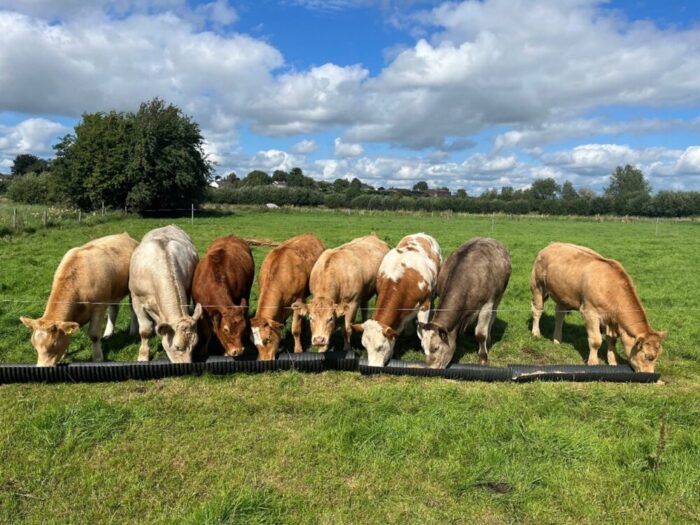
Should I feed at grass to finish cattle before housing or to reduce the time in the shed next winter? Manager of the Future Beef Programme, Martina Harrington provides some key answers to this question in this article.
When compared with spring grass, autumn grass generally has a lower feeding value. Additionally, weather and grazing conditions in autumn may be less than optimum. As grazed grass is considerably cheaper than grass silage, strategic concentrate supplementation at pasture to enhance feed-nutrient intake, and thus help animals meet an acceptable carcass fat score, before the need for housing become very attractive.
One important factor in feeding cattle is the substitution rate. It essentially measures how much the concentrates ‘substitute’ for the grass they would otherwise be eating. Research at Teagasc Grange found that when finishing cattle on autumn pasture with concentrates, the substitution rates varied widely, depending on the availability of grass. If grass was limited, the substitution rate was low, meaning the cattle still ate a lot of grass. But if there was plenty of grass, concentrates reduced grass intake but usually increased the overall intake of dry matter and energy
Carcass growth response to concentrate supplementation while grazing can be variable. It depends on the quality and quantity of pasture, as well as the amount of concentrate given. The response is better when grass is in short supply or of lower quality, but as more concentrate is added, the additional benefit decreases.
Studies at Teagasc Grange showed that with adequate grass in autumn, feeding 0.5-0.75 kg of concentrate per 100 kg of live weight resulted in carcass growth responses between 30 and 110 grams per kilogram of concentrate. Feeding a moderate level of concentrate (0.5 kg/100 kg live weight) is likely to give good growth results.
| Suckler steers
(95 days) |
Suckler steers
(75 days) |
Beef x Dairy steers
(112 days) |
||||||||
| Finishing strategy | GO | GC5 | Sig | GO | GC5 | Sig | GO | GC1.5 | GC3 | Sig1 |
| Daily live weight gain (kg) | 0.34 | 1.04 | *** | 0.81 | 1.14 | *** | 0.80 | 0.88 | 0.91 | NS |
| Slaughter weight (kg) | 547 | 596 | *** | 604 | 667 | *** | 459 | 469 | 471 | NS |
| Carcass weight (kg) | 291 | 323 | *** | 334 | 379 | *** | 226 | 233 | 236 | NS |
| Kill-out proportion | 532 | 541 | *** | 554 | 568 | ** | 488 | 498 | 500 | * |
| Carcass conformation | 6.3 | 7.6 | *** | 7.5 | 8.8 | ** | 5.2 | 5.4 | 5.2 | NS |
| Carcass fat score | 6.2 | 7.4 | *** | 7.5 | 8.3 | * | 5.1 | 5.6 | 5.8 | NS |
NS= not significant, * = P<0.05; ** = P < 0.01; *** = P <0.001
For instance, the table shows that for suckler steers, feeding 5 kg of concentrate daily, over 95 days, resulted in a significant increase in daily live weight gain (from 0.34 kg to 1.04 kg) and carcass weight (from 291 kg to 323 kg). That’s an extra 32kgs carcass for 476kgs of meal. Cost meal at €320/tonne and a kg of carcass at €7.50, that’s an extra €240 per animal at a cost of €143, in simple sums. However, this sum does not take into account the extra grade, the shorter time on the farm, the saving from feeding silage and meal etc. The results are similar for the second suckler trial, however in the beef x dairy steer there was no significant difference.
Health warning when feeding concentrates
Feeding a large number of cattle at grass does carry health and safety risks. Falls or mauling – a lot of large cattle rushing into feed can know you over and walk on you. Its best practice to try and avoid being in with the cattle, feed under the wire, have trough fenced off that you can fill meal and then let in cattle, have automatic feeders etc.
For more tips and advice, view the Teagasc Future Beef Programme webpage here.
More from Teagasc Daily: The Future Beef guide to weaning