
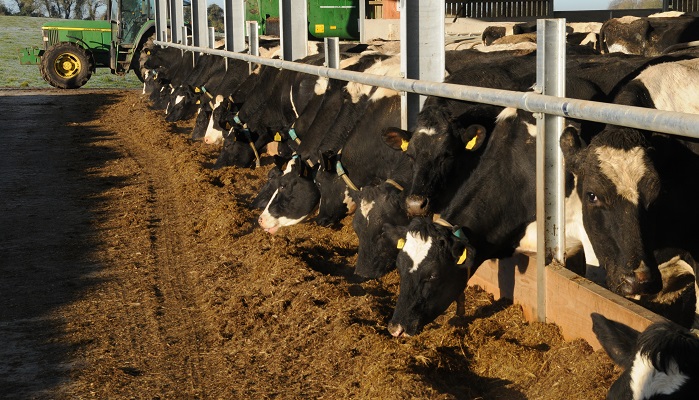
The dry period is a crucial transition in the dairy cow’s production cycle, writes Dairy Advisor in Teagasc Claremorris, Ronan Mulligan, and getting nutrition right during this time is key to health, fertility and performance in the subsequent lactation.
A well-managed dry cow period will help ensure cows calve down at the correct body condition, with optimal mineral status and fewer metabolic issues.
Body condition score (BCS) at calving
One of the primary targets is for cows to calve at a BCS of around 3.25 (on a 1–5 scale) with a recommended acceptable range of about 3.0–3.5. Cows that are too thin (<2.75) will struggle to meet their potential, while over-fat cows (>3.5) are at increased risk of milk fever, ketosis and reduced intake in early lactation. If cows are thin at late lactation or at dry-off, they may need to be dried off earlier or fed a diet that supports a modest BCS gain.
Energy and forage quality
Dry cows require a diet that meets their maintenance needs and supports moderate foetal growth without leading to excessive fat accumulation. For a 600 kg cow housed, the estimated energy (UFL) requirements rise from about 6.4 UFL/day three months pre-calving to 8.1 UFL/day in the last month pre-calving. Silage quality is critical: ideally forage should have good digestibility (e.g., 68 % DMD or higher) so cows can maintain intake and gain condition where needed. Where silage quality is lower, supplementation (e.g., concentrates) may be required, particularly for thin cows or those with only a short dry period.
Minerals and close-up nutrition
Mineral supplementation is essential in the latter part of the dry period (commonly the last 6–8 weeks) to support calcium mobilisation and reduce risks such as milk fever, retained placenta and other transition disorders.
Attention should also be paid to the potassium content of forages; high potassium silages interfere with magnesium and calcium metabolism and elevate risk of metabolic issues therefore action must be taken.
Practical management tactics
Grouping cows by BCS and calving date allows more tailored feeding; late-calving cows often have longer dry periods and may need their feeding managed differently to avoid over-condition.
Frequent assessment of BCS, silage testing, and adjustment of feed allowances are encouraged to ensure targets are reached.
In summary, ensuring cows are at the correct condition, feeding good-quality forage, providing appropriate energy and mineral supply as well as sorting animals into appropriate feeding groups can help improve outcomes at calving as well as reduce metabolic risk and enhance subsequent production and fertility.