
Feeding the freshly calved cow this winter
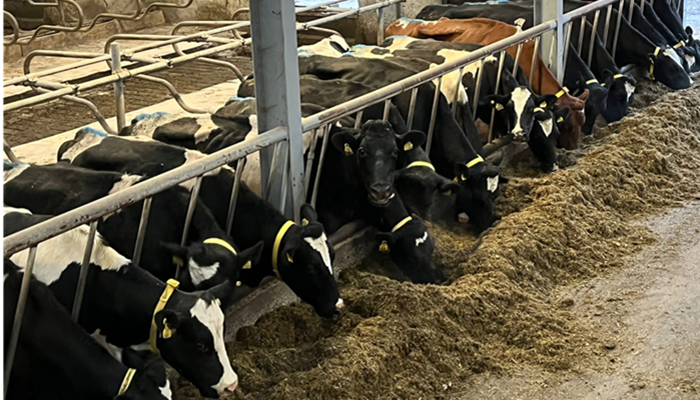
With a lot of winter herds in the middle of calving, Teagasc Dairy Specialist, James Dunne shares advice on feeding strategies to meet the winter feed requirements of these cows.
Concentrate feed is the largest variable cost for winter milk farms. While average cost is around 10.5 -11c/L (cent per litre), there is considerable variation around the average (6.5 to >15c/L). It is important to not lose focus on the economics around feeding the main herd.
When it comes to diet formulation, table 1 outlines what the typical autumn calving cow requires at differing daily milk output levels.
Dry matter intakes of 20-22.5kg are required to meet nutrient demand. Quality forage (75DMD) is essential; target at least 60% of DMI as forage (13 to 14kg per day). The balance of DMI should come as concentrate.
Energy is the first limiting nutrient for milk. Diet UFL per kg is constrained by the need for fibre in diet. Meet the target UFL per kg with high-quality silage and hi-energy concentrates.
Ensure you provide enough total PDI (protein) for target production. To maximise efficiency of energy and protein utilisation for milk production, it is important to match the PDI and UFL ratio of the diet. For example, a diet with 0.94UFL per kg should have 94-97g PDI. A total diet NDF (fibre) target of 30-36% will maintain rumen health and avoid acidosis, 24-28% should come from forage; silage DMD and intake achieved dictate overall diet NDF.
However, excess NDF (>40%) from poor forage sources or straw reduces DMI and milk yield. Use quality digestible fibre sources if forage intake/quality is limited.
Guide meal feeding rates along with good quality silage are included in the table. Note: Forage analysis should be the basis of all diet formulation. Only analysis completed by an FAA approved lab should be used.
Table 1: Requirements for a 600kg cow at 4.1% fat and 3.4% protein
| Milk/day | 25kg | 30kg | 35kg |
| UFL/day | 17.2 | 19.4 | 21.6 |
| PDI g/day | 1,675 | 1,930 | 2,238 |
| UFL / kg DM | 0.90 | 0.94 | 0.97 |
| PDI / kg DM | 90 | 94 | 98 |
| DMI (kg) | 19.1 | 20.7 | 22.5 |
| 75 DMD silage plus guide meal kg (18% high energy conc. equivalent) | 5.0 | 7.5 | 10.0 |
Milk recording
Farmers should check the milk yield distribution for their own herd using winter milk recording data before setting their feeding strategy for the coming winter. Following analysis of milk recording data for a high yielding herd (8,000kg) with 40% of the herd calving in the autumn, figure 1 below shows the milk yield distribution per cow for the months January and February which is typical for herd of this type. The average yield for the herd was 27kg. This high yielding herd has 9% of cows over 35kg.
Figure 1: Milk yield distribution January/February
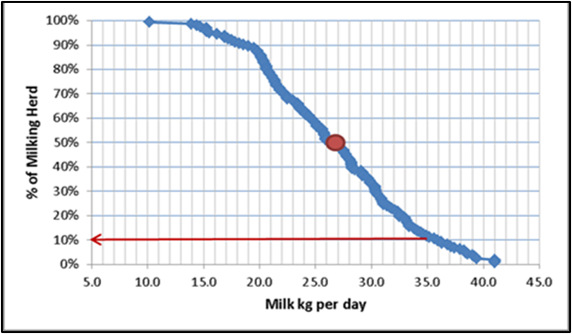
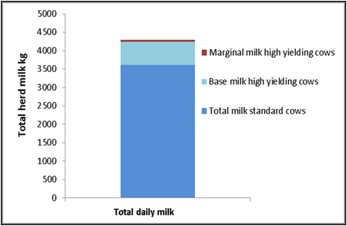
Figure 2 below details the breakdown of total herd milk supplied on a daily basis. The total milk output from the highest yielders accounts for 14% of total output while the marginal milk produced (milk produced >35kg by these cows) equates to 1.2% of daily output. Therefore, 86% of daily milk output comes from the standard base cow within the herd.
Figure 2: Breakdown of total daily milk
The strategy to ensure the best economic return should be to ensure the basis of the diet is formulated to a herd level and not that of the “best” cows based on the herd’s own performance. Individual high yielders can be managed as sub-group thereafter. To control feed costs during winter, concentrate fed per kg milk should be 0.24-0.28kg.