
Fertiliser and slurry decisions
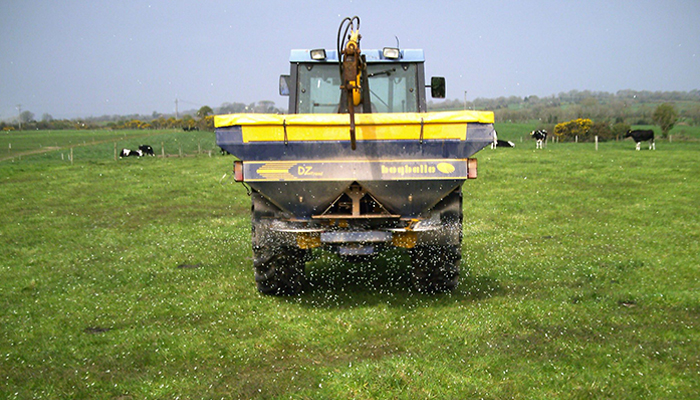
Following the arrival of rain, Dr. David Wall, Head of Enterprise at Teagasc Johnstown Castle, shares advice on managing grassland fertiliser and slurry applications.
The situation on grassland farms varies around the country and so the advice pertaining to fertiliser and slurry applications will differ across farms and even paddocks within the one farm.
For areas most impacted by the drought, where grassland swards browned due to severe soil moisture deficits, it will take approximately 4-5 weeks after rainfall to witness a peak grass growth response. Farms where a ‘green drought’ occurred can expect a recovery in approximately two weeks, provided no overgrazing occurred in the weeks leading up to rainfall.
As flagged by PastureBase Ireland and the Teagasc presentations to the National Fodder and Feed Security Committee, grass growth rates slowed on many farms. A priority now is to ensure rotation length is stretched to Autumn grazing targets (30-35 day rotation and extending) to develop sufficient leaf area to enable grass to recover.
Farmers will be acutely aware that the closed period for chemical nitrogen applications is fast approaching, coming into effect on September 15, but they also need to cognisant of the situation on their own farm in terms of soil moisture deficits, rainfall levels and the potential for grass growth before committing to spread chemical nitrogen (N).
An awareness of soil N mineralisation is also needed, where post drought, higher levels of N are supplied from the soil once it has received moisture. For instance, the requirement to grow up to 35kg DM/ha/day is 1kg N/ha/day and this is available through soil N mineralisation and previous N deposition on soils.
Another variable to consider is the perennial ryegrass grass (PRG) sward’s ability to utilise nitrogen, which corresponds to growth rate. Teagasc research has consistently shown that as we move through the Autumn and grass growth rates decline, the potential fertiliser N demand of the PRG grass plant steps back – with rapid declines being witnessed from October 1 onwards.
Fertiliser applications
Given all the above, farmers making fertiliser decisions over the coming days will likely fall into three categories:
1). Areas unaffected by drought conditions
If your swards have been unaffected by drought conditions, it’s very much a business as usual scenario:
- Apply N early to build autumn covers as normal.
- Extend the grazing rotation to 30-35 + days.
- Empty any remaining slurry in tanks as soon as possible in preparation for housing.
2). Areas affected by a ‘green drought’
Where rain has fallen and grass swards are recovering:
- Consider mineralised N supply (soil N supply) and how this can be utilised first.
- When growth goes above 35 kg DM/ha/day consider spreading ~25kg N/ha.
- This additional 25 kg N/ha will be sufficient to sustain grass growth for ~ 40 days when added to the mineralised N in soil.
3). ‘Brown drought areas’ – little to no rain had fallen
In areas where a ‘brown drought’ occurred, grass swards will take 7-10 days to recover after rainfall. In these areas:
- Fertiliser should not be spread when growth is below 35 kg DM/ha (no demand)
- Do not pre-spread fertiliser. After rainfall arrives, consider spreading up to 15-20 kg N/ha by September 14, providing growth rates exceed 35kg DM/ha/day.
- Utilise slurry and dirty water as an alternative to chemical fertiliser.
Slurry applications
After the prolonged dry spell and the buffer feeding of cows indoors, slurry may have accumulated on some farms. Farmers should plan to have slurry tanks empty by the start of the closed period, which commences on October 1, but preference is to spread slurry early in September rather than late September to ensure better nutrient utilisation.
Where available, slurry and dirty water can be mixed and utilised to replace some of the fertiliser N requirements of farms. This dilute slurry should be applied at lower application rates (≤2,500 gallons/ac) to match grass growth requirements.
Table 1: Nutrients supplied by cattle slurry
| Cattle slurry application rate | N application rate | P application rate | K application rate | ||||
| m3/ha | gallons/ac | kg/ha N | units N/ac | kg/ha P | units/ac | kg/ha K | units/ac |
| 16,500 | 1,500 | 17 | 14 | 9 | 8 | 60 | 48 |
| 22,000 | 2,000 | 23 | 18 | 13 | 10 | 80 | 64 |
| 27,500 | 2,500 | 28 | 23 | 16 | 13 | 100 | 80 |
| 11 m3/ha (1,000 gallons/ac) of dirty water will supply 5-6 kg N/ha (4-5 units N/ac) | |||||||
For more on managing your farm after the dry weather, visit here.