
02 June 2023
Fertiliser for second cut silage
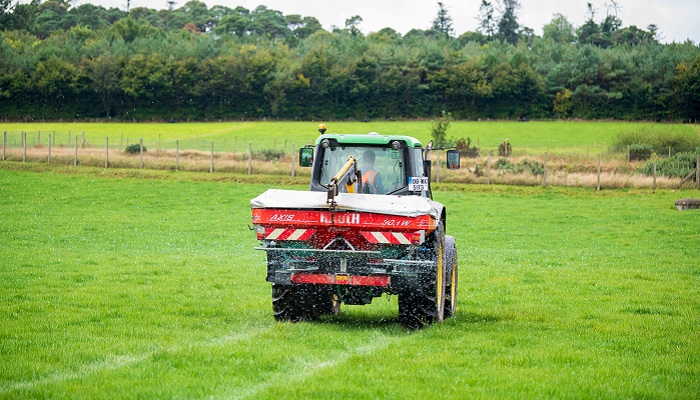
As first cut silage is currently underway or just completed, now is a good time to assess the nutrient requirements to support second cut silage later in the season. Eddie Webb, B&T Soils & Environment Advisor, tells us more.
Lower yields in first cut have been reported, which is mainly attributed to the poor grass growing conditions in spring. Second cut silage crops will tend to be lighter than first cut – ranging from 2.5-3t DM/ha versus approximately 5t DM/ha for second cut.
To maximise second cut, a balanced nutrient supply is essential, with adequate phosphorous (P) and potassium (K) applications. Nitrogen (N) will drive grass growth and yield. It is important to get N application right to support crop growth, while also ensuring you are only applying what is required by the crop. Newly reseeded swards with a high ryegrass content have the potential to utilise the applied N more efficiently.
Much of the phosphorous and potassium requirement for second cut silage can be got from cattle slurry. Low emission slurry spreading (LESS) increases the recovery of N by 3 units/1,000 gallons and reduces N losses as ammonia. LESS delivers slurry nutrients more precisely across the spread width, giving a more targeted nutrient placement.
Table 1: Available N,P,K values for cattle and pig slurry (units/1,000 gallons)
| Manure Type | Application Method | N | P | K |
|---|---|---|---|---|
| Cattle slurry (7% DM) | Splashplate | 3 | 5 | 32 |
| Cattle Slurry (7% DM) | Low Emission | 6 | 5 | 32 |
| Pig slurry (4% DM) | Splashplate | 13 | 7 | 20 |
| Pig slurry (4% DM) | Low Emission | 19 | 7 | 20 |
Second cut silage should be fertilised according to crop yield potential. The table below shows the fertiliser requirements based on a grass dry matter yield of 2-4t DM/ha (3 bales/acre to 6.5 bales/acre). Applying a 18-6-12 compound in the absence of slurry is more likely to result in a potassium deficit, which plays an important role in bulking up the crop.
Table 2: Second cut silage N, P & K Req. (off takes)3,4 Based on Grass Yield & Fertiliser Programmes
| Grass Yield (ton DM/ha)2 |
N kg/ha (units/ac) |
P kg/ha (units/ac) |
K kg/ha (units/ac) |
No slurry1 | Cattle slurry gal/ac |
|---|---|---|---|---|---|
| 2 (4tn/ac fresh grass)5 |
50 (40) | 8 (6) | 50 (40) | 2 bags/ac 15-3-20 | 1,500 gals/ac 1 bags/ac CAN |
| 3 (6tn/ac fresh grass)5 |
75 (60) | 12 (10) | 75 (60) | 3 bags/ac 15-3-20 0.75 bags/ac CAN |
2,000 gals/ac 2 bags/ac CAN |
| 4 (8tn/ac fresh grass)5 |
100 (80) | 16 (13) | 100 (80) | 4 bags/ac 15-3-20 0.75 bags/ac CAN |
2,500 gals/ac 2.75 bags/ac CAN |
1Protected urea can replace CAN as N source. 2Apply 4kg P & 25kg K per tonne of grass dry matter (DM). 3N, P & K advice for crop off takes based on grass DM yield at harvest time. 4Apply additional P & K for soil fertility build after grass harvest refer to Teagasc Green Book for specific rates. 5Fresh grass @ 20% DM.
The importance of sulphur
Sulphur (S) is an important nutrient for grassland production and is closely associated with nitrogen uptake and efficiency. The response to sulphur fertiliser increases with the rate of nitrogen fertiliser applied. S deposition from the atmosphere has gradually decreased due to improvements in air quality in recent decades.
Amino acids are the building blocks of protein and 20 amino acids contribute to the make-up of plant protein, all containing Nitrogen (N). Two of these essential amino acids (methionine and cysteine) contain S and if deficient in soil, it will be the limiting factor in production of plant protein.
Protein is associated with chlorophyll (green pigment giving the colour), which is involved with the plant photosynthesis. Sulphur deficiency has a similar appearance to nitrogen deficiency. In both cases, plants will have a pale green or yellow colour. However, with sulphur deficiency, it is the new leaves that are mostly affected due to the poor mobility of sulphur in the plant. In contrast, n deficiency symptoms are mostly expressed in the oldest leaves, as nitrogen is very mobile.
There is no soil test to determine the level of sulphur in the soil. Sulphur, like nitrogen, is lost through leaching. Sandier, well-drained soils with lower soil organic matter can often be low in sulphur. Poor drained, heavier soils with high organic matter (OM) have less leaching and have greater potential to release sulphur from OM reserves, making it available to meet the demands of crop uptake.
Legumes such as clover have higher S demands than grass and in this case, S is important in nodule formation and N fixation in clover. This needs to be kept in mind considering the increased inclusion of clover in grass swards. It is not recommended to oversupply S, as excess can depress the uptake of selenium (Se) and reduce the absorption of copper (Cu) by animals, causing Cu deficiencies. It is best practice to apply N and S at a ratio of 12:1 over the grazing season from March onwards. For second cut silage grass crops apply 8-15kg S/ha (6-12 units/acre) per cut.