
10 April 2025
Field tasks for winter cereals and spring crops
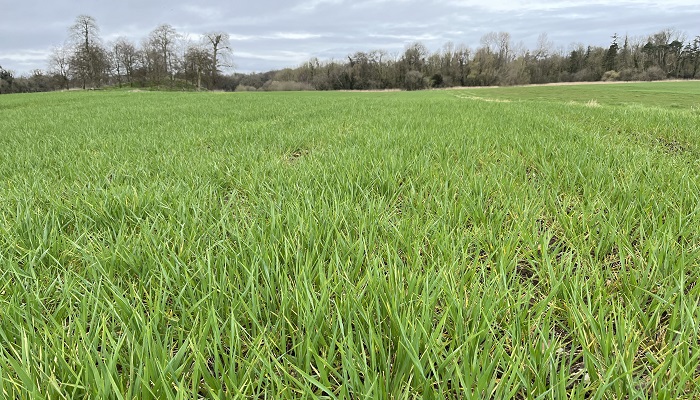
With winter crops moving through growth stages, Crops Specialist at Teagasc, Shay Phelan takes a closer look at the field tasks for the weeks ahead and provides an update on spring crop establishments.
Winter barley
Growth in winter barley has increased in the last few days on the back of some high temperatures, although crops on light soils are starting to suffer from the drought. Most crops are approaching growth stage (GS) 32, with earlier developing varieties like KWS Joyau approaching GS 37. The last application of nitrogen should be on by now as barley doesn’t use nitrogen efficiently post GS 32. Remember crops will be shooting out in about one month’s time and so will need all the nutrients applied to support this growth.
The recent dry weather has kept disease pressure very low in most crops, although there are reports of mildew in Integral. The recent cold nights have made applications of plant growth regulators (PGRs) tricky, so wait until there is no frost forecast before applying one.
Most winter barley crops are on a two-spray fungicide strategy. For most crops, ramularia is the key target disease at this stage and Teagasc trials have shown that the fungicide applied at the awns peeping gives the best result. Applying a fungicide at GS 37 has repeatedly shown little benefit to overall yield, unless you need to control the mildew in the likes of Joyau or Integral.
Winter wheat
Growth in winter barley has increased in the last few days on the back of some high temperatures, although crops on light soils are starting to suffer from the drought. Most crops are approaching growth stage (GS) 32, with earlier developing varieties like KWS Joyau approaching GS 37. The last application of nitrogen should be on by now as barley doesn’t use nitrogen efficiently post GS 32. Remember crops will be shooting out in about one month’s time and so will need all the nutrients applied to support this growth.
The recent dry weather has kept disease pressure very low in most crops, although there are reports of mildew in Integral. The recent cold nights have made applications of plant growth regulators (PGRs) tricky, so wait until there is no frost forecast before applying one.
Most winter barley crops are on a two-spray fungicide strategy. For most crops, ramularia is the key target disease at this stage and Teagasc trials have shown that the fungicide applied at the awns peeping gives the best result. Applying a fungicide at GS 37 has repeatedly shown little benefit to overall yield, unless you need to control the mildew in the likes of Joyau or Integral.
Winter wheat
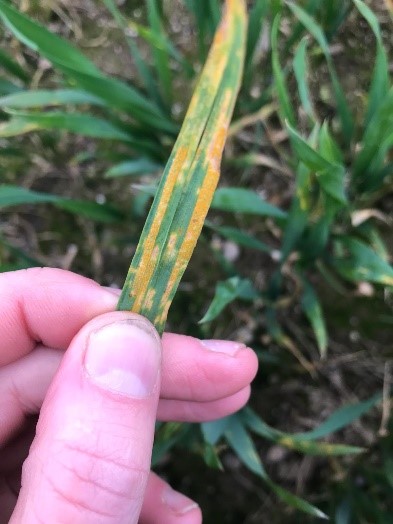
Wheat crops are starting to move through the growth stages quite quickly now. Most crops are at GS 31 and are in need of the main split of nitrogen. Disease levels vary with yellow rust prone varieties starting to show signs of infection, septoria is evident in all crops at various levels.
Crops are in stem extension and so will require a PGR in the coming week, with other jobs like wild oat control also needed in the coming weeks. The addition of a leaf 4 fungicide will depend on whether or not yellow rust is present. For prone varieties, control is generally warranted. Options include Comet + Folpet or Sulphur. Septoria levels are relatively low given the dry conditions. However, in early sown crops in the south, a leaf 4 fungicide application is common which has generally consisted of Folpet or Sulphur.
Figure 1: There are some reports of yellow rust on susceptible varieties
Winter oats
Winter oats have grown considerably over the past 10 days, although some are still a little bit backward. Crops are generally looking well and growth stages range from GS 30 – GS 32. Mildew reports are rare as many would have received Talius plus prothiocoanzole, so crops are still very clean.
Most crops are approaching GS 32 and should get their main growth regulator, options include Ceraide/ K2 1.5 l/ha or Moddus 0.2L/ha + CCC 1.0 L/ha. Teagasc trials show that the GS 32 timing is most effective for shortening in oats.
Spring crops
Planting of spring cereals is practically completed, with only the odd exception here and there. Early sown cereals have emerged at this stage and most have received fertiliser. For most of these crops, the next job will be weed control. There are plenty of options for each crop with most crops receiving a mixture of an SU product, e.g. Cameo Max etc., and a mixer product, e.g. Galaxy. Conditions at the moment are dry so wait until there is rain before applying a herbicide, as there will be a flush of weeds afterwards.
Early drilled crops shouldn’t need an insecticide as BYDV risk is usually lower in March drilled crops except where there may have been with volunteer cereals growing over the winter.
Table 1: BYDV risk and control strategies
| Control actions | ||
|---|---|---|
| Sowing date | BYDV Risk | Control Action |
| Before end March |
Low Low risk except for very high pressure areas (coastal, etc) |
Not needed |
| Early April |
Low-moderate Low-moderate risk except for very high pressure areas (coastal, etc) |
+/- Pyrethroid at 3-4 leaf stage |
| From mid April |
Moderate-high Monitor pest numbers in field |
Pyrethroid at 3-4 leaf stage |
Beans have emerged well over the past week but will need to be monitored for bean weevil damage over the coming weeks. Where damage is evident, consider using a pyrethroid insecticide but only if it is warranted.
Tillage Edge Podcast
With crop inputs being applied weekly, farmers and agronomists face constant decisions around product choice, application timing and overall strategy.
For this episode of The Tillage Edge, Denis Dunne, Trials Manager at Seedtech, joins Michael Hennessy to discuss how he uses the Teagasc Crop Report as a vital tool — not just for daily agronomy decisions, but also to inform strategies for weed and disease control.
Listen in below: