
24 December 2022
Finding a suitable soil moisture range for safe field operations in grassland
Soil compaction is one of the most serious threats to soil productivity by increasing bulk density, decreasing the number and dimension of pore space and decreasing rhizosphere development.
Water content at time of trafficking impacts the level of compaction. About 33Mha of the European agricultural lands are severely compacted due to increased weight of modern agricultural machinery and traffic in wet conditions.
Soil moisture content is a good indicator of soil vulnerability to compaction. However, it is challenging to predict field moisture content accurately, thus hampering pasture management decisions in short to medium timescales.
Heavy machinery and cultivation equipment can cause smearing if soils are wet. This effectively creates a cemented or sealed layer which restricts water, air and roots.
The deeper this happens the more difficult it is to remedy. Most of compaction by trafficking happens in the first 0-20 cm; however, for example, ploughing in wet conditions may cause smearing at the bottom of the plough furrow creating a “pan” at 20 to 25 cm depth.
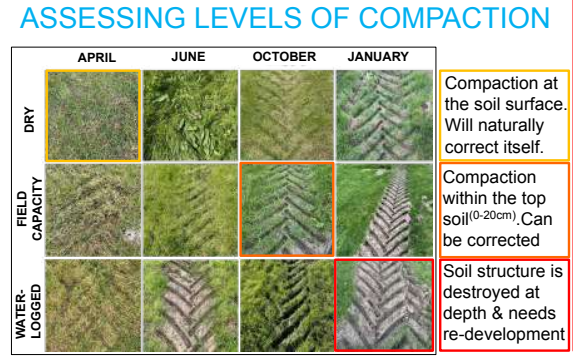
The identification of a threshold range of soil moisture content for safe field operations can improve management decision in short and medium timescales and prevent compaction.
Tips to avoid compaction:
- Trafficking close to a rainfall event makes the soil prone to irreversible compaction;
- Field traffic is safe from irreversible compaction when it occurs one or two days after a rainfall event, depending on the rainfall intensity;
- Soil moisture ranging from 36-42% can be considered as the limit to avoid loss of soil structure during field operations.
When is it suitable to travel with heavy machinery on soils?
- Soil compaction on intensive managed temperate grassland soils is a major threat to soil health, nutrient efficiency and grass yield.
- Machinery trafficking of wet soils results in higher risk of soil structural damage.
- Identification of suitable soil moisture conditions for safe field operations will inform better management decisions to prevent soil compaction from occurring.
Key messages
- With soil compaction – ‘protection is better than cure’.
- Avoid trafficking soils that are saturated >35 % MC.
- Highest risk of long-term compaction in early spring (Jan-Mar).
- Leave 4-5 days for soils to dry out after rainfall in early spring and autumn.
- Leave 2-3 days for soils to dry-out after heavy rainfall in late spring and early autumn.
By: Emanuela Lepore, Giulia Bondi, Owen Fenton, David Wall, Teagasc Johnstown Castle. This paper was originally published in the Farming for a Better Future – Technolgies for Today and Tomorrow – Teagasc Johnstown Castle Open Day.