
Five Top Tips to Protect Water Quality This September
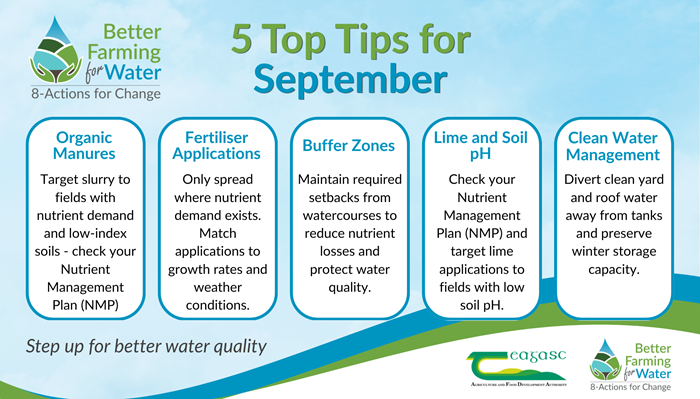
September provides an excellent opportunity to improve nutrient use efficiency while protecting water quality. Here, the Teagasc Better Farming for Water Campaign share five practical steps farmers can take to protect local waterways while making the most of valuable nutrients.
September marks an important transition period on Irish farms. Fertiliser deadlines are approaching, slurry closed periods are only weeks away and many farmers will be making final nutrient applications before autumn and winter take hold. The actions taken over the coming weeks will have a significant impact on both nutrient use efficiency (NUE) and water quality. Here are five practical steps farmers can take this month to protect local waterways while making the most of valuable nutrients.
1. Slurry and Organic Manures
The closed period for the application of slurry and other organic fertilisers (excluding farmyard manure and soiled water) begins on October 1st, making September the final opportunity for many farmers to utilise these valuable nutrients. Farmyard manure may continue to be applied during October, while soiled water application is generally permitted up to the end of November, provided conditions remain suitable and applications comply with the requirements outlined in the latest Good Agricultural Practice for Protection of Waters (GAP) Regulations.
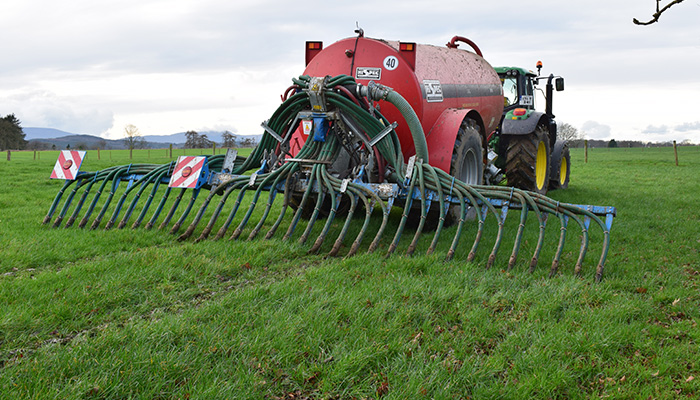
In September, target slurry applications to fields with a nutrient requirement. Low-index soils (identified through your Nutrient Management Plan), recently grazed paddocks and silage ground often provide the greatest return from organic manures, both economically and environmentally. Use Low Emission Slurry Spreading (LESS) equipment to maximise nutrient recovery and improve NUE.
As always, avoid spreading where heavy rainfall is forecast, on waterlogged ground or where there is a risk of surface runoff. The objective should be to maximise nutrient uptake by the plant while minimising the potential for nutrient losses to water.
2. Fertiliser Applications
With the closed period for chemical fertiliser commencing on September 15th, now is the time to carefully assess nutrient requirements rather than simply applying fertiliser because a deadline is approaching. Any nutrients should only be applied where there is a genuine crop or grass demand and where suitable weather and ground conditions exist.
Following the recent drought conditions experienced in many parts of the country, soil temperatures remain relatively high and there is considerable potential for nitrogen mineralisation from soil organic matter. However, conditions remain highly variable between farms, soil types and regions. Decisions on nutrient applications should always be based on local grass or crop demand, weather forecasts, soil fertility and prevailing ground conditions.
This natural release of nitrogen can contribute significantly to crop and grass growth during September and should be considered before applying additional fertiliser. Where grass growth rates are above 35 kg DM/ha/day, farmers may consider applying up to 25 kg N/ha (20 units N/acre) before the 15 September deadline. Where growth rates are lower, applications of approximately 15 kg N/ha (12 units N/acre) should be considered. In all cases, applications should be tailored to the needs of the individual farm, weather conditions and expected grass demand. Excessive applications at this stage of the year will not be used efficiently and increase the risk of nutrient losses later in the autumn and winter period.
3. Buffer Zones Around Watercourses
Buffer zones remain one of the most effective measures available to protect water quality.
Key setback distances outlined in the GAP Regulations include:
- 3 metres from surface waters for chemical fertiliser applications
- 5 metres from surface waters for slurry, soiled water and other organic fertilisers
- 10 metres from surface waters where land slopes greater than 10% towards a watercourse
- 20 metres from lake shorelines and turloughs likely to flood
Farmers should also remember that the setback distance for organic fertilisers and soiled water increases from 5 metres to 10 metres during the two weeks before the commencement of the relevant closed period and remains at 10 metres for the first two weeks after the closed period reopens. Before spreading any nutrient source, identify nearby streams, drains, rivers and lakes. Maintaining these setbacks will reduce the risk of nutrients reaching watercourses.
4. Autumn is the Ideal Time to Spread Lime
Correcting soil pH is the first step in improving soil fertility, and autumn is often the ideal time to spread lime. Lime is one of the most cost-effective inputs available to Irish farmers. Correcting soil acidity improves the availability of phosphorus, potassium and nitrogen already present in the soil and can significantly improve NUE. This allows crops and grassland to make better use of nutrients already in the soil and helps reduce the need for fertiliser inputs over time.
Where soil test results indicate a lime requirement, consider targeting grazed-out paddocks or recent silage ground this autumn. Farmers should also take the opportunity to revisit their Nutrient Management Plan (NMP) lime recommendations. The NMP will help identify fields requiring lime, estimate application requirements and help prioritise those areas where improving soil pH will deliver the greatest return. A ‘little and often’ approach, where fields are limed regularly over several years, can be easier to manage than attempting to correct all deficiencies in a single season. Improved soil pH also supports stronger root development, improved nutrient uptake and healthier soil biology.
5. Clean Water – Keep it Clean
One of the simplest actions farmers can take to improve water quality is to keep clean water from becoming contaminated in the first place. In autumn, heavier rainfall events become more likely, making now the ideal time to check gutters, downpipes and drainage systems around the farmyard. The National Agricultural Inspection Programme (NAIP), which is carried out by local authorities across the country, continues to identify issues relating to clean and dirty water separation, roof water management and soiled water generation on farms. Ensuring clean roof water is diverted away from slurry, soiled water and effluent storage facilities can significantly reduce runoff of contaminated water and storage requirements over the winter period.
It is also worth checking yards, roadways and drainage channels for potential runoff pathways. Heavy downpours can create pulses of sediment, nutrients and organic matter that move rapidly towards nearby drains and watercourses. Addressing these issues now can help reduce losses throughout the winter period. Separating clean and dirty water reduces storage requirements and improves nutrient management flexibility.
Protecting Water Quality This September
September provides an excellent opportunity to improve nutrient use efficiency while protecting water quality. Careful management of slurry, fertiliser, buffer zones, soil pH and farmyard drainage can help maximise the value of nutrients already on the farm while reducing losses to the environment. Small actions taken now can deliver significant benefits for farm performance, nutrient efficiency and water quality throughout the autumn and winter months.
For more on the Teagasc Better Farming for Water Campaign, visit here.