
Flexible grazing paying dividends in a wet spring
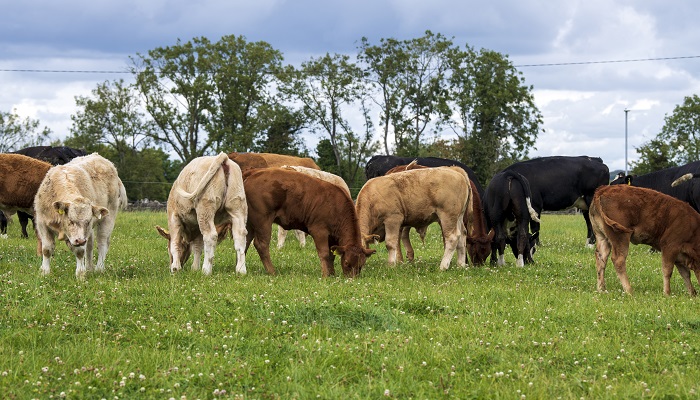
John Kilboyle highlights how record rainfall levels have made it difficult to get cattle out grazing, and outlines management strategies to maintain grass-based beef systems under these challenging conditions.
Athenry weather station recorded 114.9 mm of rainfall in January and 125.5 mm in February, a total of 240 mm, which is 90 mm more compared to 2025. So it has been very difficult. At a Drystock Grass workshop held on the farm of Brian Audley near Headford, farmers discussed the challenges that the rainfall has caused.
Brian operates a dairy calf-to-beef system, with 70 reared calves bought in annually and brought through to finish. Up to 3–4 years ago, Brian was buying 40–50 calves per year, which were finished at 30 months with an average carcass weight of 320 kg. Last year, 70% were finished under 22 months, and all were finished under 26 months, with an average carcass weight of 310 kg. Brian has placed huge emphasis in recent years on improving performance at grass and has increased the number of paddocks from 8 to 23 on the farm. This has been possible through investment in extra water troughs placed in locations that enable paddocks to be split with reels and pigtail posts. Brian measures grass weekly on Pasturebase Ireland, which has allowed him to increase grass quality and also make better quality silage, with 50% of the silage harvested coming in the form of surplus bales. Silage quality used to be in the mid-60s DMD; last year it was 74 DMD, significantly reducing concentrates being fed to weanlings over the winter while maximising animal performance, with weanlings achieving 0.75 kg ADG last winter.
At the recent workshop, Brian had 70 weanlings turned out to grass, which resulted in significant savings in feed costs:
12 bales of silage saved per week (€40 per bale) = €480
1.5 kg meal per head avoided (€350/t) = €260
When valued at 7c/kg DM, the cost of grass to feed 70 weanlings was €240 per week, meaning Brian was making a €500/week saving at grass versus in the shed. That’s before factoring in the additional weight gain being achieved with animals out grazing.
The weanlings were turned out on 24th February on low to medium covers on the grazing ground. A group of cattle also grazed on the silage ground before both groups were joined together. They were rehoused again from 12th–19th March due to poor weather and grazing conditions before being turned out again. Brian has a very flexible approach to grazing. As Brian works off-farm, labour management is very important. The whole farm was blanket-spread with half a bag of Protected Urea 38% + S on 9th March. The silage ground was grazed, and 2,000 gallons/acre of slurry was applied, with 1.5 bags/acre of Protected Urea 38% + S to also be applied to silage ground before closing. The plan is to harvest in mid-May.
Soil fertility on the farm has also been a huge focus in recent years. In 2023, the whole farm received 2 t/ac of lime to increase pH. This has led to no lime requirement on the farm currently.
Spring is a great time to check soil test results and calculate farm lime requirements. Where there is a requirement on farm for lime, it is important to put plans in place to organise lime delivery and apply lime over the coming weeks/months at opportune times. Lime can be spread any day of the year, provided soil and weather conditions are suitable—on grazing ground and after silage is harvested for the year. Lime can improve the productivity of our soils and the health of livestock, while increasing farm sustainability and profitability for a small investment.
Additional potassium (K) has been targeted to silage ground to build K indexes through the use of 0-0-50 (MOP). It is also applied on paddocks where surplus silage bales have been taken off to replace offtakes. Slurry is a very important asset on Brian’s farm. Making best use of the nitrogen, phosphorus and potassium within it is important for reducing chemical N use and reducing costs. A typical 6% DM slurry comprises 6-5-32 (N-P-K) per 1,000 gallons.
The production of one tonne of grass DM requires 4 kg of phosphorus and 25 kg of potassium. Hence, slurry is targeted to the silage ground on the farm to grow a good crop of silage that can be harvested in mid-May.