
Flock management tips up to and during mating
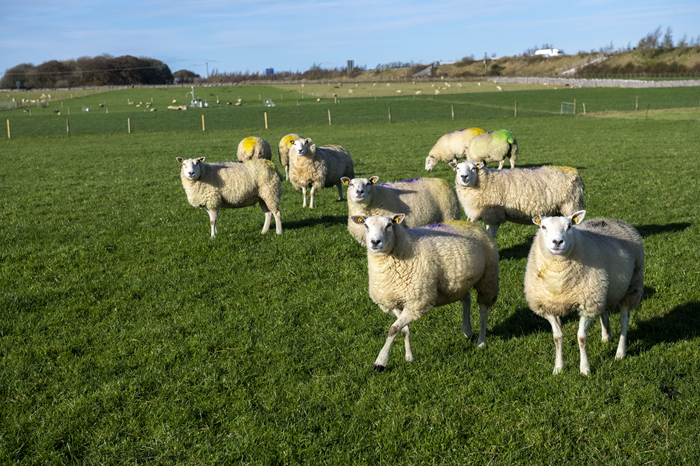
The management of the flock over the coming weeks and months will determine next season’s lamb crop. In this article, Teagasc Sheep Specialist, Damian Costello looks at practical management tips for a successful breeding season.
Focus on Body Condition Score (BCS)
For lowland flocks, the aim is to have ewes at least Body Condition Score (BCS) 3 and ideally BCS 3.5 at mating. This is usually achieved on good grass with thinner ewes (BCS 2.5 or less) taking 8 to 10 weeks to achieve this target.
On farms where grass supply was hit by drought this year, building body condition on ewes has been more challenging than usual. Supplementary silage/hay and concentrate feeding was needed in extreme cases, but thankfully grass supply is now turning a corner on most farms.
It may be necessary to continue supplementation until enough grass is built up to carry the flock through the breeding season. In this situation, concentrate supplementation for the thin ewe group could be justified at a rate of 0.5kg/head/day to build condition in the short time left pre-breeding.
Rams also need to be in good condition at turnout (BCS 3.5 to 4.0) for two reasons:
- They eat very little during the mating season and can lose up to 20% of their bodyweight
- Thin rams tend to have lower libido and are less inclined to seek out ewes to mate
Complete routine health treatments
Carry out any routine treatments before ram turnout to ensure minimal flock disturbance during mating e.g. fluke treatment, footbathing etc.
Try to have lameness under control prior to mating and continue to monitor during mating so that individual cases can be treated.
After fertilisation, you are looking to give the embryo every chance of survival and successfully attaching to uterus. After ram turnout, avoid things like excessive handling, dipping or sudden changes in diet.
It is important to monitor the health of rams in the run up to mating and have sourced any replacement rams in good time. Sperm production in the ram takes five to seven weeks. This means that a ram mating ewes in mid-October will have started producing that sperm at the end of August / or start of September. Anything that interferes with sperm production in the run up to mating can have disastrous effects on the ram’s ability to impregnate ewes.
Any infection that increases the ram’s body temperature by as little as 0.5˚C for 24 hours can render a ram temporarily infertile. A spare ram is no harm as a replacement for any ram that may get lame or is unable to function for any other reason.
Planning for adequate homebred ewe replacements
When breeding your own homebred ewe replacements, a common mistake is not mating sufficient ewes with your maternal rams.
The current weaning rate of your flock will determine what proportion of the ewe flock that needs to be mated to a maternal ram to produce enough replacements. Table 1 below outlines this based on a 23% replacement rate. These calculations assume that about 50% of lambs reared will be female and are minimum figures which allows for very little further selection. It is advisable to increase the proportion of ewes mated to maternal rams to give you more ewe lambs to choose from as well, allowing for stricter culling of underperforming ewes.
Table 1 Lowland Flocks – Minimum % ewes bred to a maternal sire based on current weaning rate to achieve 23% replacement rate
| Number of lambs reared per ewe joined | Percentage of ewes required to produce ewe replacements |
| 1.1 | 47 |
| 1.3 | 39 |
| 1.5 | 34 |
| 1.7 | 30 |
| 1.9 | 27 |
Ewe:Ram Ratio
As a guide to number of ewes per ram:
- 1 mature ram to 45 ewes (up to 70 ewes more active ram breeds)
- 1 ram lamb 1 to 25 (up to 40 for more active ram breeds)
Ram group mating vs single sire mating
Turning out a number of rams to each group of ewes can help ensure against the ram in the team that may be infertile or sub fertile.
Ideally use three or more rams together per group of ewes. This eliminates the effect of the blocker ram – where two rams are run together and the dominant one of them spends a lot of time and energy stopping his comrade from mating.
Finally, with groups of rams, don’t mix mature rams and ram lambs if possible. With single sire mating or one ram per group, it’s all the more important to raddle your rams. With one ram per group, it’s a good idea, where possible, to rotate rams between groups after 14 days.
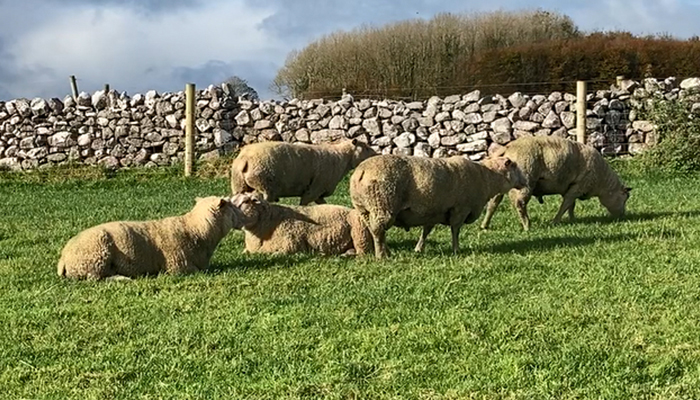
Raddling the ram
Do not to skip this very important task even if running rams in groups as opposed to single sire mating. Start with lighter colours which can be overmarked by a darker colour e.g. (yellow to orange to green to red to blue to black) and change the colour at least every 14 days, which will show repeats in the new colour. If a lot of ewes start repeating, suspect that there is a problem with a ram. There is still time to do something about it, much better than finding a lot of empty ewes at scanning.
Options for raddling
Many people mix raddle powder with oil to make a paste and apply liberally to the area of wool just above the brisket of the ram. It’s important to work the raddle paste well into wool and reapply every few days, especially during the first few weeks when rams are busy. Some rub on raddle crayon to this area and again it needs to be applied regularly.
The other option is fitting a harness to the ram to which the colour crayon can be attached – the crayon block can be replaced when changing colours. It is important to check that the harness stays in place as they tend to stretch and can bed into the wool, therefore it needs to be checked and adjusted as necessary. Avoid having it slipping back on ram as it can potentially impede him from mating ewes.