
Fly control guidance
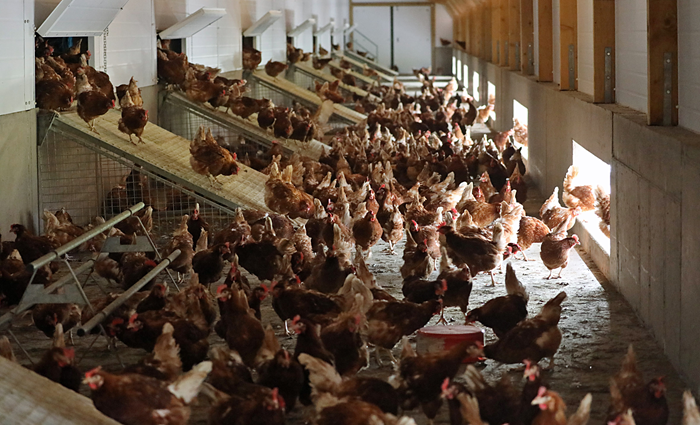
Managing the fly population is vital all year round, as fly infestations can pose significant challenges for poultry farmers, Joanne McStraw, Division Lead – Agrihealth Advanced Animal Care shares some key guidance.
Poultry manure is the ideal medium for fly reproduction. Flies can transmit both human and animal diseases such as Salmonella, Campylobacter, Brachyspira and E. coli. They can also impact production by causing stress in birds resulting in weight loss or reduce egg production.
Did you know: a female fly can lay up to 500 eggs in several batches of 75 to 150 eggs over a 3-4 day period.
There are two types of flies:
- Non-Biting Flies (e.g. Common House Fly / Lesser House Fly)
- They can transmit diseases, are vectors for many pathogens; spreading viruses, worms and more,
- Flies are one of the key carriers of salmonella, they can spread bacteria from unit to unit or from farm to farm.
- Biting Flies (e.g. Stable Fly)
- They feed on blood, they can cause anaemia and loss of condition in farm animals and animals may develop a hypersensitivity to the saliva of the biting flies which can result in a painful skin condition.
The lifecycle of a fly
Did you know that the lifecycle of flies is dependent on temperature? Flies can reproduce year-round in warm conditions, but their life cycle becomes shorter as the temperature increases. The life cycle takes 50 days from egg laying to adult at 16°c. This decreases to 16 days at 25°c and 7 days at 35°c – making summer more of a risk as there are a higher number of fly lifecycles.
- Egg laying: Female flies deposit hundreds of eggs in rotting organic matter such as rubbish, manure, and leftover food.
- Larval stage: Maggots hatch from the eggs and feed voraciously on decaying material, aiding in its decomposition.
- Pupal stage: Maggots transform into pupae within protective casings called puparium, undergoing metamorphosis into adult flies over days to weeks.
- Emergence: Adult flies emerge from the pupal casing, embarking on a short-lived journey focused on breeding and feeding on waste and food materials. Their lifespan typically ranges from a few days to a few months.
Types of insecticides
Larvicides
Larvicides are employed to manage fly larvae, as only about 15% of the overall fly population consists of adult flies at any given time. Implementing an integrated fly control approach is crucial on farms to effectively manage fly populations.
Relying solely on adulticides can lead to rapid reinfestation of buildings by eggs, maggots, and pupae.
Normally larvicides contain Insect Growth Regulators. These substances disrupt the development of larvae into adult flies, thereby interrupting their life cycle.
Flies such as common, lesser, and stable flies lay their eggs in organic matter.
After hatching, the larvae reside in the upper 4 inches of waste material. It’s vital for larvicides to be present in this layer to effectively control the larvae. In livestock housing environments where waste accumulates, it’s essential to reapply larvicide before an additional 4 inches of waste accumulates.
Larvae spend the first 3 stages in the warmth of a group below the surface of the muck then make their way to the surface and seek a dry place to pupate before emerging as a fly.
Flies are clever and will avoid laying in treated muck if there is an untreated area. It’s important to treat all areas!
Adulticides
These are substances or products designed to control the adult fly population.
Forms of Adulticides: Traps, aerosols, fogging liquids, ready-to-use trigger sprays, wettable powders, granules
Types of actives:
- Knockdown: These substances kill flies on contact but do not have a lasting effect. They act immediately but may not provide ongoing control.
- Residual: These leave a residue on surfaces, which continues to kill flies when they come into contact with it or ingest it. Residual adulticides provide longer-term control.
Importance of reading labels
Each active ingredient and formulation has specific instructions regarding its suitable usage areas, spaces, and surfaces. Reading the label ensures effective and safe application of the adulticide product.
Successful fly control – on-farm 7 step guide
- Monitor fly activity using sticky traps, fly reel kits and fly bags before and during warmer months. Keep a record of numbers and locations – this will also help build a history for future reference.
- Identify the fly Common, Lesser or Horse Fly etc. to determine treatment
- Larvicide Kill larvae stage (80% of life cycle) in breeding areas such as manure heaps, slurry pits, straw bedding areas.
- Adulticide Kill adult flies (20% of life cycle) using baits, sprays, wettable Kill migrating flies and those already present.
- Monitor fly activity and repeat the process.
- Alternate between insecticides every few months where possible. It prevents the insect using its natural defences to overcome active ingredients and reduces resistance.
- Always follow the product labels!
Effective fly control is essential in maintaining good biosecurity and maximising production.