
Forage crops: Correct practices when grazing
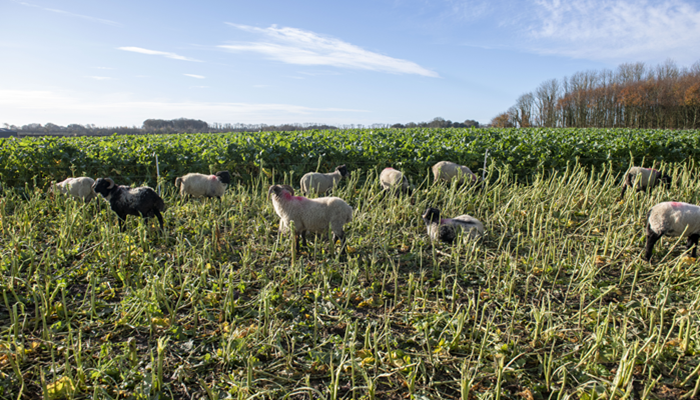
Frank Campion, researcher at Teagasc Athenry, focuses on forage crops and the management practices farmers need to implement in terms of gradual introduction, utilisation and grazing strategies.
As we move into the winter months, some farms will be starting to graze forage brassica crops with either ewes or lambs. These crops can provide good levels of animal performance during the winter months from a comparatively cheap forage compared to the other options at this time of year.
However, as with any forage, they do require management to ensure good animal performance is achieved. Firstly, careful attention needs to be paid to the GAEC guidelines for grazing forage crops to ensure compliance. Areas such as the correct lie back space (at least 30% of grazing area) and buffer zones will need to be planned in advance of any grazing.
Gradual introduction
When starting to graze the crops, sheep need to be introduced to forage brassicas gradually. Forage brassicas are highly digestible and can cause digestive issues if introduced to the diet too quickly.
Sheep should be introduced to brassicas for 1-2 hours initially and then built up to full-time access over time. A key component of dietary management when grazing these crops is that sheep always have access to clean water and an additional forage source i.e. a grass run back.
Maximising utilisation
In the studies carried out by Teagasc, lambs receive either two- or four-day allocations of forage brassica, to try to maximise the utilisation of the crop and the performance of the lambs.
Further studies are ongoing looking at different grazing lengths and post-grazing utilisations to assess how these impact on lamb performance.
In commercial practice, the length of time lambs spend grazing a particular area will vary between farms, but it is important that sheep are not left grazing the one area for too long.
Sheep will selectively graze the leaves of the crops first, followed by the soft stem and eventually the harder stem, with the highest nutritional benefit to the lamb coming from the leaf.
By moving the sheep regularly, they are getting more regular access to the leaf of the plant, spending less time grazing the harder to graze and lower nutritional value parts of the forage.
It is still important that lambs be allowed to graze some of the stem, which will improve utilisation and increase grazing days on the crop, but also ensures they are getting a balance of fibre from the plant.
Grazing strategies
When deciding on grazing strategies for these crops, measuring the yield of the crop and calculating the available dry matter yield is essential.
The area of crop offered should be based on the number of sheep grazing, the yield of the crop and the approximate dry matter (to calculate DM yield). Feed intake for this calculation should be calculated based on 3-4% of body weight.
When splitting the crops into sections for grazing management, electric polywire is generally the best option as it can be easily moved and managed.
For sheep, 3-4 strands of wire will be necessary along with ensuring there is sufficient power in the fence.
In most crops, this will require either cutting or pushing the crop down along where the wire will be so that the crop is not earthing the wire which will significantly reduce the power in the fence.
Health and other considerations
If the crop is frozen, sheep should not be allowed into a new/fresh section of crop until it has thawed. Forage brassicas are also low in key trace elements and contain goitrogens meaning a mineral supplementation (bolus where possible) with high iodine plus cobalt and selenium should be provided before turnout.
While grazing animal health should be carefully managed, it is important that prior to introducing sheep to grazing forage brassicas that any lameness issues are dealt with. While grazing the crop, any lameness cases should be treated quickly.
For finishing lambs, it is also important that lambs are clean and compliant with clean livestock policy before drafting for slaughter.