
29 September 2023
From the shades to the high canopies: The potential of western hemlock in Irish Forestry
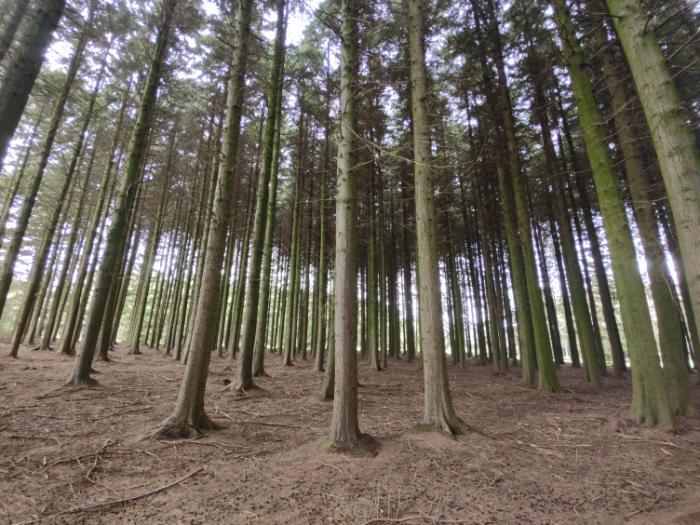
Western hemlock is a known shade bearer species with a high capacity to regenerate naturally. Thus, it represents an alternative to diversify our forests while keeping good production rates.
From the seed origin choice to additional options western hemlock provides in silviculture, Dr. Bruna L. Longo and Dr. Niall Farrelly present western hemlock and its characteristics in more detail.
Native range and adaptability
Western hemlock (Tsuga heterophylla (Ref.) Sarg.), also known as Pacific hemlock or Coastal hemlock, is naturally found along the west coast of North America, stretching in a similar region to Sitka spruce. Ireland is located on the same latitude as mid British Columbia (Figure 1), showing similarities to the climate of parts of western hemlock natural range, from north of Vancouver Island (corresponding to south Cork) to around Dundas Island (corresponding to north Donegal). While Ireland’s climate shows similarities with the Pacific Northwest region, the species show a much greater distribution of climate types, occurring from Alaska to California and inward into the Rocky Mountains. Due to its adaptability to a wide range of environmental conditions, western hemlock is an attractive choice for Irish forestry.
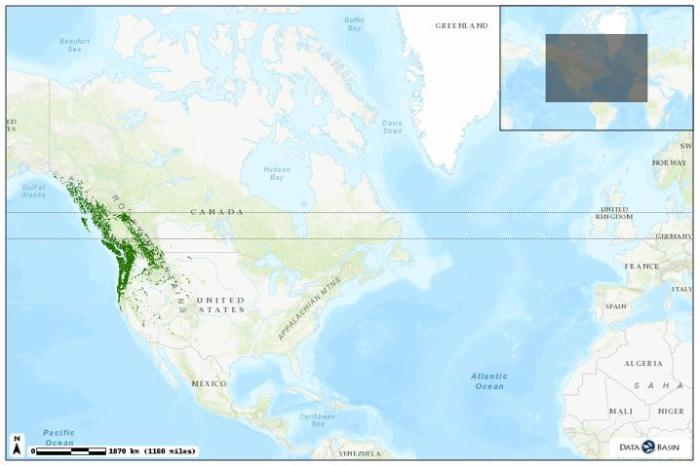
Figure 1. Natural distribution of western hemlock in the Pacific Northwest region in North America (highlighted in dark green). Dotted lines indicate the approximate latitude range of Ireland and its correspondent range in the species natural occurrence area. Source: Mathys et al. (2014).
Site suitability
While the species can grow on a range of soils in Ireland, best development is on well-drained, moist soils with a pH range of 4.5 to 6.3. The species should be planted in sheltered locations, while frost prone areas and clay-rich soils should be avoided. In Ireland, there are areas of western hemlock performing well on well drained soils, e.g. Avondale Forest Park, JFK Arboretum (Figure 2), and Slieve Bloom Mountains, where the species can produce commercial assortments in a similar time frame to Sitka spruce. The species, like Douglas-fir and broadleaved species, is susceptible to browsing from deer, therefore adequate protection in the form of fencing is recommended.
Figure 2. Western hemlock stand in JFK Arboretum, Co. Wexford. Photo: Bruna L. Longo.
Performance and growth rates
Western hemlock is renowned for high growth rates, making it a suitable plantation species for timber production. In some instances, it can outperform Sitka Spruce in terms of early growth. When managed optimally, mature western hemlock crops can yield between 12 to 24 m3/ha.year. The average yield class in Ireland is approximately 18 m3/ha.year.
Selecting the right seed origin
The selection of seed origin plays a pivotal role in the success of western hemlock cultivation. Provenances from southern Alaska and British Columbia have shown greater frost resistance. The Council for Forest Research and Development in Ireland (COFORD) have recommended using provenances from Washington State’s Puget Sound region, the coastal ranges, and the Cascade Mountains of Washington and Oregon, which have all show promise. However, it may be worth considering Irish and British stands as potential seed sources. Thoughtful selection of seed origin can influence the change of successful establishment and the production of quality timber.
Suitability to Management Systems
Western hemlock is an adaptable species. Being shade tolerant makes it a versatile choice for various management systems. It introduces structural diversity to ongoing projects, as it grows in the understory quite happily. In fact, its capacity to thrive in the understory and its natural regeneration abilities provide support for emerging seedlings in continuous cover forest management. Western hemlock can play a valuable role in mixed-species forests, as it grows well with Sitka spruce and other conifers from the Pacific North west of America (e.g. Douglas-fir, Pacific silver fir, western red cedar, among others). Therefore, under the right conditions of soil and shelter, western hemlock offers an alternative to pursue and diversify productive forestry.
Timber Properties and Utilization
The timber of western hemlock possesses desirable qualities for various applications. It is typically pale to light brown in colour with fine to medium-grained texture, making it easy to work with. Showing good mechanical properties, timber from stands in Great Britain showed a high yield of class C18 timber for structural uses (Gil-Moreno et al. 2016). Western hemlock properties render it suitable for interior joinery, furniture production, plywood manufacturing, and construction purposes. However, it’s important to note that western hemlock is not naturally durable against outdoor exposure. To harness its full potential in outdoor applications, consider treatment with preservatives.
Practical Considerations
Western hemlock offers adaptability, impressive growth rates, versatile wood properties, and has a potential role to play in Irish forestry. However, before embarking on western hemlock cultivation, there are practical considerations to keep in mind:
- Site Assessment: Conduct a thorough assessment of your site’s soil type, drainage, and exposure to determine its suitability for western hemlock. Avoid poorly drained, heavy clay soils and utilise in sheltered locations.
- Seed sources: Source plants from nurseries. Use Irish sources and give preference to Washington State’s Puget Sound region, the coastal ranges, and the Cascade Mountains of Washington and Oregon.
- Planting and Care: Follow best practices for planting and initial care, including spacing and protection from browsing animals. Deer fencing is essential to limit browsing.
- Thinning and Pruning: Implement appropriate thinning and pruning practices as your plantation matures to optimize timber quality and growth. As the species grows at similar rate to Sitka spruce, following similar guidelines to the management of Sitka spruce would be prudent.
References
Gil-Moreno, D., Ridley-Ellis, D., McLean, P. 2016. Timber properties of noble fir, Norway spruce, western red cedar and western hemlock grown in Great Britain. Research Note FCRN026. Forestry Commission.
Mathys, A., Coops, N.C. and Waring, R.H. 2014. Soil water availability effects on the distribution of 20 tree species in western North America. Forest Ecology and Management 313: 144-152.
Funding
This work has been conducted as part of the DAFM funded FitForests project (2019R511).