
Fungicides and PGRs on winter wheat and barley
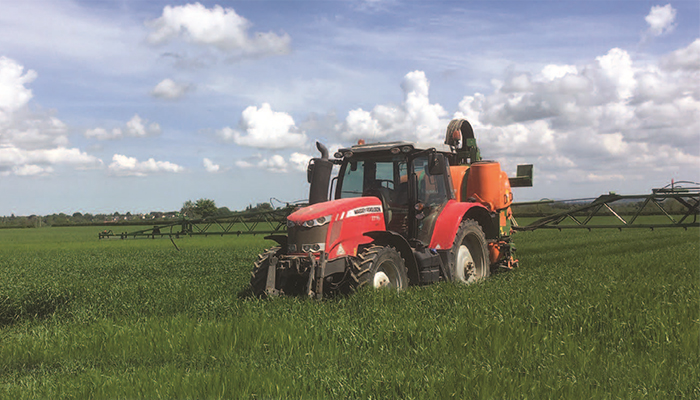
Crops Specialist at Teagasc, Shay Phelan reminds us of the importance of timing when it comes to fungicide and PGR applications on winter wheat and barley crops.
Winter wheat crops are currently progressing through stem extension, with most crops ranging between GS31 and GS32. However, there is considerable variation in crop development, particularly when assessed by leaf emergence.
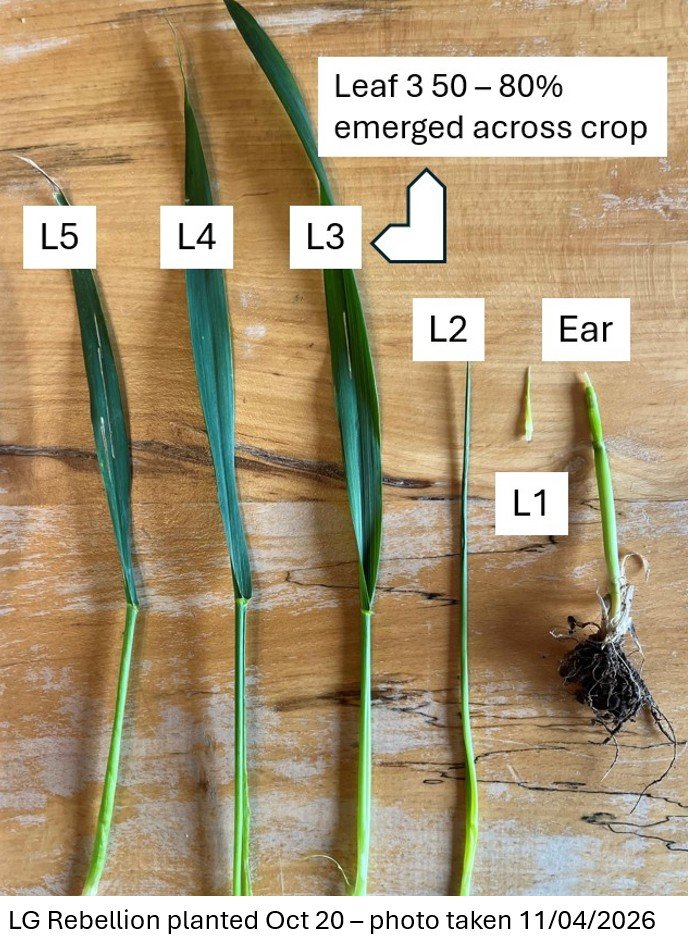
Crops range from leaf 4 just emerging through to leaf 3 almost fully unfolded, especially in earlier maturing varieties such as LG Rebellion. This variation highlights the importance of monitoring crops closely rather than relying solely on growth stage.
Winter barley crops are at GS32 and should have all their nitrogen applied at this stage. Some of the early developing varieties are at flag leaf emergence. BYDV symptoms are evident in many crops, especially those that didn’t get and insecticide pre-Christmas. The T1 fungicide application is applied in most cases and there are few reports of disease in crops.
Over the next week or so there are two questions growers will be faced with:
- Do I include a plant growth regulator (PGR) with my first fungicide Leaf 3 application on wheat?
- Do I include a fungicide with my PGR on barley?
Wheat
In the case of wheat, many crops will have already received a PGR, typically CCC + Moddus/Meddax Max etc. Usually this is the first half of a split strategy with the second application with the Leaf 3 fungicide. There are some crops which have yet to receive anything or may just be recovering from a herbicide application, which has caused some stunting in many cases.
The decision on the PGR strategy should be based on a number of factors. These include the nitrogen applied, rotation and the variety (e.g. Champion has a poor rating so should receive a robust rate of the mix mentioned above). CCC must be applied before GS32 so other options include Terpal (but beware of straw contract restrictions), ceramide or the straight Moddus products or Meddax Max all which can be used slightly later.
The leaf 3 fungicide application should be timed as the third last leaf is fully emerged. This will need grower/agronomists to split out the leaves to identify the correct leaf. In the photo, you can see that in Rebellion, leaf 3 is almost fully emerged whereas in other varieties leaf 4 is just now fully emerged.
The choice of products will depend on whether you are chasing yellow rust or not. In most crops, there is very little rust but some crops of Champion, Fitzroy or Dawsum do have disease present. For most, septoria is still the main target so products with good control of it should be applied e.g. Questar/Proteb etc., Ascra Xpro, Jessico One + Jettano, Revystar. However, where yellow rust is the main target then Questar products, Ascra Xpro, or Elatus Era may be the stronger options.
Barley
In barley, most crops are now due to receive the final PGR application which, at this stage, is usually Terpal or Cerone. Most will have already received a PGR application already like the wheat. And, in many cases, the second application is an insurance that the crop doesn’t lodge. Likewise, they all have received a fungicide application and the question is: Are you on a 2 or 3 spray strategy? In the northern half of the country, the first fungicide has probably only recently been applied in the last fortnight and that should be enough until the awns emerge. However, in the southern counties the first fungicide may have been applied at the end of March and so there could be a gap of 5-6 weeks between it and the final application. For this reason, many will opt to apply a fungicide with the PGR application.
Trials carried out in Oak Park suggest that the two-spray strategy will give the same yield as a three-spray strategy where crops are clean from disease. However, in crops that have disease, especially in the south, then the three-spray strategy may be warranted.