
19 January 2025
Future-proofing a part-time beef enterprise in Tipperary
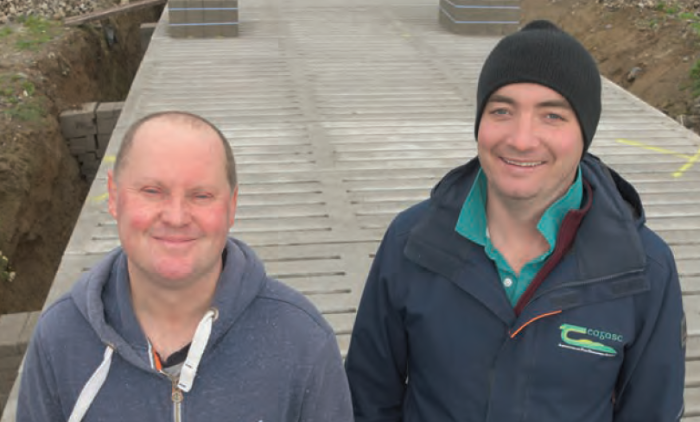
Investment in facilities, technology and business partnerships will ensure the future of Michael O’Donnell’s calf-to-beef farm in south Tipperary. Alan Dillon tells us more.
Michael O’Donnell farms 48 hectares of good quality land near Clerihan in south Tipperary. The farm is split between 32 hectares of owned land around the farm yard with the balance leased nearby. Michael works off-farm as an electrician and time is one of his main limiting factors. “I previously ran a suckler enterprise but found it difficult to be around to monitor calving of cows,” he says. “My job means I can be off the farm for up to 10 hours per day.”
Dairy calf-to-beef offered slightly more structure and routine to his working day. Michael’s sister Joan and her husband run a dairy farm and had a ready supply of calves coming. They agreed that Michael would buy 110 calves, reared and vaccinated against pneumonia, at 9-10 weeks of age.
“As the calves come from a single farm, my exposure to disease is reduced. I can also have an influence over sires used on the cows in future,” says Michael. “The herd is spring and autumn calving. For me, buying at both times spreads the work, improves cashflow, reduces risk and means I’m making better use of sheds.”
Michael says he aims to work with the source dairy farm further by agreeing sire criteria for beef bulls in order to influence the type of calves he will be purchasing.
Sire criteria
- Greater than 10kg carcass for early maturing bulls, 20kg of carcass or greater for continental bulls.
- A Beef Sub Index, which is located within the Dairy Beef Index (DBI), will be set at a minimum of €100.
- Calving difficulty and gestation length will be decided by the dairy farmer as these are traits that will impact on him only.
| Sire AI code | Breed | DBI € | Beef sub index € | Carcass wt kg | Calving diff % (dairy cow) |
| LM2010 | LM | 120 | 162 | 24.1 | 4.7 |
| BB5226 | BB | 143 | 188 | 31.8 | 6.5 |
| CH4321 | CH | 138 | 193 | 42.6 | 5.5 |
| BB4438 | BB | 53 | 174 | 29.8 | 8.7 |
| AA4640 | AA | 143 | 112 | 14 | 3.1 |
Table 1 gives examples of the sires currently used to produce the cattle in Michael’s herd.
All the calves from these sires fit the criteria. While there are some bulls with poorer carcass characteristics used that are outside this range, these will be weeded out in the next year and replaced by bulls of higher beef merit. These high beef merit bulls will deliver higher carcass weights at a younger age and help drive profit without requiring extra labour.
Current performance show steers averaging 326kg with an average grade of O+ at 22 months while heifers averaged 265kg at an average grade of O= at 21 months. There is scope for improvement here but bear in mind the weather in 2023 reduced live weight gain of stock around the country. This should improve if the back end of 2024 and early 2025 stay dry and allow more days at grass.
Michael’s whole farm performance is well above average with 511kg of liveweight output achieved per livestock unit compared to a national average of 295kg. Per hectare, Michael is achieving over double the national average in live weight output at 971kg/ha. Michael runs a relatively high stocking rate at 1.91 LU/ha but results across the Teagasc DairyBeef500 demonstration farms and Teagasc research farms show that this level of stocking rate is required to achieve high profitability.
Future-proofing the farm
Michael is completing development works that will future-proof him against any changes in slurry storage regulations, and the works will also reduce his workload. “We are building a five-bay slatted shed with a covered feeding area on both ends that will allow me to feed with the diet feeder at both sides of the shed. I fill the diet feeder at night and empty the feeder along the feed passage the following morning before heading to work.”
Michael is also considering adaptations to a hay shed in the event he may have to rear the calves himself in the future. This will involve getting the slopes in the floor correct to a fall of 1:20. The floor will slope from both sides of the shed into the middle where water will be able to drain away into a storage tank.
As the shed is very high and not a very warm environment for young calves, internal low roofs may need to be installed to create an optimum microclimate. Calves are not very good at retaining heat in the early stages of life and 8×4 sheets of plywood hinged to the existing walls will create a warmer area within the high roofed shed.
“If I go down the route of calf rearing, an automatic feeder will be installed to further reduce labour input,” says Michael. “The shed floor will need to be designed to accommodate this while also ensuring the shed can be cleaned out easily with a tractor and loader and also that the shed can be used for storage of machinery and hay or straw when not rearing calves.”
A system in development
While Michael has made great strides in changing his system from a suckler unit to a dairy beef unit, the next few years could bring about more changes if calves are to be reared at a younger age on farm, and carried through to slaughter.
Cattle performance is relatively good with a high level of output achieved. There is, however, more opportunity to improve the system and deliver greater output from grass. Any changes to the farm in terms of system will have to ensure labour requirement is not exceeded beyond what is achievable.
“I love farming but farm work has to fit around what free time I have outside of my main occupation” says Michael, whose situation is similar to that of many beef farmers. Technology, planning and appropriate facilities can ensure part time farming is feasible from a work point of view and, equally important, also a profitable enterprise.
Read more from the latest edition of Todays Farm