
19 December 2023
Future-proofing the farm with solar panels
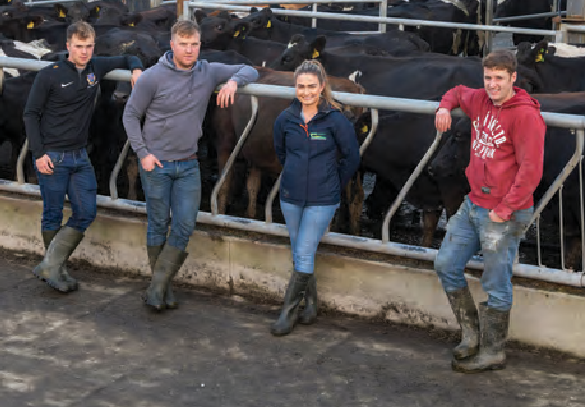
The Dolan family have installed a solar energy system to cut costs and enhance sustainability on their 400-cow dairy farm in Westmeath.
John and Una Dolan, and their children Aoife, Shane and Cathal, are dairy farmers in Fardrum, Co. Westmeath close to Athlone. The family can be best described as ‘dynamic’ with all, including Aaron Daly, Aoife’s husband, helping out and moulding a farm for the future.
The Dolans have no fear of change or innovation. In 2010, the farm comprised 80 high yielding cows in a liquid milk contract and fed TMR to the herd. Today, they operate a 400-cow spring calving dairy enterprise focused on grazed grass and high genetic merit animals. At each step of the expansion, the family would come together to help decide on the best way forward for the dairy enterprise. They were assisted by the six-year business planner and Profit Monitor from their Teagasc dairy advisor Jennifer Brachen.
“We were attracted to solar as a way to enhance our sustainability,” says Shane. “We thought solar would require less maintenance and cost less than windmills.” They investigated the potential of a large scale solar photovoltaic (PV) panel and battery system for the farm to help reduce electricity bills and potentially export power back to the grid.
“The system was installed nearly 18 months ago, but we feel we have learnt more about solar in the last six weeks than we knew when purchasing it,” says Shane. “If we were doing it again we would do more research into the capabilities of the solar panels and the impact they would have on our farm.”
Stored power
The Dolans installed a 50 kWp (kilowatt peak) solar PV system with two 10 kWh (kilowatt-hour) batteries to store power during the day when energy demand would be low. The plan was that the stored power would be released at milking when energy demand would peak. “Initially we were disappointed with the system,” Cathal explains. “We thought that by charging the batteries during the day we would nearly get the evening milking for free. However, the batteries can’t discharge the power quick enough so we still rely on power from the grid during milking.
“It takes two hours to discharge the batteries and we get a discharge rate of about 4 kW from each battery. The batteries will not discharge to zero as the depth of discharge is about 80%. With everything running our peak demand is about 25 kW during milking. If we installed more batteries, we would increase the solar energy available at milking, but it would be far more expensive to install and we would not get the payback,” says Shane.
“One advantage however is that we charge the batteries on night rate electricity and discharge them during morning milking which reduces the electricity cost during the morning milking.”
Costs
The Dolans got quotes from five solar companies before deciding on the size of the system to be installed. “We wanted to reduce our electricity bill by 30% and we were recommended to install 50 kWp to achieve this goal,” says Shane.
“We got no grant on the system and the full 132 panels and two batteries installed cost €60,000 plus VAT. A similar system today, though potentially grant aided, could cost closer to €90,000.”
Cathal and Shane reckon, based on savings over the summer months and using a day rate price of 40 cent per kWh, that the system will pay for itself after five years. The current higher price of electricity is helping the payback figures.
“We were hoping that we could export surplus solar energy off the farm back to the grid,” adds Cathal.
“As for the panels there was a lot more to be considered than just contacting the ESB. You have to apply to ESB Networks for an export connection under the Mini-Generation scheme. The ESB will conduct a survey of the grid infrastructure on your farm to see what amount you can export back. They won’t necessarily take all you can generate. “So when sizing your panels this needs to be considered. You will also need to get a smart meter installed. We are allowed to export a max of 12 kVA back to the grid (1 kVA can be assumed equal to 1 kW here for simplicity),” says Shane.
On-farm storage
“Since our ability to export excess electricity back to the grid is limited, on-farm storage takes on a high importance. We think it would make sense if farmers could put more solar panels on buildings and export to the grid.” When asked if they would do anything different, the Dolans say they are happy with the investment and how it’s operating. But they add that they should have sought more advice at the start to best understand what they were investing in, and guidance on the right system for their farm.
This article was written by Patrick Gowing, Teagasc Dairy Specialist, John Upton Teagasc Dairy Researcher, Moorepark, and Jennifer Bracken Teagasc Dairy Advisor
Read more from Today’s Farm – November/December 2023