
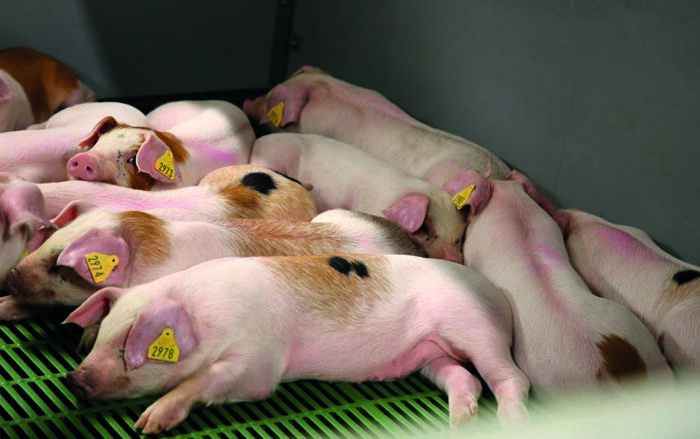
Emer McCrum and Michael McKeon discussed the key pillars of pig production; health, housing and feed, and how effective management drives profitability at the recent Teagasc Pig Farmers’ Conference.
Pig production is very simple, it only requires three simple elements for maximum efficiency; health, housing & feed.
The difficulty is how well these three elements are effectively managed! One of these elements could take a whole paper on their own, so we are only going to deal with one aspect per element.
Health – Intestinal Parasites
Every pig producer is aware that worms can be an issue on pig units and probably think there is ‘nothing new for me here’! However, consider the fact that some units are effectively free of worms, and some units are not. Why?
Even more worrying, some units think they are free of worms but they are not! Is your unit actually worm free? Perhaps it’s time to re-assess if worms are a silent issue on your unit, as worms on an average unit may cost upwards of €100,000 in lost productivity.
Ascaris suum or roundworm is the most widespread and economically important parasite in pig production. As the clinical signs associated with infection are not always alarmingly obvious, the presence of worms subtly undermines growth and feed efficiency over time thereby increasing feed costs.
Migrating larvae cause problems beyond the gut with alterations to the liver, so-called milk spots, leading to the condemnation of affected livers at slaughter. Migration through the lungs also causes pulmonary lesions which open the door to pneumonia and other infections particularly in animals co-infected with other viral or bacterial pathogens.
Ingesting a low number of eggs is sufficient to cause chronic infection and the continuous production of larger egg volumes leading to a cycle of continuous reinfection. Most farms have routine worming protocols in place, but is this really effective?
The prevalence of milk spot lesions is a common diagnostic tool but not the most reliable. Milk spot lesions become visible 7–10 days after infection but will regress within 1–4 weeks, so their presence only indicates recent infection or reinfection. Milk spot and liver condemnation rate therefore do not indicate the severity of herd infection.
Faecal egg dung sampling, on the other hand, is a valuable diagnostic tool to detect and monitor intestinal worm burdens, and it is very cheap and fast! Results can also be used to design tailored and targeted treatment and control strategies which helps to minimise the risk of resistance.
The breeding herd also plays a critical role in the introduction and persistence of worms within the herd. Even if grower pigs are managed, poor management in the breeding herd can act as a silent reservoir of parasites, continuously contaminating the environment and reinfecting younger pigs.
Piglets can be exposed to infection if sows are shedding in the farrowing house which can impact their growth potential from a very young age. It is essential to ensure sows are treated in the dry sow house a minimum of two weeks pre-farrowing. Some farms introduced routine top-dressing of infeed wormer 3 weeks pre-farrow (at vaccination time) and this has proved very successful in eliminating worms in both the sows and grower herd.
Don’t forget to also worm boars, these are often the ‘forgotten man’, but can also harbour and spread worms! Maiden gilts must also be treated in the finisher house at least two weeks before entry into the sow herd, to ensure that they are not bringing a fresh reservoir of worms into the breeding herd.
Worm control programmes should not depend solely on anthelmintics. Operating houses AIAO with thorough cleaning, disinfection, drying and ideally resting between batches is the gold standard. Washing alone will not kill worm eggs but the complete removal of organic matter using high pressure washing, particularly in pen corners, feeders, and drinkers where eggs build up, is required to remove worm reservoirs.
Some disinfectants are effective against worm eggs; however, applying disinfectants without thorough washing is largely pointless. It is also recommended to switch disinfectants regularly on farm (every six months) to minimise the development of resistance.
Worm eggs require moisture to survive so thorough drying of houses after washing, while slow, is very effective. Finally, good manure management and control of flies and rodents is recommended.
A recent study¹ estimated the cost of roundworm infection at €5 – €8/pig, driven by reduced feed conversion and lean meat content, plus increased susceptibility to respiratory pathogens. A worm burden can be a silent and costly problem in terms of grower performance, making the implementation of regular monitoring, strategic deworming and strong biosecurity essential to protect herd health and profitability.
Housing – Ventilation
Similar to worm infestation, we all know that ventilation is critical to good pig production. When is the last time you really re-evaluated how well the ventilation is working in each of your houses?
Take a finisher house as an example:
Your 500 pig finisher house was built 20 years ago in 2005. The house was presumably designed for the average national sale weight at the time = 100 kgs liveweight². The fan size and the size and number of ventilation inlets were also designed for this liveweight. That means your house needed to be able to have an air turn-over of 50,000 M³/hr.
Roll-on 20 years and your sale weight is now 120 kgs² which means that those 500 pigs now need an air turnover of 60,000 M³/hr. This means the ventilation rate of your house is 20% sub-optimal.
In reality it is probably even lower as the pigs/sow/yr have increased from 21.9 to 27.9, so your 500 pigs in that building have probably also ‘inched-up’ a bit more too. This means that your ventilation rate could be up to 30% sub-optimal!
Another common problem on units is how the pigs use the pen. If pigs use the pen incorrectly then this will lead to increased aggression, injury and reduced performance.
Take another finisher house as an example: your finisher house has a centre passage with the feeder and drinker beside the passage. The pigs should ideally be lying at the back of the pen underneath the wall vents as this is the warmest part of the pen. The incoming cold air through the vents should fall at the feeder/drinker making this the dunging area.
How well is this working in your finisher house? When did you last walk down the centre passage and observe if the back wall is clean or has dung on it?
One may ask: does it really matter either way? Well yes, a back wall with dung does matter as it’s effectively money down the slats. Dunging at the back means that this is the coldest area.
If the pigs are lying here for the first few days after entry, as will usually happen, then the feed intake in this period is used to stay warm / increased activity rather than growth. Even a modest 3 days of no-growth will increase the finisher period FCE by 0.05 (e.g. 2.55 to 2.6).
On an annualised basis for a 700 sow herd this equates to €40,000/yr extra feed costs.
Feed – Space Allowance
Pig producers spend a lot of time ensuring that the feed specifications and the nutrient content is ‘top-notch’ for maximum performance efficiency. However, if the pigs don’t eat enough of the feed they simply won’t grow, no matter how good the feed is!
A recent trial on a commercial unit illustrates this point.
A pig unit was producing its own high specification feed. The housing, pig health and management on the unit were excellent but the finisher performance was very disappointing. The finishers entered at 40kgs and were sold at 125 kgs.
The growth rates were 1040 g/day and the FCE was 2.85 over this period. While the growth rate was above the national average (998 g/day), the FCE was poor considering all the main elements were excellent (health, housing, feed).
When the pigs were put on trial they were weighed at three different stages:
-
Grower (40–80kg)
-
Finisher 1 (80–105kgs)
-
Finisher 2 (105–125kgs)
The feed allowance per valve was recorded each week and any pigs removed off-trial (minimal) were recorded. For the benefit of consistency, the pigs remained on grower feed throughout the trial period.
The trial data showed that the pigs performed very well in the grower stage with growth rates of 1,111 g/day and an FCE of 2.3. However, in the finisher stage the performance deteriorated rapidly with a growth rate of 997 g/day and an FCE of 3.3.
However, when the space allowance was increased by 15%, the growth and feed conversion improved dramatically (Table 1).
The FCE improvement alone arising from this increased space allowance equates to an estimated €15.93/pig, which on an annualised basis is equivalent to a saving (excluding extra accommodation costs) of €312,228 for a 700 sow herd producing 28 pigs/sow/year.
Table 1. Performance Results from Increased Space Allowance
| Space Allowance | KPI | Grower | Finisher 1 | Finisher 2 | Overall |
|---|---|---|---|---|---|
| Standard | ADG g/day | 1,111 | 997 | 1,040 | |
| FCE^ | 2.30 | 3.31 | 2.85 | ||
| Standard +15% | ADG g/day | 1,044 | 1,383 | 1,336 | 1,211 |
| FCE^ | 2.14 | 2.31 | 2.52 | 2.29 |
^ Kg feed per kg liveweight gain
Conclusion
In conclusion, the key elements of pig production are simple: housing, health & feed, but their effective implementation can be difficult!
This paper illustrates the financial benefit of re-assessing aspects of these key elements with a ‘new eye’ rather than falling into the trap of ‘continuing to do what we have always done’.