
Getting more from your nitrogen spend
With the global uncertainty around fertiliser cost and availability, improving the efficiency of nitrogen used on farm is critical in maintaining crop and animal performance, while reducing any negative impact on water quality.
Better for the wallet and better for the watercourse, Teagasc Better Farming for Water share key tips on improving Nitrogen Use Efficiency (NUE) and N Balance.
The cost of one kilogram of Nitrogen (as protected urea) has increased from €1.24 to €1.85 since the start of the year. It makes sound financial sense to use Nitrogen (and Phosphorous and Potassium) as carefully as possible and avoid wasting nutrient and money.
The Better Farming for Water Campaign (BFFW) – 8 Actions for Change has reducing purchased N and P surplus as one of its core actions. In order to achieve this, we must first understand the concept of Nitrogen Use Efficiency – NUE, N Balance and the key steps involved in improving this in a sustainable manner.
Nitrogen Use Efficiency (NUE)
In simple terms, NUE is a measure of how efficiently a farm converts nitrogen inputs into outputs such as milk, meat or crops. Nitrogen inputs on a farm include chemical fertiliser but also purchased concentrate, forage and imported organic manures. NUE reflects how effectively the nutrients are converted into saleable outputs. It is expressed on a percentage (%) basis with the aim of as high a figure as possible.
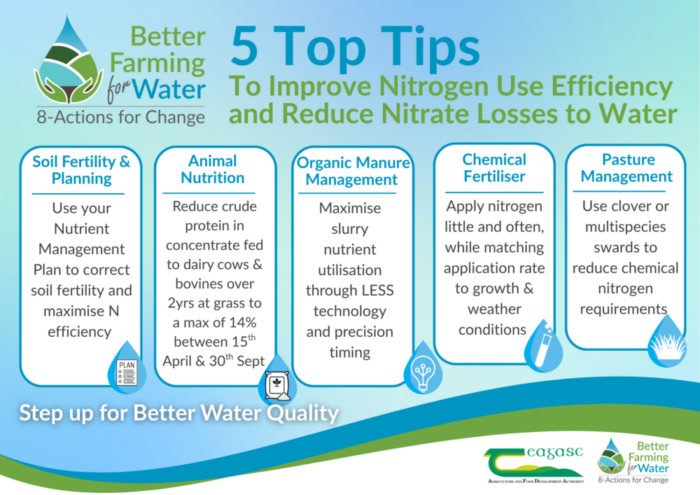
5 top tips
N Balance
Nitrogen balance (often called N surplus) is the difference between total nitrogen imported onto the farm and nitrogen exported off the farm in saleable products, expressed on a Kg/Ha basis. It indicates the portion of N that is not captured as output and that therefore could be lost to the environment. The lower the N balance, the better, as it means there is less surplus to lose to the environment (air or water).
So how do these differ and which is more important?
While NUE and N balance both use the same figures for inputs and outputs, NUE focusses on efficiency (%) while N balance looks at the difference (Kg N/Ha). In simple terms, NUE tells us: ‘How well am I using nitrogen?’ While N Balance tells us: ‘How much nitrogen is left over?’
The truth is that both figures are important and together, they work to give us a more complete picture of nitrogen use on our farms, both in terms of efficiency and potential risk to water quality. While the target for NUE for a grassland farm is 35%, the focus must also be on achieving this at a reduced N surplus figure. This will reduce the risk of surplus N leaching into our watercourses and estuaries.
For more from the Teagasc Better Farming for Water Campaign, visit here.