
Getting Ready for the 2026 Dairy Season
Michael Donoghue, Teagasc Dairy Advisor, highlights areas that will require attention over the next few weeks before cows start calving again in February.
Milk Price
Up until August, base milk price was running around the 50 c/l mark, but the last few months have seen cuts of 10 to 12 c/l. While this has been a significant drop, the reality on most spring milk farms in 2025 was that it was a profitable year, as most of the year’s milk was processed during the period of higher prices. However, in 2026, with a likely base price of around 38 c/l to start the year, it will be far more challenging. There are no silver bullets to address a price reduction of this scale. However, focusing on the basics of farm profitability is key to keeping the farm business healthy.
Grass
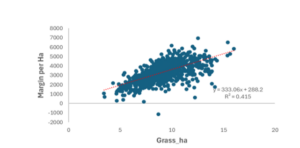
The graph below highlights the strongest link to farm profitability in Irish dairy farming. The more grass a cow eats, the more profitable your business will be. The graph is from this year’s Teagasc Dairy Conference. Each dot represents a farm, showing its profitability and grass utilised. Forty one per cent of the difference in profitability is due to cows eating more grass, making this the biggest driver of farm profitability. There are two important aspects to increasing grass utilisation by the cow. The first is growing more grass, and the second is encouraging the cow to eat more of it.
Walk Your Farm
While things are quiet on the farm now, take the time to walk the milking platform and complete a closing farm cover. Ideally, the Average Farm Cover (AFC) should be about 700 to 800 kg DM/ha. This will vary depending on how dry your farm is and your calving profile. As you are walking the farm, start to think about the paddocks that will be grazed first in the spring. These will be drier, have good access and have a cover of 500 to 600 kg DM/ha on them now. The importance of walking your milking platform and measuring grass cannot be overstated. It is the single most important hour of the week.
Soil Sampling
Soil sampling is essential for any grass farmer, both from a regulatory and a financial point of view. Regulations dictate that any farm stocked over 130 kg N/ha must have valid soil samples that are no older than four years and represent no more than 5 ha. Otherwise, the farm will be deemed to be P Index 4, effectively meaning there will be no chemical P allowance. From the farmer’s own financial perspective, if soil fertility is below par in terms of lime, P or K, nitrogen use efficiency can be reduced by 30 to 40 per cent.
Feeding the Grass Plant in Spring
Slurry can be spread from 16 January once conditions are suitable. This should be targeted mostly at silage ground, although some will be spread on the milking platform. An application rate of 2,000 gallons per acre will supply about 18 units of N per acre. From 1 February, chemical fertiliser can be spread again. Wait until soils are starting to warm up, above 6°C, ground conditions are good and no rain is forecast. Once these boxes are ticked, protected urea should be targeted at suitable grazing land at a rate of 20 units per acre.
Clover
If you have not already done so, take the opportunity in 2026 to look at, and possibly start, the clover journey. Clover has the potential to provide 150 kg N/ha while also increasing pasture quality. There are challenges with persistence, and some farmers have experienced bloat issues, but clover is working and delivering both financial and environmental benefits on Galway dairy farms.
Farm Roads
If farm roads have not been maintained or resurfaced already, make sure to get this done as soon as possible so they have time to settle. This will ensure freshly calved cows have a kind surface to walk on. If cows become lame in the first few months at grass, it can have very negative effects on milk yield and their ability to go back in calf in May.
Mindset
Feeding cows quality grass is every farmer’s goal, but it will not happen by itself. Time must be made in the spring, even when you are very busy, to check whether land can take cows for a couple of hours, followed by setting up wires so they have a fresh break. During the summer, time must be allocated to walk the milking platform every five to seven days to ensure cows always have leafy grass in front of them. This does require a change in mindset, but it is what will drive the profitability of your farm business.
Above are the key areas that will drive the profitability of the dairy business in 2026. Of course, there are more areas that need to be addressed, but if the above are done correctly, the cornerstones will be in place to survive what is likely to be a challenging milk price in 2026.