
13 March 2025
Getting spring crops off to the best start
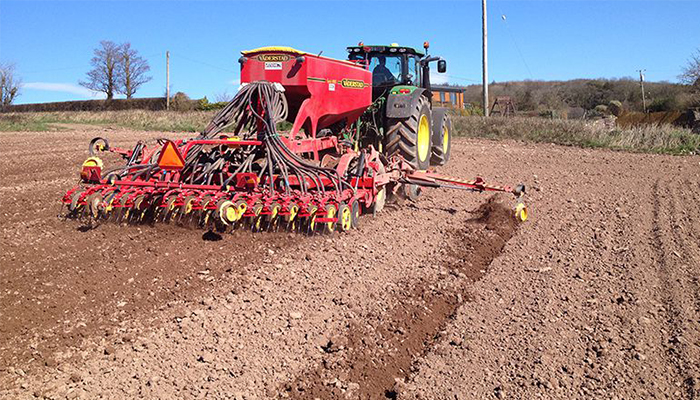
Crops Specialist, Shay Phelan offers key tips on establishing spring crops, highlighting the importance of thousand grain weight and seed drill calibration. He also looks at the critical management tasks for winter crops over the next week or two.
Spring sowing
Most growers are busy with the fine weather this week, with spring beans, wheat, oats and barley all being drilled at the moment. The old saying ‘Tús maith leath na hoibre’ – i.e. a good start is half the work – is always true when drilling spring crops, meaning calculating the correct seed rate and subsequently calibrating the seed drill correctly will give you the best chance of achieving optimum crop stands.
Use the thousand grain weight (TGW) of the seed to calculate the seed rate and then subsequently set the drill. Remember that the TGW will change between varieties and also between batches of seed. This will have an impact on the seed rate and the subsequent setting on the drill.
In the two videos below we show how the TGW can affect the seed rate and also how then to set up the drill.
Effect of TGW on seed rates
Calibrating the seed drill
Winter crops
Winter barley
Crops are starting to move again with many cases having already received its first application of fertiliser. Early drilled crops of Joyau are approaching GS 30 and are due an application of a PGR in the coming days or weeks.
This week, there is quite a bit of frost forecast so avoid frosty nights if applying any PGRs. Options include CCC + Moddus, which can work well at this time of year. Where trace elements deficiencies occur, now is a good time to apply those as well.
Always be careful where tank mixes include multiple active ingredients at this time of year, as crops can be scorched quite easily, so if in doubt split up applications and leave a few days between passes.
The main split of nitrogen will be applied on those advanced crops at typically GS 30/31. This split should account for approximately 50% of the total nitrogen for the crop.
Winter wheat
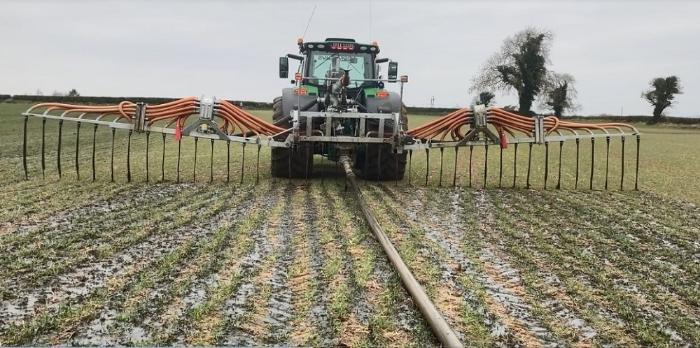
Most crops are now receiving their first application of a compound fertiliser in the coming weeks or so. Where possible, consider using slurries as a source of nitrogen (N), phosphorus (P) and potassium (K). There are a number of growers who are now spreading slurry on winter wheat in the spring and subsequently reducing the amount of chemical fertiliser needed to grow the crop.
Where slurry is being used, make sure to get it analysed so that you can accurately calculate how much slurry is required. Where nitrogen is concerned, we generally use a strategy of ¼; ½ ; ¼ so depending on the nitrogen level in the slurry you can supply that first nitrogen in the form of slurry.
Figure 1: Slurry being applied to winter wheat
Winter oilseed rape
Winter oilseed rape (OSR) crops are recovering well and are approaching green bud stage at the moment. Grazed crops will need an application of nitrogen to try to achieve a GAI of 3.5 at the start of flowering. The amount of nitrogen required will be determined by the current GAI of the crop. Table 1 below shows the rates of nitrogen required at the different GAI measurements.
Table 1: Nitrogen strategy of OSR based on GAI
|
Crop description (total N) |
Early split (Late Feb) |
Main split (Mid March) |
Seed fill (Late March / Early April) |
|---|---|---|---|
|
GAI <1.0 (225kg/ha) |
70kg/ha (Late Feb) | 120kg/ha | 35kg/ha |
|
GAI 1.0 (210kg/ha) |
50kg/ha (Early March) | 100kg/ha | 60kg/ha |
|
GAI 1.5 (190kg/ha) |
40kg/ha (Early March) | 90kg/ha | 60kg/ha |
|
GAI 2.0 (130kg/ha) |
0 | 70kg/ha | 60kg/ha |