

As part of Farm Safety Week 2025, Dr. John McNamara, Teagasc Health and Safety Specialist, highlights the importance of eye safety on farms.
Our eyes are vital organs. It’s through our eyes that we see and perceive the outside world. Without sight, we have difficulty working, we become dependent on others, and enjoyment in life is likely to be greatly curtailed. ‘Eyes on Safety – the Importance of Protection’ is the theme for Wednesday of #FarmSafetyWeek 2025
Yet, there is evidence that farmers don’t give eye protection the attention it deserves. As many as 6% of all serious farm workplace injuries are eye injuries. I have been contacted by eye surgeons on several occasions seeking to promote eye injury prevention among farmers. These medics frequently deal with farmers suffering from sight loss due to eye injury. In short, for some eye injuries, cure may not be possible, so prevention is essential. We should all become more conscious about protecting our eyes.
Injury and Farmers
Workshops and machinery maintenance
With workshop work, objects can ‘fly’ and become embedded in the eye — for example, welding slag or metal fragments. Similarly, with machinery, items causing eye injury include high-pressure hydraulic oil leaks.
There are many situations involving workshop or maintenance work that could cause an eye injury. Consult the Teagasc Farm Workshop Safety booklet.
Hydrated lime (also called builder’s lime) is used as a disinfectant material for cow cubicles. However, this is an aggressive product that chemically attacks the lens of the eye, causing it to become opaque or clouded, which prevents vision. Wearing eye protection is crucial to prevent loss of sight.
Wood, particularly thorns or a springing branch striking the eye, presents a safety hazard. If wood or a thorn punctures the eye, it can introduce infection that is hard to cure, as the eye has a poor blood supply.
Splashes of chemicals, particularly acids or alkalis, can cause loss of sight. This can occur due to a burst hose or if a valve is turned on inadvertently.
Eye health
It is important to have your eyes checked by an ophthalmologist regularly. Issues such as glaucoma or diabetes can cause deterioration in eye health. The earlier these conditions are identified and treated, the better the prognosis.
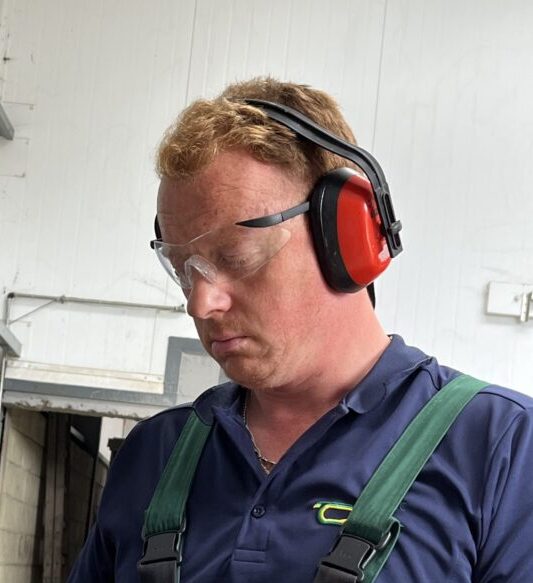
Prevention is the single biggest solution to accidental eye injury. This involves watching out for risk situations and taking avoidance measures. Wearing eye protection is a vital approach to guarding your eyes from injury. In many industries, wearing eye protection is routine due to its effectiveness in preventing injuries and its low cost. Many ‘easy-to-wear’ and ‘anti-misting’ options are available in co-ops and merchants. The challenge is to wear eye protection whenever a hazard exists.
A good way to manage eye protection is to have a designated storage place or box for personal protective equipment, including eye protection, in accessible locations. Ready availability solves the problem of ‘not having the eye protection when you need it’ — and, as a consequence, neglecting to use it.
 Eye Injury First Aid
- All eye injuries should be treated as serious to prevent loss of sight. Accompany a person with an eye injury to hospital Accident & Emergency without delay.
- Physical injuries: Reassure the patient and advise them not to rub or touch the eye. For a blow to the eye, use a cold compress to reduce swelling. Dress and bandage the injured eye. Never remove an object from the eye.
- Chemical eye injury: Treat by flooding the eye with water for at least 15 minutes. This can be done by holding the eyelids open and using the flow of water from a hose. Take care not to contaminate the uninjured eye.
- Eye wound: Do not attempt to remove an embedded object. Where there is no embedded object, ask the person to lie down and close both eyes. Place a sterile dressing over the injured eye and bandage. Also bandage the uninjured eye.
Undertaking a first aid course is highly recommended, as it imparts the necessary skills to deal with farm injuries, including eye injuries.