
Good for tillage and also good for dairy
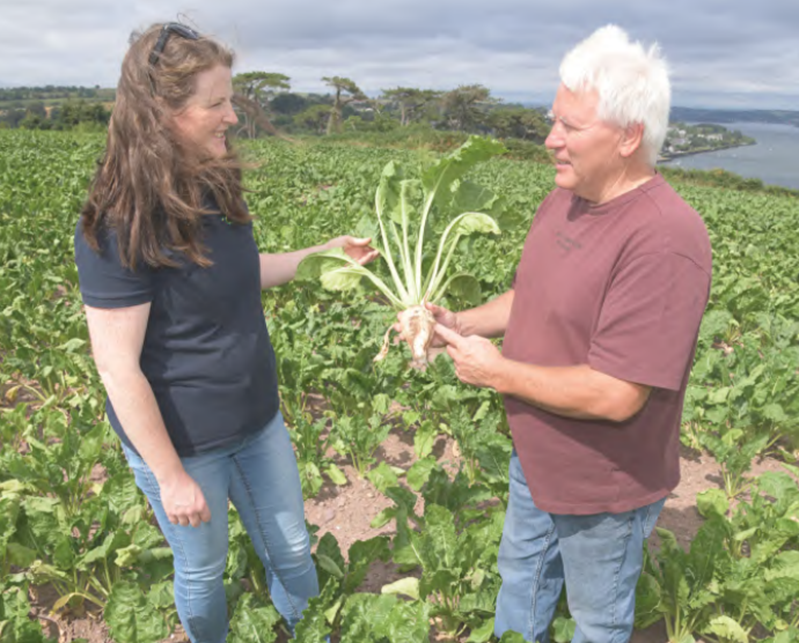
In a recent Today’s Farm article, Tillage Advisor in Teagasc Middleton, Ciara O’Donovan visited a Cork farm who’s constantly innovating to meet market needs.
I recently sat down with tillage farmer JB O’Donovan, from Carrigtwohill in east Cork, to discuss the unique business that he has developed over the past 10 years.
“When I started my tillage career, I was growing a variety of crops, such as oats, winter wheat and malting barley, as well as sugar beet, which was the main crop at the time,” says JB.
“When the sugar beet factory in Mallow closed in 2006, I went from growing circa 100 acres of sugar beet to about 40 acres of fodder beet.”
Around 2008, JB, in partnership with other tillage farmers in Cork, established a biodiesel production facility and grew winter oilseed rape (WOSR) to feed it, for about five years or so until the REFIT tariff for the operation was rescinded. This made the venture unviable.
“I also dropped winter wheat from the rotation, as the cost of production was very high given the high Septoria pressure in Cork, and the tight margins we were achieving.”
JB had also taken a financial hit after forward selling wheat for, what turned out to be, a bad price. “I also found it a tricky crop to dry and store in our grain drying facilities,” he adds.
Following this, JB scaled up his beet production and started supplying washed beet to add value to his product.
“I found it easier to sell the washed beet, as there was no loss in weight from stones and dirt, and customers, mainly dairy farmers, found it more convenient.”
The beet was sold for feeding out fresh, with some farmers ordering beet for pitting in the springtime. They would then feed it during the summer months if grass was in short supply for any reason.
“We would pit it with beet pulp and add soya hulls, supplied by the customer,” says JB.
JB started growing maize to replace some of the beet pulp and soya hulls, as it was seen as a cheaper option. Clearly JB is no stranger to experimenting. He tried growing a triticale lupin arable silage mix to whole-crop and tried growing blue lupins for combining as a protein crop to produce a higher protein feed to sell, as he saw a gap in the market for it.
“As milk quotas were being abolished, I concentrated my business on beet and maize, because land was getting more expensive and scarce. It was also hard to control weeds in the lupin triticale mix, so we opted to grow barley for whole-crop instead,” says JB.
“Spring and winter barley is cheaper to grow than maize, so this brings down the cost per tonne of the finished product. They are harvested earlier than maize, too, and there is less spoilage in the pit with a lower risk of soil contamination.”
JB always had a truck on the road, which he sees as key to his success and key to accessing the markets he wanted to sell and deliver into. He also has a weighbridge in his yard to keep track of crops coming in and product going out of the yard.
“My current rotation is mainly maize, beet and barley, with some spring beans,” says JB. “I like growing beans. The protein aid is attractive – it’s a good break crop and with the high cost of fertiliser, it just makes sense to have some in the rotation.”
Depending on the price of soyabean meal, he will either sell the beans green or includes them in his feed mix. He direct drills the beans and likes to grow them before beet. He says he is getting a boost in yield and also notes that his beet following beans this year seems to be suffering less from the drought conditions. He believes this is because the soil tilth is so good after the beans.
According to JB, the benefits of his current operation revolve around risk reduction.
“I went away from selling green grain and home-dried grain as the market was too volatile and more weather-dependent than what I’m doing now,” says JB. “You need good weather for harvesting grain and straw, and the cost of storing my feed is cheaper and less risky than drying and storing grain.” (Acknowledging that drying was not a major issue in 2026.)
JB says his system is flexible, he has less harvest losses, fewer staff are required at harvest times. He says it’s less labour intensive at peak times because the harvesting of the maize and whole-crop barley is contracted out and he can manage most of the other work himself.
JB does all cultivation work, ploughing and grubbing, he does all the spraying and fertilising, he plants, harvests, washes, chops, mixes and pits all his own beet. It is only the maize planting and the whole-crop harvesting of the maize and barley that are the contracted out to his local contractor, M & J Contracting Ltd.
JB is trying to be more of a price maker than a price taker and to create a market for his own product, which tends to track the price of grain.
“Knowing my costs of production is vital for setting the sale price. In a good grass growth year, downward price pressure and lower demand can be a challenge.”
JB says the system he has developed is a more sustainable farming business. In years with dry summers and late springs or long winters, which seem to be more frequent with climate change, sales can increase and the market price can increase with higher demand for fodder at the shoulders of the year.
Money management and developing a good relationship with his accountant and customers has been vital to the success of JB’s business. He says Teagasc’s Contract Forage Cropping Agreement, which is available for free on the Teagasc website, can also be a useful tool.
JB has travelled long distances in his lorry to deliver his feed mix, to places as distant as Galway and Wicklow. With a truck on the road, he says distance is not a problem. He says it’s a low carbon feed, as there are no imported feeds included in the mix. He views it as being a superior and more natural mix compared to palm kernel and other by-products with dubious sustainability credentials, as there is no carbon emissions associated with imported products. The mix does not cause acidosis, it’s cost competitive and guaranteed to be of quality, palatability, and have a high feed value leading to higher feed intakes, resulting in good liveweight gains and milk yields. JB is an innovator who adapts to market conditions, add value to his product and mitigates risks in his business. These are skills that are becoming almost as important as being a skilled grower.