
Grazing forage crops – Michael McGuigan’s approach
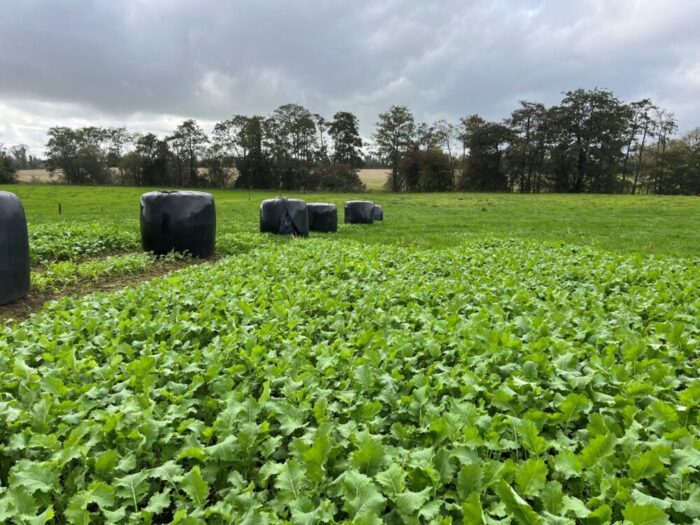
A Future Beef Programme participant from Co. Meath, Michael McGuigan is following best practice when it comes to grazing forage crops this winter.
Grown to carry weanlings over the winter months, Michael’s crop of Interval – a hybrid forage rape – has performed well this season. To ensure the most is made when grazing forage crops this winter, Michael follows a number of key steps, both before and during grazing. These are necessary to ensure good animal performance is achieved and water quality and soil are protected.
To prevent bloat and toxicity, Michael gradually introduces weanlings to the forage crops over a period of 7-10 days. Additionally, silage will always be available. As forage brassicas are low in dry matter (8-16%), Michael ensures at least 30% of the diet comes from silage to maintain adequate fibre intake. Despite the crop being relatively low in dry matter, water is still needed and to do so cattle have constant access to clean, piped water. This ensures they do not drink directly from streams or watercourses, reducing contamination risks.
With brassica crops being low in key trace elements, a mineral bolus is administered to weanlings before turnout, this contains iodine, copper, cobalt and selenium. Weanlings are also supplemented with 2kg of ration per head per day. Feed troughs are placed 20m for watercourses and moved regularly to prevent poaching and runoff.
To maximise crop utilisation, strip grazing is utilised with the wire moved daily. This is typically carried out towards the watercourse to control nutrient flow, while it also helps to minimise soil compaction. Michael assesses the yield and available dry matter in the crop to match animal demand. Care is taken during periods of frost to prevent the possibility of poisoning occurring. Michael will not more the wire or offer new crop during frost, and grazing will be completed before the crop flowers in mid-March.
Additionally, in order to prevent soil damage, a 30% lie-back area is provided. Michael has installed bungee cords along the length of the paddock so that the cattle will have multiple access gaps to the grass lie-back instead of entering and exiting through one gap. A 5m-long double-fenced buffer zone is also maintained along the river, which remains uncultivated and ungrazed. This prevents nutrient and sediment runoff into waterways and supports Good Agricultural and Environmental Condition (GAEC) 4 compliance.
To meet GAEC 4 requirements when grazing forage crops, Michael implements practical soil protection measures. These include:
- Providing adequate lie-back areas,
- Moving troughs and feeders regularly,
- Avoiding leaking water troughs,
- Limiting stock numbers during wet periods and,
- Reducing access through single gateways to prevent poaching.