
Grazing forage crops – Michael McGuigan’s approach
15 January 2025 Grazing forage crops – Michael McGuigan’s approach Weanlings on the farm of Michael McGuigan, a participant in the Future Beef Programme, commenced grazing a forage crop in mid-November. Read the management steps he’s following in this article. Totalling 2.5ha and sown in a sheltered field, the forage crop is Interval – […]
15 January 2025
Grazing forage crops – Michael McGuigan’s approach
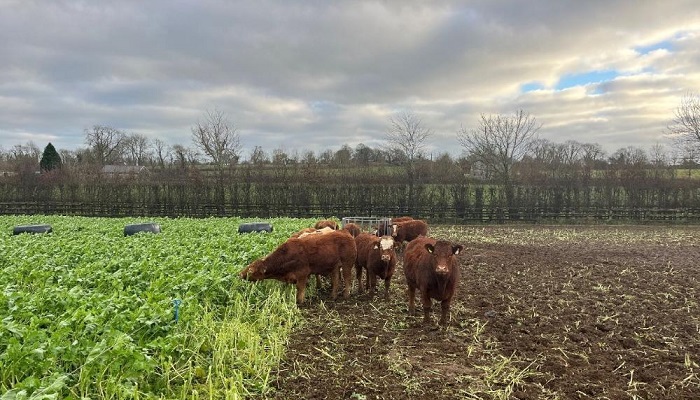
Weanlings on the farm of Michael McGuigan, a participant in the Future Beef Programme, commenced grazing a forage crop in mid-November. Read the management steps he’s following in this article.
Totalling 2.5ha and sown in a sheltered field, the forage crop is Interval – a kale/rape hybrid. In order to achieve optimum animal performance from the crop, Michael is managing the stock as follows:
- Weanlings were given a mineral bolus pre-grazing containing copper, cobalt, iodine, and selenium;
- They were gradually introduced to the crop over 1 week to help avoid any dietary upsets;
- The crop is strip grazed and the wire is moved daily;
- The wire is not moved until frost thaws (high nitrates can be toxic);
- Red clover and grass silage is provided ad-lib to ensure that at least 30% of the diet is a fibre source;
- Silage bales were lined after sowing in the field;
- Ration is being offered at a feeding rate of 2kg/head/day;
- Water is available at all times.
At sowing, Michael followed the cross compliance rules and left a 6 metre buffer from the water course and is grazing towards it, rather than away, to help avoid any nutrient loss. He also has a 0.8ha (>30% of forage area) grass lie back area to help prevent soil erosion.
Feeding dry cows and preparing for calving
The cows were housed on November 26th and Michael body condition scored them. The target score is 3-3.5 at housing and this reduces to 2.5 at calving. The average score for Michael’s cows was 3.07 and this ranged from 2.75 to 3.5, which he is happy with.
He assess the body condition score by handling 3 key areas on the cow and assessing the fat cover they have:
- Over the ribs
- Over the short Ribs – transverse processes
- On the tail head, above the pin bones
Further information on body condition scoring cows can be found here.
After initially reserving second cut silage for dry cows, results of silage testing proved this silage to be 72.9% DMD, with 13.86% crude protein at 36.58% dry matter. As the ideal DMD silage for dry cows is 66% DMD, he has switched over to poorer quality bales so that the cows aren’t over conditioned at calving.
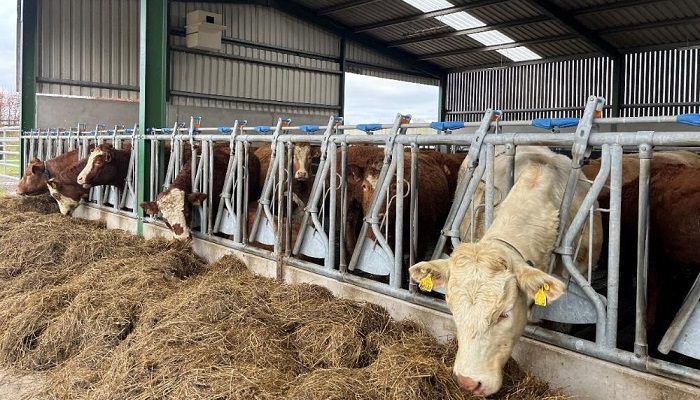
Along with ensuring cows don’t become over conditioned, the cows will be fed a pre-calving mineral for at least 6 weeks before they are due to calve. They have also been vaccinated against rotavirus, coronavirus and E.coli to prevent scours in the calves after birth.
Preparing for breeding
Michael blood tested the breeding stock on the farm for neospora and while one result was inconclusive, the other results were negative thankfully. This helps to rule out any fertility issues as a result of that parasite.
He also took blood samples from cows to assess their mineral status and it showed that they were low in copper, cobalt, magnesium and iodine. A mineral bolus containing copper, cobalt, iodine and selenium was given to them in March at breeding time and he is considering if a second bolus should be given in the autumn for year round cover. Magnesium is a macro mineral and has to be ingested in the diet daily so he can’t administer a bolus for it.
For more information on dry cow mineral supplementation, visit here.
The above article first appeared in the January Future Beef newsletter. To keep up to date with the happenings in the programme, register for the Future Beef newsletter here.
Find out more about the Future Beef Programme here.
Upcoming Future Beef Webinars
The Future Beef Programme will host a webinar on pre-calving on Tuesday, January 21st at 8pm. The webinar will be chaired by Aisling Molloy, Future Beef Programme Advisor, and will feature: Professor David Kenny, Head of the Animal and Bioscience Research Department, Teagasc; Emma Sargent, Ruminant Veterinary Area Manager, MSD Animal Health; and Ed Curtin, Future Beef Farmer. This webinar will focus on the cow pre-calving, covering topics such as body condition score (BCS), minerals and pre-calving vaccinations.
Additionally on Thursday, January 23rd at 8pm, the Future Beef Programme will host a calving and post-calving management webinar. This webinar will be chaired by James Mullane, Future Beef Programme Advisor, and will feature: Dr John Donlon, Beef Herd Health Research Officer, Teagasc; Dr Doreen Corridan, CEO of the National Cattle Breeding Centre (NCBC); and Michael Biggins, Future Beef Farmer. This webinar will centre on the calf, covering topics such as the first principles of calving, managing the calf’s first month and getting the cow back in calf.
For more information and to register for the Future Beef webinars, click here.