
06 October 2024
Green Thinking – Plants for Bees
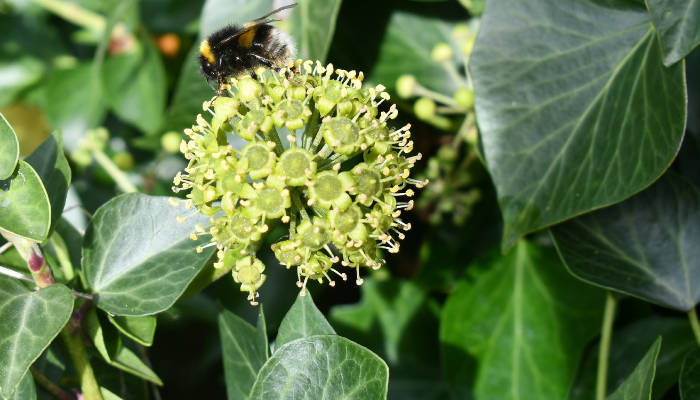
Dónall Flanagan, Teagasc Nursery Stock and Ornamentals Specialised Advisor, discusses the importance of ivy as a critical late-season food source for pollinators like bees and butterflies, highlighting its ecological benefits for biodiversity in Ireland.
Common Ivy (Hedera helix) and Irish Ivy (Hedera hibernica) are critical plants for pollinators in Ireland, particularly during the late season when other food sources are scarce. The native climbers initially grow with juvenile lobed leaves but as they mature and reach higher, leaves become entire and rounded. This evergreen climber flowers in autumn on adult foliage, providing a rich source of nectar and pollen, essential for sustaining bees, butterflies, and other insects as they prepare for winter. The honeybee produces a strong flavoured honey from ivy that quickly sets to hard candy like texture. The Ivy Bee (Colletes hederae) is a new arrival to Ireland, with the first observation in Ireland in autumn of 2021. It’s a solitary mining bee that feeds on the nectar of ivy in the autumn. Ivy also supports a variety of garden ecosystems. It provides shelter and habitats for insects and small birds, enhancing biodiversity for example Ivy is a food source for the caterpillar of the Holly Blue butterfly.
There is a vast array of ivy verities available. Popular flowering varieties such as H. helix ‘Arborescens’ and ‘Ice Cream’ (non-climbing selections) and H. helix ‘Buttercup’ and Maple Leaf are all flowering selections. H. hibernica is more tolerant of coastal conditions than H. Helix. Notable selections of Irish Ivy include H. hibernica Glengariff, Betty Allen and Rona. Non flowering selections such as H. Congesta and new introduction ground cover H. Algerian Bellecour are useful where seed and foraging birds are not desirable e.g. airports.
Useful sources of information are specialist ivy nursery, Lierres Nursery in France and RHS Wisley Ivy guide