
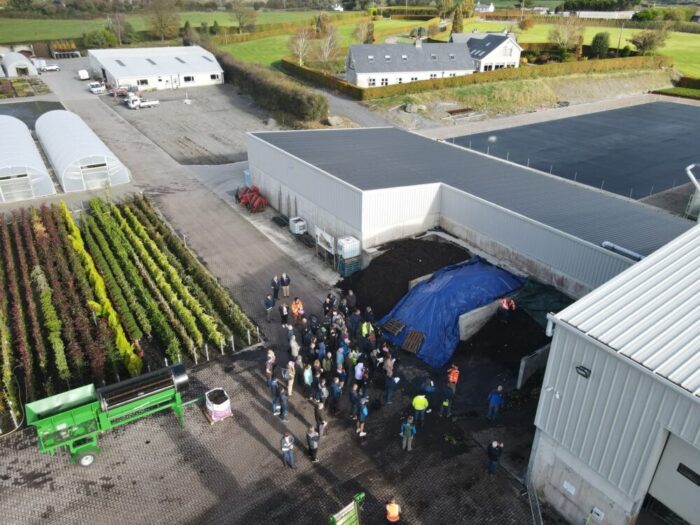
Around 60 nursery growers and students attended a practical composting demonstration at Kelly’s Nursery on October 22 to see nursery scale, green waste systems in action and to hear Teagasc updates on safe use of composted green waste in growing media.
Organised by Dónall Flanagan, Teagasc Nursery Specialist Stock Advisor, and kindly hosted by Kelly’s Nursery, the event featured a live demonstration of the Eco‑green shredder by Eoin Kelly and walkthrough of green waste material at multiple stages of composting from freshly shredded material to active-stage heaps and the end-product; screened, mature compost.
From Teagasc Ashtown, Dr. Eoghan Corbett, Growing Media Researcher Officer, joined Dónall Flanagan to outline the key control points for successful composting: achieving and monitoring temperatures throughout the composting process, maintaining correct moisture and aeration, balancing green and brown feedstocks, and finally when and how to intervene if you’re experiencing problems.
Practical demonstrations covered temperature‑probing techniques and quick media tests for pH and electrical conductivity (EC). Dr. Corbett also demonstrated plant bioassays; Chinese cabbage and cress for screening genera phytotoxicity, and a broad bean test to help detect hormonal herbicide residues; these tests help to detect issues before compost is blended into growing mixes.
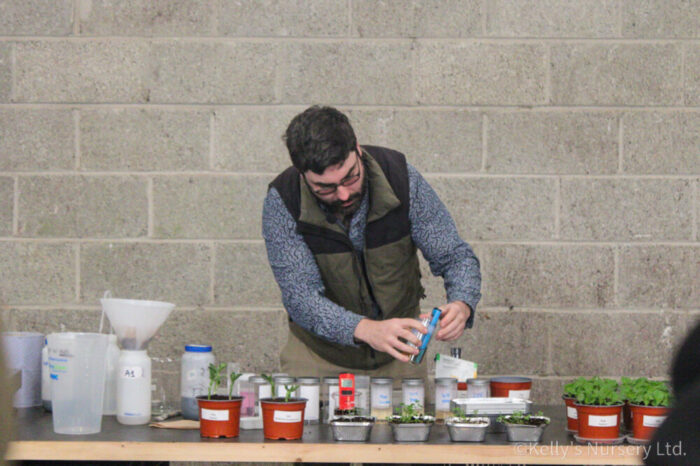
Image source: Kelly’s Nursery
Owner of Kelly’s Nursery, Billy Kelly demonstrated the Aqua Hort fertigation system with copper‑ion dosing and the nursery’s substantial rainwater‑harvesting infrastructure. Billy Killy explained that harvested roof water, stored in a swimming pool sized covered tank, can provide better irrigation quality than local groundwater. Fertigation on the nursery is mapped out in zones enabling precise nutrient delivery through the season, while copper ions are used in the irrigation system to help control algae and reduce disease pressure.
Frank Alley, owner, Dundrum Nursery, attended and shared some of his experiences, explained: “We have been developing a suitable growing media for a selection of trees and shrubs using green waste from our own nursery.
“It’s taken a few years to get the mix right but now we have a product that works for these plants. The system we use with a Trommel screener is very quick and has helped to combat some of the recent increases in growing media cost.”
Teagasc is running trials at Ashtown under the Department of Agriculture, Food and the Marine funded Beyond Peat project to identify suitable and safe inclusion rates of composted green waste in growing media across popular nursery and ornamental plants in Ireland. Preliminary work was showcased at the event and formal results from the Beyond Peat trials will be published within the next year and will inform future Teagasc guidance to the sector.
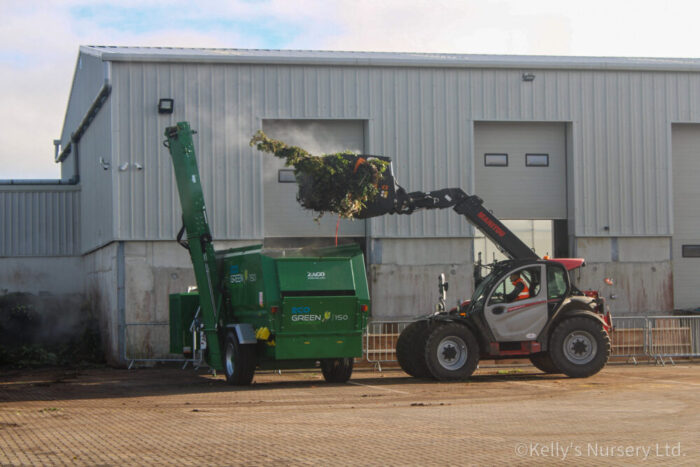
Image source: Kelly’s Nursery
Attendees gave positive feedback, enjoyed lunch and networking on site. For further information or to request event materials contact the Teagasc Nursery Advice service or Dónall Flanagan, Teagasc Nursery Specialist Stock Advisor.
4‑step checklist for growers and practical takeaways for composting green waste:
- Monitor temperature across all parts of the compost pile regularly using a long probe thermometer. Aim to maintain the active phase at about 55–65°C (minimum 55°C for 15 days across the pile) to control pathogens and weeds.
- Balance moisture, aeration and feedstocks: keep moisture around 50-60% (squeeze test: ball holds shape when material is squeezed in the fist, 1–2 drops of water emerge), turn or mechanically aerate to keep pile temperatures in check, dry bulk brown material can be added to improve aeration, reduce overly wet composts.
- A balance of green (N-rich) and brown (C-rich) material is needed to achieve a suitable C:N balance. If a pile is not reaching active phase temperatures, consider a modest N boost and correct moisture and aeration.
- Screen and test before use: after monitored composting (typically 10–16 weeks to a mature, stable product), screen to remove contaminants and oversized material and perform quick checks (pH, EC and short bioassays for weeds, phytotoxicity and herbicide residues). Introduce compost at conservative inclusion rates (5-15%) to build experience.
The images above were supplied by Kelly’s Nursery Ltd.