
Growing farm assets and storing carbon
Forestry can be a long-term investment that complements the main farming enterprise and strengthens the farm business for the next generation, Siobhan Kavanagh, John Casey and Brendan Smiddy, Teagasc, introduce the Jones family in Co. Cork, a farm partnership where forestry has proven to better than stocks and shares.
Stephen Jones, in partnership with his father Colman, farms 108ha, milking 100 dairy cows on a platform of 40ha on the main farm holding in Bawnmore, Kanturk, Co. Cork. They operate a spring-calving dairy herd, with an average EBI of €154, producing 504kg of milk solids in 2025. The farm also carries about 30 weanlings on out farms as well as a forestry enterprise. Shane O’Hanlon is his local Teagasc Advisor.
The beginnings of the forestry enterprise
Back in 2005, at a time when land prices were particularly high, the family purchased an outside block of land. It was a mix of good grassland and more marginal land. At the time, they decided to put 22ha of it in forestry, mostly Sitka Spruce but also 7ha of ash and some groves of oak, alder and birch. Ash dieback meant that the ash had to be removed and replaced in 2025/2026 with 80:20 mainly Sitka spruce: broadleaf mix under the Reconstitution Ash Dieback Scheme.
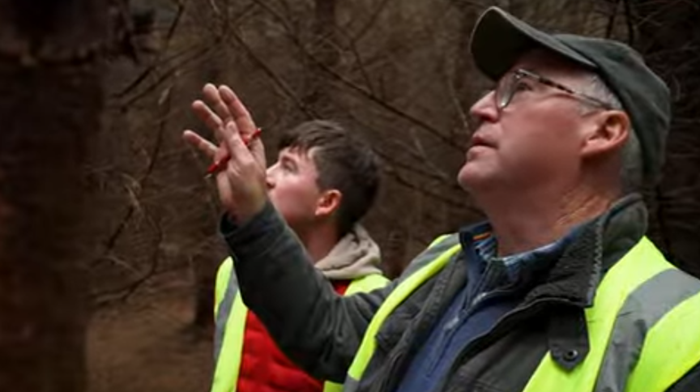
In the below video, Colman and Stephen Jones explain why forestry has become an important part of their family farm:
Carbon sequestration potential
With all the talk of climate, the target to reduce agricultural emissions and the very significant role of forestry in achieving that target, both Stephen and Colman were interested to learn more about the carbon sequestration potential of their crop.
Teagasc has a tool called the Teagasc Forest Carbon Tool that provides indicative data for potential carbon sequestration associated with forest enterprises. It also provides indicative sequestration data for specific tree species / species groups.
Stephen and Colman uploaded some details on their forest, including the species type, the yield class, soil type, productivity, crop rotation and management.
The Teagasc Forest Carbon Tool was then able to calculate the average amount of carbon being sequestered by their crop per hectare in 2025 but also provide an estimate of the average carbon sequestered or stored by the crop per year over the lifetime of the crop.
The forest sequestered around 30 tonnes of CO2e per hectare in 2025 with an average of approximately 16 tonnes CO2e per hectare per year over the lifetime of the crop.
Greenhouse gas emissions on the farm
On the other side of the coin, Stephen and Colman also looked at the greenhouse gas emissions for the farm. This required completing the Bord Bia Sustainability Survey, which they do anyway every 18 months as part of the Bord Bia Quality Assurance Scheme. Ideally it could be done every 12 months in order to check their carbon emissions. It’s a useful exercise to track progress on the farm’s emissions profile.
Stephen gathered the information needed including fertiliser used, housing and turnout dates, slurry spreading methods and dates as well as concentrates used. It was important that the information uploaded was accurate to give an accurate estimate of emissions from the farm.
The total emissions for the farm were 550 tonnes of CO2e in 2025 or 8 tonnes of CO2e per hectare. They used 174 kg chemical N in 2025 and 76% of this was applied as protected urea, while 67% of the slurry was applied in spring using trailing shoe.
While the total emissions for Jones for 2025 was 550 tonnes, the forestry was actively sequestering carbon dioxide at a rate of 30t CO2e per hectare for the fast-growing Sitka spruce in 2025. The sequestration rate fluctuates over the growth cycle and varies on the tree species and management regime
At the moment, there is no mechanism for the Jones partnership to be credited for this sequestration. Ireland is developing a Carbon Farming Framework that, in time, could enable farmers and forest owners to earn income from certified carbon removals. Key milestones along this road are agreement on EU methodologies by the end of 2026 and an EU-wide carbon registry from 2028.
Significant income for the farm
Aside from carbon storage, the Jones family’s 22ha of forestry has the potential to provide significant income for the farm. Based on the Teagasc Forest Investment Valuation Estimator (FIVE), it is estimated that the crop is worth €30,000 per hectare, including the income from thinnings and final clearfell. That’s €660,000 across the 22 hectares over the whole rotation.
The main Sitka Spruce plantation is 16 years old and ready for thinning. It has a Yield Class of 28 which is very good. This thinning and future thinnings will provide some early income, along with a large income from the crop at clearfell. Actual returns will depend on timber prices, forest productivity, harvesting costs and the quality and quantity of timber produced.
Forestry – a valuable asset
Forestry has been a valuable asset on this farm with multiple benefits in terms of a growing asset providing an extra income stream, making best use of marginal land, with benefits in terms of biodiversity, carbon storage and shelter for livestock. Colman is passionate about how the forestry has added to the landscape in their area and that young people can build their houses with Irish timber.
The generational renewal benefit of the forestry is not lost on Stephen and Colman. The trees planted by Colman 16 years ago are there to provide income for Colman in his retirement. For Stephen, the forestry is a growing asset as he starts out on his farming career.
The above first appeared in the Farming Independent as part of a Signpost Programme update.