
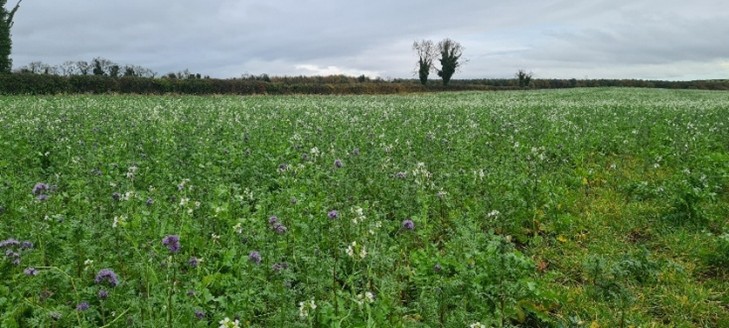
With more cover crops in the ground than ever before, many farmers now face the challenge of reducing heavy biomass ahead of spring drilling, Head of Crops Knowledge Transfer, Michael Hennessy discusses some of the options available for cover crop termination.
The timely and effective destruction of these crops is crucial for ensuring the successful establishment of crops in the spring. Where cover crops were planted under ACRES or the Water EIP then destruction can only take place after January 1. For other crops e.g. Water EIP measure 6B, these cover crops can be removed from now on, however leaving bare ground for an extended period is unadvisable.
For farmers seeking alternatives to chemical termination, particularly those with significant biomass, leveraging natural winterkill (frost termination) or managed grazing presents a viable option.
Understanding frost termination
Frost termination, often referred to as ‘winterkill’, is an appealing, low-cost method of cover crop destruction. The feasibility of relying on frost, however, depends heavily on consistent cold temperatures and the species planted. Research suggests that frost-sensitive species may not be reliably terminated in temperate climates due to variable winter conditions.
Required temperatures and species sensitivity
The critical factor for successful termination is the temperature threshold required to kill the plant tissue:
- Species matters: Cover crop species exhibit vast differences in frost tolerance. Cereals like rye are cold-tolerant and may survive even very low temperatures, potentially requiring a follow-up herbicide. In contrast, frost is likely to kill all herbs and brassicas, such as oil radish, mustards and stubble turnip, if the temperature is low enough!
- Specific thresholds: Some species are more frost-sensitive than others, for example, studies suggest that radish is typically killed at around -6oC. Spring oats are killed at approximately -5oC, while the hardier winter oats require colder temperatures around -10 oC. Phacelia and vetch can survive temperatures typically between -6 to -10 oC.
- Variety variation: Even within a species, sensitivity varies. For instance, in temperate climate trials, one variety of white mustard (‘Architect’) achieved 94% to 100% destruction by frost, while another (‘Octopus’) only achieved 25% to 27% destruction.
Combining frost with mechanical rolling
Given the large biomass many Irish farmers are managing this year, relying solely on frost may be insufficient, especially for more cold-tolerant species. Frost termination can be effectively combined with mechanical methods like rolling or crimping.
Rolling or crimping works best when there has been a ‘hard frost’ of -4 oC or lower. Rolling should be carried out ideally in the early morning when the plants and stems are brittle and frozen. It is preferable if these cold conditions persist for several days prior to rolling so the frost can penetrate and help ‘shatter’ the stems. The combination of mechanical damage and freezing temperatures helps expose the crops, causing them to die.
Grasses such as bromes, meadow grass, and even wheat and barley can withstand very low temperatures, and the combination of low temperature and rolling is often not enough to kill these plants – requiring follow up treatment to complete the job e.g. ploughing or chemical control.
Grazing with sheep as a destruction strategy
Grazing livestock, particularly sheep, offers a dual benefit: terminating the cover crop and providing a nutritional feed source, potentially reducing feed costs.
Grazing provides a viable option for cover crop destruction in arable systems. Grazing helps reduce cover crop biomass and initiates the breakdown of organic matter, which can help balance C:N ratios and speed up nutrient availability for the following crop.
When managing grazing, especially on heavier soils, sheep are preferred over cattle to minimise the risk of poaching and soil compaction. However, even with sheep, over-grazing can still contribute to soil compaction, nutrient leaching, and runoff, while also reducing the beneficial organic matter added to the soil.
Summary of practical advice
- Monitor temperatures closely and understand the frost sensitivity of your specific cover crop mix.
- If mechanical destruction is planned, aim to roll/crimp when temperatures are well below freezing and ideally under -4 oC and the plants are frozen.
- The Irish climate may not be cold enough in many years, therefore winter kill aided by rolling alone may not be reliable. A backup plan, such as a follow-up herbicide application, may be necessary for hardy species or if termination is incomplete.
- If using sheep for grazing, manage stocking rates and consider soil conditions (especially wet, heavy soils) to avoid compaction.