
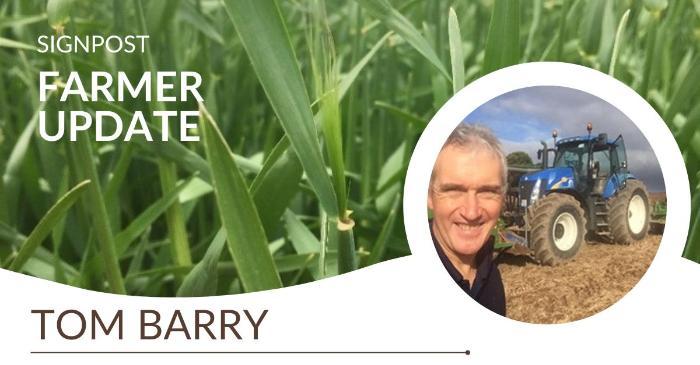
With the days shortening, Signpost Programme tillage farmer, Tom Barry reflects and reviews the 2025 cropping year on his farm in Co. Cork.
2025 will live long in my memory as a very dry year, punctuated with occasional rainfall.
In our area, the contrast in yields between spring and winter crops was pronounced. I have never seen such consistently high yields in winter wheat and winter rye. This is in contrast with the moderate yields achieved by spring barley and late spring oats.
The influencing factor for many crops was their developmental stage when drought conditions established. March was particularly dry (32mm in nearby Moorepark), affecting the yield potential of our spring barley in contrast to a crop of early sown spring oats I set on 18th January which yielded above normal. This was set in good soil conditions and, mild and damp weather ensured good establishment. However, crows were a nuisance. Once again soil fertility and pH were crucial to support these crops through times of growth pressure.
The harvest of 2025 was the polar opposite to 2024. I started cutting winter barley on the 4th of July and was finished completely on the 2nd of August with all crops harvested and straw baled. In 2024, the harvest for most farmers dragged on into late September, harvesting beans at crazy moistures.
Winter barley
The quality and moistures of the grain and beans harvested this year was exceptional. Winter barley has always been a good crop for me, but in the last few years it has not been delivering on yield. When KWS Cassia variety was the mainstay a few years ago, average yields of 4.5 t/acre were achievable but lately varieties are failing to reach 4 t/acre. I am seriously questioning winter barley in my rotation; however, I have given it another chance this year with a hybrid variety called SY Canyon and a six-row conventional variety Integral. I certainly hope the genetics deliver yield.
Winter rye
Winter Rye was next, and it yielded exceptionally at 4.6 t/acre and ample straw. This new crop plays a very important part in my crop rotation as it can be set early with no obvious signs of BYDV (Barley Yellow Dwarf Virus) and ‘take all’ is not an issue. It only received 140 units/acre of N, but its ability to root and scavenge for nutrients is impressive.
Winter wheat
Winter wheat followed and the variety was Graham. This is an exceptional yielder especially after my beans and oat break crops. Consistent yields of up to 5 t/acre were cut.
Winter oats and spring beans
Winter oats looked well but delivered only 3.5 t/acre, similar to the January sown spring oats. Spring beans, which I experimented with direct drilling on the 10th of February, looked great all year but yielded only 2 t/acre. I think this was more a factor of the weather conditions this year, as very few bean crops locally reached anywhere near 3 t/acre.
Harvest prices
The obvious disappointment and worry for all tillage farmers is the harvest price for our high quality, traceable, low carbon grain. Irish tillage farmers produce the best quality grain and yet compete with the lowest price grain that can be delivered by boat to our shores. A policy solution for this unsustainable situation is required immediately not just for Irish tillage farmers but also the merchants and co-operatives who support and buy Irish grain but have to compete with others who don’t.
Farming for Water
The EIP Farming for Water has been a very good initiative to help water quality. I set extra cover crops for this scheme, and it’s working well. I also trialled foliar applications of liquid melted urea as a nitrogen feed during periods of water stress and for head fill; the results were promising, and I intend to learn more in the coming year. I view this as similar to applying dairy and pig slurries onto the growing crops in springtime, so getting the balance right is the challenge.
I am also using this time to chat to my neighbouring dairy farmers about importing some of their surplus slurries. This has benefits for us both and additionally working together builds good relationships and develops further synergies. I believe that dairy, cattle and pig farmers working with their fellow tillage farmers is the basis of solving our current nitrates challenge and the oncoming next battle: Carbon. I am looking forward to these conversations.
Tom Barry is a participant in the Teagasc Signpost Programme, working closely with Signpost Tillage Advisor, John Mahon.
For more information on the Teagasc Signpost Programme, visit here.
The above article first appeared in the Farming Examiner as part of a Signpost Programme update.