
06 April 2025
Heat detection tips for suckler herds
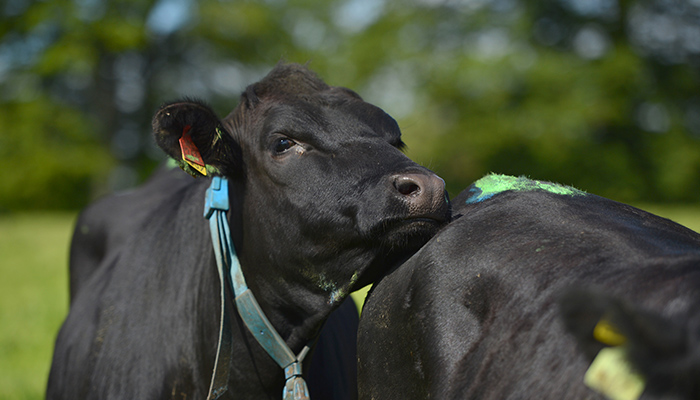
Heat detection – or lack of – is often touted as a contributing factor for the low uptake of AI on Irish suckler herds.
Whether used to identify cows to breed to AI or to provide more accurate data on expected calving dates from natural serves, Beef Specialist at Teagasc, Catherine Egan and Prof. David Kenny, Head of the Teagasc Animal and Bioscience Research Department, take a closer look at heat detection, helping farmers to understand the signs, factors affecting standing heats and some of the heat detection aids available.
Effective heat detection is critical to the successful use of AI in beef cattle herds. To be detected in standing heat, a cow must engage the attention of a herd mate willing to mount her. Numerous factors affect the expression of heat, the more important of which are briefly discussed.
Floor surface
Cows dislike being mounted while standing on concrete and have a preference for softer underfoot surfaces such as grass, dirt or straw-bedded yards. Mounting activity is reduced by almost 50% when cows are on concrete as opposed to softer underfoot conditions, while the duration of oestrous activity is reduced by about 25%. Cows distinctly dislike being mounted by herd mates if the floor surface is either slippery or very coarse.
Status of herd mates
The number of cows in heat simultaneously has a major impact on overall heat activity and on the average number of mounts per cow. The number of mounts per cow increases with the number of cows that are in heat simultaneously (up to about 3-4 cows in heat). In smaller and even in larger herds as more cows become pregnant, the likelihood of more than one cow being on heat on any given day is less, thus, making heat detection more difficult.
Understanding the signs of heat
Standing to be mounted by herd mates or by a bull is the primary sign of heat and is the most definite and accurate sign that a cow is in heat. Because standing heat may not always be observed, stockmen must frequently use other signs (secondary signs) of heat in arriving at a decision as to whether or not to inseminate a cow. These secondary signs of heat may indicate that a cow is coming in heat, in which case closer attention should be given to her over the following 48 hours, or they may be indicative of a recent heat in which case she should be given close attention 17-20 day later. Indicators to look for are: discharge of clear mucus; mounting other cows; restlessness; swelling and reddening of vulva; hair loss and dirt marks. Blood stains on the tail or vulval area (metoestrous bleeding) are normal and indicative of a recent heat.
Use an aid to improve heat detection
Vasectomised bulls with chin-ball marking harness
Active vasectomised teaser or detector bulls are useful in identifying cows either coming into or on heat. Vasectomy should be carried out 40-60 days prior to introduction to the herd. The cost of the vasectomy varies from €90-120 per bull. Many herds are now finding that teaser bulls are particularly useful after the first three weeks of the breeding season, when fewer cows are in heat each day and when the level of heat-related activity in the herd is reduced as more cows become pregnant. A vasectomised bull fitted with a chin ball marks the cows on the top of their backs when he is serving them. Position yourself to see the marks on the backs of the cows, and ensure that the paint in the chin ball is topped up as required.
Heat detection patches
There are a number of ‘scratch card-type’ patches on the market. These are affixed to the cow’s tail head. Friction from mounting activity rubs off the silver coating to reveal a bright colored patch underneath. These devices, when properly applied, are very useful as an aid to heat detection. Kamars are also use by applying to tail head – changes in colour indicate heat.
Tail paint
Apply a narrow strip 1.5-2.0 inches in width to the tail head. When the paint is completely rubbed off the cow, she is in standing heat. It is helpful to change the colour of the tail paint when the cow is artificially inseminated, to help identify repeats and undetected cows.
Digital technology
Systems that are based on cow activity and rumination can be used to alert farmers that a cow is in heat or systems that incorporate a vasectomised bull wearing a specialised interactive electronic collar.
Checking cows
The use of either a teaser bull or a heat detection device placed on the cow/heifer will increase the detection rate and also reduce the duration of each observation period and the number of observation periods from three times daily to twice daily that cows need to be checked. When one of the above aids is used, cows should be observed at least twice daily – early morning and late evening. Otherwise, cows should be checked three times daily to ensure a high heat detection efficiency. Spend a minimum of 20-30 minutes observing them during each observation period. Disturb the cows and carefully check and record cows that are sliming or exhibiting any signs of restlessness, as there are important secondary or indicator signs of an imminent heat. Early morning and late evening are critical times to check cows.
Importance of commitment
Where AI is the chosen method of breeding, farmers must be committed to heat detection, at least twice daily (early morning and late evening), for each day of the breeding season. In order to reduce the work time involved, it is highly recommended that one of the aids described above is used.
The above is part of a series of articles from Catherine Egan and Prof. David Kenny that will appear on Teagasc Daily over the coming weeks. Other topics to be discussed include heat detection, synchronisation programmes and tips on how to get suckler cows bulling earlier in the breeding season.
More from Teagasc Daily: The benefits of AI in suckler herds
More from Teagasc Daily: Getting suckler cows bulling earlier