
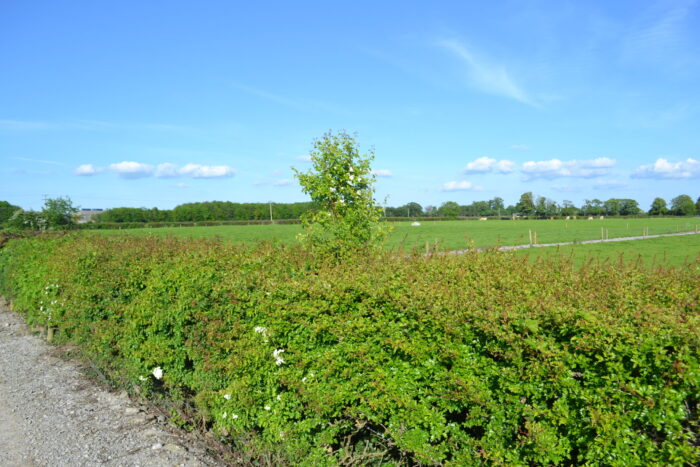
Hedges remain one of the most important features of the Irish countryside, sequestering and storing carbon, providing shelter for livestock, a habitat for wildlife, and serving as vital corridors for biodiversity. Brian Clancy and Catherine Keena tell us more ahead of National Hedgerow Week.
National Hedgerow Week, running from Friday, 29th August to Sunday 7th September 2025, is an opportunity to learn about one of Ireland’s richest natural assets. A partnership between Teagasc and the Heritage Council, this week raises awareness of the critical role hedgerows play for agriculture, biodiversity and climate.
Managed correctly, hedges make a valuable contribution to carbon sequestration. However, the benefits depend on how they are maintained.
Across Irish farms, hedges can be broadly grouped into two main types for management purposes:
- Treeline hedges, where individual stems are allowed to grow tall like a row of trees.
- Topped hedges, where cutting maintains a dense, stock‑proof structure.
Both types are important, and ideally, every farm should have a mix of the two.
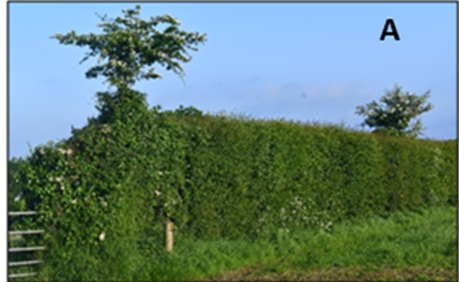
A Topped hedge with occasional flowering whitethorn
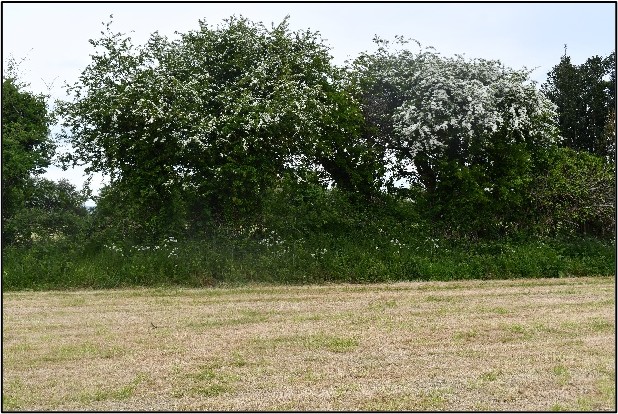
A Treeline hedge
Retain existing hedges
The first principle of good hedgerow management is simple, retain what you already have. Many hedges have been in place for hundreds of years, providing unique habitats that cannot be recreated quickly. Ancient hedges often host lichens, wildflowers and a rich soil ecosystem. These long‑standing hedges carry ecological value and should always be prioritised for protection.
Maintain in a sustainable manner
Hedge management must respect the difference between treeline and topped hedges.
Treeline hedges
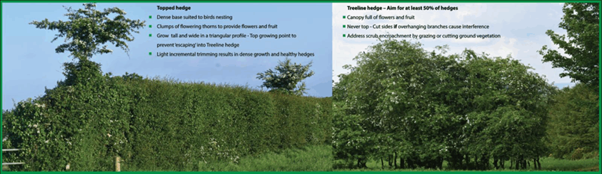
Treeline hedges should never be topped. They can be side‑trimmed only where overhanging branches interfere with farming activity. Concerns about scrub encroachment are best managed by controlled grazing or grass cutting at the base. These treeline hedges offer height, structure and continuity that benefit birds and pollinators.
Topped hedges
Topped hedges deliver best results when trimmed lightly but regularly. They should be maintained in a triangular or A‑shape profile, wider at the base and narrowing towards the top, which encourages dense growth and reduces gaps. Cutting the top is necessary to manage apical dominance, otherwise strong leaders will escape upwards and leave the hedge thin at the base. To balance biodiversity, allow occasional whitethorn stems to grow up naturally above the managed hedge, providing flowers and berries for birds and insects.
A healthy topped hedge should be cut as high as machinery allows, rather than forced low. The ideal balance is a thick bushy hedge for shelter and structure, with scattered trees emerging above.
Enhancing and planting new hedges
Where gaps exist, hedges can be improved carefully through traditional practices such as hedge laying or coppicing, though both require skill and should be done with attention to plant health.
For more information on hedge laying, visit here.
When establishing new hedges, the key decision is whether to plant them as treeline or topped, depending on the role they will play on the farm. Both types are valuable, and the long‑term target is that 50% of farm hedges should be treeline for maximum biodiversity impact.
A frequent mistake is allowing a new treeline hedge to be topped once it reaches 1.5 metres. Without years of pruning to build up a dense base, topping too early results in stumpy, unhealthy “upside‑down toilet brush” hedges, poor for biodiversity and weak in terms of carbon storage. Avoiding uniform topping and encouraging a natural structure is essential.

Stumpy ‘upside‑down toilet brush’ hedges are not good for biodiversity or carbon sequestration.
Striking the right balance
While tidy hedges might look neat, a purely cosmetic approach often undermines their ecological function. The real goal is healthy, structurally diverse hedges that are looked after in line with best practice. Whether treeline or topped, well‑managed hedges deliver multiple benefits for biodiversity, livestock and carbon sequestration, making them one of the most valuable assets on any Irish farm.
Sustainable hedge cutting event
Join us on Thursday, 4th September at 11am for a Hedge Cutting event in Teagasc, Kildalton College, Piltown, Co. Kilkenny, E32 YW08.
The event, in conjunction with FBD will feature hedge cutting machinery and its operation, machine setup and safety considerations with industry experts. Brian Clancy, Teagasc Kildalton College, welcomes all interested in hedge management. A hedge laying demonstration will also take place.
View the full programme of events taking place as part of National Hedgerow Week 2025 here